

 United Kingdom (UK)
 United States (US)
 Canada
 South Africa
 India
India Australia
 New Zealand
 China
China Russia
 Germany
 France
 Spain
Spain Netherlands
 Vietnam
 United Arab Emirates
 Italy
Italy Poland
 Thailand
 Türkiye





 Algeria


What Is Scaffolding in Teaching? A 2026 Guide
What Is Scaffolding in Teaching? A 2026 Guide

TL;DR:
- Scaffolding is a temporary instructional strategy that bridges the gap between a student’s current and potential abilities. It is based on Vygotsky’s Zone of Proximal Development and is systematically withdrawn as learners achieve mastery. Effective scaffolding enhances independence by targeting cognitive, metacognitive, and procedural skills through modeling, guided practice, and peer collaboration.
Scaffolding in teaching is defined as a temporary, task-specific instructional strategy designed to bridge the gap between a student’s current ability and their potential mastery. The formal term is instructional scaffolding, rooted in Lev Vygotsky’s Zone of Proximal Development (ZPD). Scaffolding is process-oriented and gradually withdrawn as learner confidence grows. It differs from differentiation, which adapts content on an ongoing basis. Frameworks like “I do, We do, You do,” tools like KWL charts, and formative assessments such as exit tickets are all standard scaffolding instruments in the modern classroom.
What is scaffolding in teaching and how does it work?

Instructional scaffolding is a deliberate, structured form of support that teachers provide at the exact moment a student needs it. The concept originates from Vygotsky’s ZPD, which defines the space between what a learner can do independently and what they can achieve with guidance. Scaffolding fills that space temporarily. Once the student demonstrates competence, the support is removed.
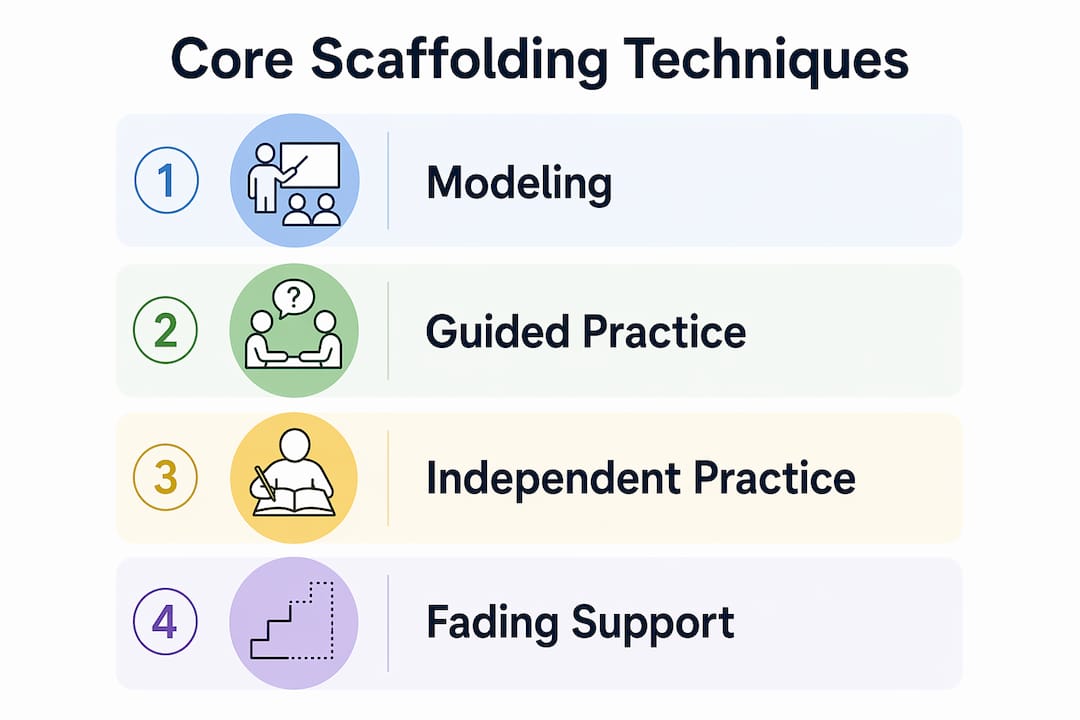
The process follows a clear arc. A teacher first models a skill or concept, then guides students through shared practice, and finally releases responsibility to the learner. This sequence is known as the “I do, We do, You do” framework. It is one of the most widely applied structures in both ESL and general education settings.
Scaffolding is not the same as making work easier. Research confirms that effective scaffolding actually “problematizes” content, directing learner attention toward the most challenging and essential aspects of a task. That productive difficulty is what drives durable understanding. Simplifying a task removes the challenge; scaffolding preserves it while providing a structured path through it.
What are the core scaffolding techniques?
Effective scaffolding includes three primary categories of support: cognitive, metacognitive, and procedural. Each targets a different dimension of the learning process.
Cognitive scaffolding reduces mental overload by breaking complex tasks into smaller, manageable chunks. A teacher presenting a multi-step writing assignment might first isolate the thesis statement, then address evidence, then work on transitions. Each chunk becomes a discrete learning target.
Metacognitive scaffolding helps students plan, monitor, and evaluate their own learning. Think-aloud strategies, where a teacher narrates their reasoning process while solving a problem, are a direct example. KWL charts (Know, Want to know, Learned) serve the same purpose by making thinking visible.
Procedural scaffolding guides students through the steps of a task in sequence. Graphic organizers, sentence frames, and worked examples all fall into this category. In an ESL classroom, a sentence frame like “The author argues that ___ because ___” gives students a procedural scaffold for analytical writing.
Common scaffolding methods include:
- Modeling: The teacher demonstrates the target skill explicitly before asking students to attempt it.
- Think-alouds: Verbalizing cognitive steps makes invisible reasoning visible to learners.
- Chunking: Dividing content into smaller units prevents cognitive overload.
- Guided practice: Shared tasks where teacher and student work together before independent work begins.
- Peer collaboration: Pairing stronger and developing learners to distribute support.
Pro Tip: Align your scaffolding level with student readiness by using formative assessments before each new unit. A quick exit ticket or diagnostic task reveals exactly where support is needed and prevents over-scaffolding students who are already ready to work independently.
How does scaffolding differ from differentiation?
Scaffolding differs from differentiation in one critical way: scaffolding is temporary and process-focused, while differentiation is an ongoing adaptation of content, pace, or learning profile. Both serve diverse learners, but they operate on different timelines and with different goals.
The table below clarifies the practical distinctions:
| Feature | Scaffolding | Differentiation |
|---|---|---|
| Duration | Temporary, fades as mastery grows | Ongoing throughout instruction |
| Focus | Process and task-specific support | Content, pace, or learner profile |
| Goal | Build independence | Accommodate learning differences |
| Responsibility transfer | Explicit and planned | Not a primary feature |
| Example | Sentence frames removed after fluency | Simplified texts for struggling readers |
Scaffolding transfers responsibility to the learner by design. A teacher using scaffolding plans from the start to remove the support structure. Differentiation does not carry that same expectation of removal. A student who receives a simplified text under a differentiation model may continue receiving that adaptation indefinitely.
In practice, the two strategies can work together. A teacher might differentiate by providing an audio version of a reading passage while simultaneously scaffolding comprehension through guided annotation. Recognizing the boundary between them helps educators apply each with precision rather than conflating the two.
What is the role of fading support in scaffolding?
Fading is the deliberate, gradual removal of instructional support as a student demonstrates increasing competence. It is the defining feature that separates scaffolding from permanent accommodation. Without fading, scaffolding becomes a crutch rather than a tool for growth.
The process of fading requires careful timing. Research recommends a planned removal over 4–6 weeks, closely monitoring learner cues throughout. Removing support too quickly causes frustration and regression. Maintaining it too long prevents the development of genuine independence.
The Goldilocks principle captures this balance precisely. The Goldilocks principle states that scaffolding support must be neither too little nor too much. The challenge level must stay “just right” to keep students engaged without tipping into frustration. Formative assessment tools are the primary mechanism for calibrating this balance.
A structured fading sequence looks like this:
- Establish baseline: Use a diagnostic task or KWL chart to identify where the student currently stands.
- Introduce full support: Provide modeling, sentence frames, graphic organizers, or worked examples.
- Monitor progress: Use exit tickets and real-time observation to track readiness.
- Reduce one support at a time: Remove the least critical scaffold first, then observe the effect.
- Confirm independence: Only remove all scaffolding once the student demonstrates consistent, unaided performance.
Pro Tip: Monitor shared attention and student frustration cues closely. Research from the Education Endowment Foundation confirms that shared attention between teacher and student is a prerequisite for effective scaffolding. If a student is disengaged or overwhelmed, the scaffold is either mistimed or mismatched to their current need.
How can educators implement scaffolding in diverse classrooms?
Practical implementation of scaffolding strategies depends on knowing your students, your subject, and your available resources. The following approaches apply across subjects and learner levels.
Leverage More Knowledgeable Others (MKOs). Vygotsky’s concept of the MKO extends beyond the teacher. Distributed scaffolding uses peers, digital tools, and physical aids to share the support load. Peer mentoring pairs, where a more advanced student guides a developing one, reduce teacher cognitive burden and deepen learning for both participants. Research confirms this approach fosters learner autonomy through social dialogue.
Use digital tools strategically. Platforms like Google Classroom, Nearpod, and Padlet allow teachers to embed scaffolds directly into digital tasks. A teacher can attach a vocabulary reference sheet to a reading activity or include a sentence starter within a digital writing prompt. These tools make distributed scaffolding practical at scale.
Tailor scaffolds to the subject. The table below shows subject-specific examples:
| Subject | Scaffold Type | Example |
|---|---|---|
| ESL Writing | Procedural | Sentence frames and paragraph templates |
| Mathematics | Cognitive | Worked examples with annotated steps |
| Science | Metacognitive | Lab prediction journals and KWL charts |
| History | Procedural | Source analysis graphic organizers |
| Reading | Cognitive | Chunked texts with guided annotation |
Additional strategies for diverse classrooms include:
- Co-created reference materials: Build anchor charts or vocabulary walls with students rather than presenting them pre-made. Students retain information better when they participate in constructing it.
- Lesson planning integration: Embedding scaffolds directly into your lesson planning process ensures they are deliberate rather than reactive.
- Classroom setup: Physical arrangement matters. Organizing seating to facilitate peer collaboration supports MKO-based scaffolding. Teflinstitute’s ESL classroom setup guide offers practical layout strategies aligned with these principles.
- Motivation maintenance: Scaffolding works best when students understand why support is temporary. Framing each scaffold as a step toward independence, not a permanent aid, preserves student motivation and self-efficacy.
Key takeaways
Instructional scaffolding works because it provides temporary, targeted support within a student’s Zone of Proximal Development, then systematically removes that support to build genuine independence.
| Point | Details |
|---|---|
| Core definition | Scaffolding is temporary, task-specific support tied to Vygotsky’s ZPD, not a permanent accommodation. |
| Three technique types | Cognitive, metacognitive, and procedural scaffolding each target a different dimension of learning. |
| Fading is non-negotiable | Plan support removal over 4–6 weeks using exit tickets and observation to confirm readiness. |
| Scaffolding vs. differentiation | Scaffolding transfers responsibility to the learner; differentiation adapts content without that goal. |
| Distributed scaffolding | Peers, digital tools, and physical aids can share the support load and increase learner autonomy. |
Why most teachers get scaffolding wrong
Most educators understand the concept of scaffolding in theory. The failure point is almost always fading. In my experience reviewing instructional practice across ESL and general education settings, the most common error is not under-scaffolding. It is over-scaffolding that persists well past the point of student readiness.
Teachers develop scaffolds with care and then become reluctant to remove them. The sentence frame that helped a student in week two is still present in week eight. The graphic organizer that was a genuine support becomes a procedural habit. The student never has to think without it. That is not scaffolding. That is dependency.
The second mistake is treating scaffolding as simplification. Scaffolding is not about reducing the intellectual demand of a task. It is about making the path through a demanding task navigable. The moment you lower the ceiling rather than provide a ladder, you have stopped scaffolding and started limiting.
What I find genuinely transformative about well-executed scaffolding is how it changes a student’s relationship with difficulty. A learner who has been scaffolded correctly does not avoid hard tasks. They have a mental model for approaching them. That is the real outcome. Not the completed worksheet, but the internalized process.
— Muller
Deepen your scaffolding skills with Teflinstitute
Teflinstitute offers structured professional development for educators who want to apply scaffolding and other pedagogical strategies with precision in language teaching contexts.

The 120 Hour Elective TEFL Course covers core instructional methods including scaffolding techniques for ESL learners at varying proficiency levels. For educators seeking a more comprehensive foundation, the 240 Hour Master TEFL Course provides externally accredited training across advanced teaching methodologies, lesson design, and learner support strategies. Both courses are fully online and designed for working educators. Explore ESL teaching methodologies on the Teflinstitute blog to complement your coursework with practical classroom application.
FAQ
What is the zone of proximal development in scaffolding?
The Zone of Proximal Development, defined by Vygotsky, is the gap between what a learner can do independently and what they can achieve with guidance. Scaffolding operates specifically within this zone to move students toward independent mastery.
How long should scaffolding support last?
Research recommends a gradual removal over 4–6 weeks, with teacher monitoring of student readiness throughout. The timeline varies based on task complexity and individual learner progress.
What is the difference between scaffolding and differentiation?
Scaffolding is temporary and process-focused, designed to be removed as the student gains competence. Differentiation is an ongoing adaptation of content or pace that does not necessarily transfer responsibility back to the learner.
What are the most effective scaffolding methods for ESL classrooms?
Sentence frames, graphic organizers, think-alouds, and peer collaboration are among the most effective methods. These tools reduce cognitive load while preserving the intellectual demand of the task.
Can digital tools support scaffolding in the classroom?
Digital tools like Google Classroom, Nearpod, and Padlet allow teachers to embed scaffolds directly into tasks and remove them incrementally. Teflinstitute’s guide to online teaching tools covers practical options for distributed scaffolding in digital environments.