

 United Kingdom (UK)
 United States (US)
 Canada
 South Africa
 India
India Australia
 New Zealand
 China
China Russia
 Germany
 France
 Spain
Spain Netherlands
 Vietnam
 United Arab Emirates
 Italy
Italy Poland
 Thailand
 Türkiye









 Algeria


What is English immersion? A TEFL teacher’s guide
What is English immersion? A TEFL teacher’s guide

TL;DR:
- English immersion primarily uses English as the core instruction method to develop proficiency quickly while teaching academic content. Structured English Immersion (SEI) employs ESL methodologies, offering various models like pull-out, newcomer, or block scheduling, to ensure consistent exposure without submersion’s pitfalls. The theory of comprehensible input and i+1 guides effective teaching, emphasizing content slightly beyond learners’ current level for natural, subconscious language acquisition.
English immersion is widely misunderstood, even by experienced educators. Many assume it means throwing students into an English-only classroom and expecting them to figure it out. That version, sometimes called submersion, is the opposite of what quality English immersion programs actually do. Understanding what is English immersion, how it is structured, and what theory drives it is foundational knowledge for any aspiring TEFL teacher preparing to work abroad or online. This guide covers the definition, the research, the program models, and the practical classroom strategies you need.
Table of Contents
- Defining English immersion and structured English immersion (SEI)
- How English immersion works: the theory of comprehensible input and i+1
- English immersion program structures and instructional strategies
- Comparing English immersion with other ESL and bilingual education programs
- Practical tips for TEFL teachers implementing English immersion abroad or online
- A fresh perspective on English immersion: why less explicit grammar can be more effective
- Advance your TEFL career with immersion-focused training
- Frequently asked questions
Key Takeaways
| Point | Details |
|---|---|
| English immersion defined | English immersion programs use primarily English instruction designed for rapid language proficiency and academic success. |
| Comprehensible input | Learners acquire English best when exposed to language slightly above their current level in meaningful contexts. |
| Program structures vary | Structured English Immersion programs often require minimum daily English exposure and use scaffolding strategies. |
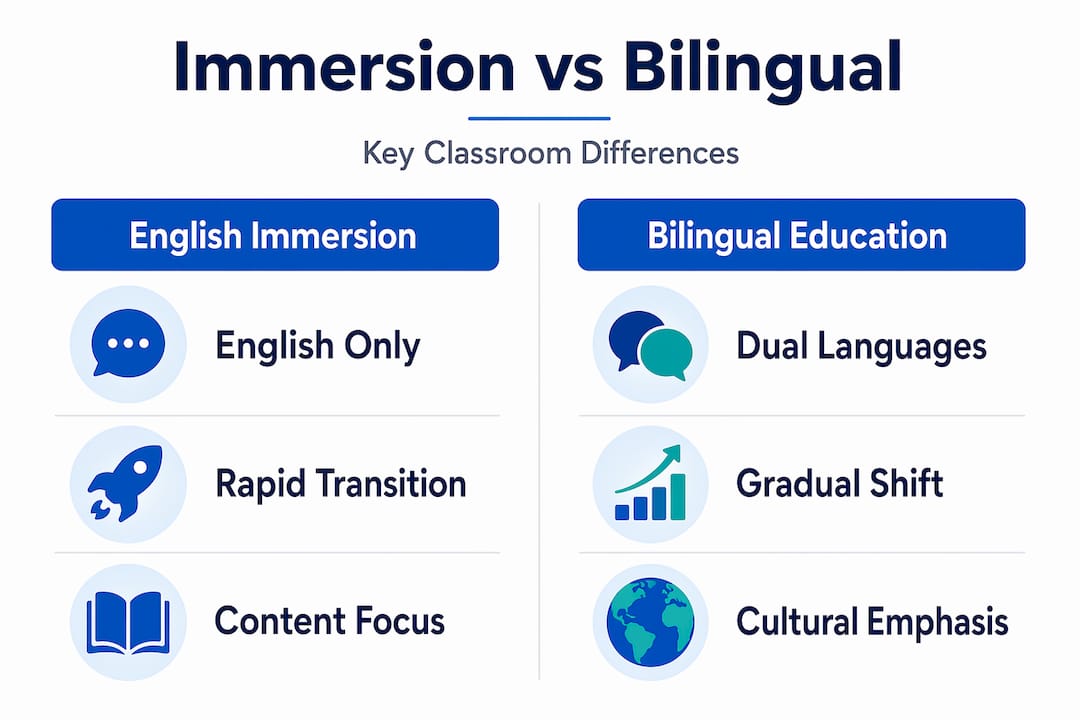
| Immersion vs bilingual | Immersion focuses on English only, while bilingual education develops skills in two languages concurrently. |
| Effective teaching tips | TEFL teachers should use visuals and avoid over-correcting to create a supportive immersion learning environment. |
Defining English immersion and structured English immersion (SEI)
At its core, the definition of English immersion is an instructional approach that uses English as the primary medium of instruction to help learners develop English proficiency quickly, typically while also teaching academic content. This is distinct from bilingual education, which develops two languages in parallel, and from submersion, which offers no structured language support at all.
Structured English Immersion (SEI) is the most formalized model of English immersion, particularly in the United States. SEI programs use primarily English instruction to help Limited English Proficient (LEP) students acquire English quickly while learning academic content. Several U.S. states mandate SEI for LEP students as a condition of public school enrollment.
What makes SEI different from simple English-only instruction is its use of ESL methodology. Teachers are trained to modify their delivery, not the content standards, to make grade-level material accessible. Some native language support is permitted for motivation and clarification, but the dominant medium remains English.
SEI programs typically come in three structural formats:
- Pull-out model: Students leave their mainstream classroom for dedicated English Language Development (ELD) sessions, then return for content instruction.
- Newcomer model: Recently arrived students receive intensive ELD in a separate setting before transitioning into mainstream classes.
- Two-hour block model: A fixed daily block of ELD time is built into the school schedule, often alongside sheltered content instruction.
For TEFL teachers, understanding this range of formats matters. Whether you are teaching in a private language school in South Korea or an online platform serving adult learners, the underlying principles of ESL teaching methodologies in immersion contexts apply across these settings. You can also find SEI program research insights helpful as a supplement to your course preparation.
How English immersion works: the theory of comprehensible input and i+1
The most important theoretical foundation behind English immersion is Stephen Krashen’s comprehensible input hypothesis. According to this framework, language acquisition occurs through exposure just above the learner’s current level, a concept Krashen labeled “i+1,” where “i” represents current proficiency and “+1” represents the next achievable step.
“Learners acquire language subconsciously when they receive input that is largely understandable but contains structures or vocabulary slightly beyond what they already know.”
This is not how most traditional grammar-focused ESL classrooms operate. In a grammar-heavy class, a teacher explains the past perfect tense explicitly, drills it, and tests it. In an immersion setting, learners encounter the past perfect repeatedly in meaningful context until they internalize it without being told what it is called. The acquisition is subconscious, and research suggests it produces more durable, natural language use as a result.
The i+1 principle also explains why both over-simplified input and input that is far too advanced are counterproductive. If a beginner is placed in an environment where 60% of language is incomprehensible, acquisition stalls. Learners become frustrated, anxious, and disengaged.
Pro Tip: When planning immersion lessons, aim for 90 to 95 percent of your language to be within the learner’s current understanding. That narrow band of unfamiliar language is where acquisition happens. Consistent use of visuals, gestures, and repetition helps you stay in that productive zone, which you can read more about in tips for boosting oral proficiency in your ESL classroom.

Understanding i+1 also explains why correcting every error is counterproductive. Over-correction raises the learner’s affective filter, a psychological barrier caused by stress or embarrassment that blocks input from being processed. Effective immersion teachers know when to let errors pass and when targeted feedback will genuinely support acquisition.
English immersion program structures and instructional strategies
Knowing the theory is one thing. Knowing how programs are actually structured, and what teachers are expected to do, is another. Program requirements vary by country and institution, but some formalized systems offer a clear benchmark.
For example, Arizona SEI programs require a minimum of 120 minutes daily ELD for K-5 students and 100 minutes for grades 6 through 12, using state-approved instructional models. This level of structured time reflects a commitment to consistent, measurable exposure rather than incidental English use.
| Grade level | Minimum daily ELD | Instructional focus |
|---|---|---|
| Kindergarten to Grade 5 | 120 minutes | Foundational literacy, oral language |
| Grades 6 to 12 | 100 minutes | Academic language, content integration |
| Adult learners | Varies by program | Functional language, workplace English |
Beyond time requirements, the instructional strategies used in immersion classrooms follow consistent principles. SEI uses scaffolding and sheltered techniques to make English accessible and avoid the sink-or-swim outcomes associated with unstructured submersion.
Key instructional strategies used in English immersion programs include:
- Visual supports: Diagrams, images, and graphic organizers reduce reliance on verbal explanation alone.
- Gestures and body language: Physical cues reinforce meaning and keep learners engaged with context.
- Think-alouds: Teachers narrate their reasoning process aloud, modeling academic language in context.
- Vocabulary scaffolding: New words are introduced with visual anchors, synonyms, and repeated meaningful use rather than memorized definitions.
- Sheltered instruction: Academic content is delivered at grade level but with language modifications to increase accessibility without reducing rigor.
Pro Tip: One practical strategy for online immersion teachers is to use screen-share visuals and digital whiteboarding tools in place of physical gestures or classroom realia. Adapting these scaffolding methods for remote delivery requires deliberate planning but produces the same cognitive benefits. For age-specific guidance, strategies for teaching young learners provide a strong starting point, and engaging ESL activities offer further ideas for keeping immersion interactive. You can also explore Arizona SEI program details for additional model reference.
Comparing English immersion with other ESL and bilingual education programs
English immersion vs bilingual education is a comparison that generates ongoing debate in education policy and applied linguistics. The differences are more nuanced than “English only vs. two languages,” and TEFL teachers benefit from understanding where each model is most appropriate.
| Program type | Language of instruction | Target outcome | Transition timeline |
|---|---|---|---|
| Structured English Immersion (SEI) | Primarily English | English proficiency, mainstream integration | 1 to 3 years |
| Early-exit bilingual | English and native language | English proficiency with some L1 support | 2 to 3 years |
| Late-exit bilingual | English and native language | Bilingual academic proficiency | 5 to 6 years |
| ESL pull-out | English (separate sessions) | English language skills | Ongoing, varies |
Research shows SEI students demonstrate similar English growth rates as bilingual peers in early grades, but late-exit bilingual students may accelerate academically in later elementary years. This suggests SEI is highly effective for rapid English acquisition, while bilingual programs may serve learners who have long-term academic aspirations in two languages.
Key distinctions for TEFL teachers to keep in mind:
- SEI prioritizes speed of English acquisition and mainstream classroom integration.
- Bilingual programs prioritize preservation and development of the native language alongside English.
- Pull-out ESL isolates language instruction from academic content, which can create gaps in subject knowledge.
- The right model depends on the learner’s age, context, goals, and the institutional resources available.
Understanding these distinctions is essential for ESL curriculum development across diverse learner groups, whether you are designing a course for school-age children abroad or adult learners in an online program.
Practical tips for TEFL teachers implementing English immersion abroad or online
Knowing what to expect from English immersion, and knowing how to deliver it effectively, are two different competencies. The following strategies are grounded in both research and classroom practice.
TEFL teachers should provide i+1 input using visuals, gestures, and context, and avoid over-correcting to prevent raising learners’ affective filter. That principle, simple to state, requires consistent intentionality in execution.
Practical strategies for immersion teachers include:
- Use multimodal input: Pair spoken language with images, diagrams, or physical demonstrations. This is especially important for beginners.
- Maintain patience with errors: Fluency develops through practice and exposure, not correction. Reserve explicit feedback for patterns that repeat or impede comprehension.
- Repeat with variation: Repeating key vocabulary or structures across multiple activities, in different contexts, accelerates retention without feeling like drill work.
- Incorporate games and interaction: Implicit learning through interactive tasks produces strong acquisition outcomes. Structured games keep anxiety low and engagement high.
- Monitor affective conditions: A nervous or embarrassed learner processes very little. Create routines that normalize approximation and reward effort over accuracy.
Pro Tip: For adult learners in online settings, English immersion for adults works best when content is linked to real goals, such as job interviews, professional emails, or travel situations. Embedding language practice in tasks the learner actually cares about keeps the affective filter low and motivation high. For more ideas, see ESL games for engagement and effective ESL teaching methods that align with current immersion research.
A fresh perspective on English immersion: why less explicit grammar can be more effective
Teachers trained in traditional ESL approaches often feel uncomfortable letting grammar errors pass without correction. That discomfort is understandable, but it reflects a fundamental misunderstanding of how language acquisition actually works in immersion environments.
Immersion learners hypothesize language rules naturally through exposure rather than memorizing grammar paradigms, leading to more authentic proficiency. This is not a theoretical abstraction. It is observable in immersion classrooms where students who have never formally studied a tense begin using it accurately after sufficient exposure.
The conventional view in many ESL programs is that explicit grammar instruction is the foundation of language learning. Immersion research challenges that assumption. Learners who can explain every grammar rule often cannot produce spontaneous, fluent speech. Learners who have been immersed in comprehensible, contextual English frequently outperform them in real communication tasks.
This does not mean grammar instruction has no role. It means the role is secondary, not primary. Targeted corrective feedback, introduced after a learner has already internalized a pattern through exposure, tends to accelerate accuracy without disrupting fluency development. The key is sequence. Exposure and acquisition first. Explicit refinement second.
For TEFL teachers, adopting this mindset requires trust in the process. It also requires moving away from lesson plans built around grammar explanations and toward task-based, content-rich input. The practical guidance available through proven ESL teaching strategies offers a structured entry point into this approach.
Advance your TEFL career with immersion-focused training
Having understood both the theory and practice of English immersion, you are ready to enhance your skills through specialized TEFL training.

TEFL Institute offers courses that cover the instructional strategies, scaffolding techniques, and lesson planning approaches central to effective English immersion teaching. Whether you are preparing to teach abroad or in an online setting, the immersion-focused TEFL courses at TEFL Institute equip you with research-backed methods validated by current ESL practice. You can also explore TEFL course extensions to deepen your expertise in advanced ESL methodologies and specialization areas. With structured training, field-applicable skills, and a globally recognized certification, TEFL Institute positions you to meet demand for qualified English immersion educators worldwide.
Frequently asked questions
What is the main goal of English immersion programs?
The main goal is to help learners rapidly acquire English proficiency while accessing academic content, enabling quick transition into mainstream English-speaking environments. SEI programs aim for rapid English language acquisition and integration into mainstream classes.
How much English language development time do SEI programs typically require?
Requirements vary by state and grade level. Arizona SEI models require at least 120 minutes daily for K-5 students and 100 minutes daily for grades 6 through 12.
What is comprehensible input in the context of English immersion?
Comprehensible input means language just beyond the learner’s current level but still understandable through context. Comprehensible input supports acquisition according to Krashen’s hypothesis, enabling subconscious language learning without explicit grammar instruction.
How does English immersion differ from bilingual education?
English immersion focuses primarily on English to build proficiency rapidly and transition learners into mainstream classes. Bilingual education maintains and develops two languages simultaneously and typically follows a longer acquisition timeline. English immersion and bilingual education have fundamentally different approaches and goals.
What challenges should TEFL teachers anticipate in immersion classrooms?
Teachers must calibrate input at the i+1 level, avoid over-correction that raises learner anxiety, and use multimodal supports to maintain comprehension. TEFL teachers implementing immersion should deliver comprehensible input via multimodal cues and manage affective conditions carefully to maximize acquisition.
Recommended
TEFL Institute guides

Spain
Jobs, pay and visa routes
China
Z visa, pay and cities
Portugal
Jobs, pay and visa routes
Taiwan
Buxibans, pay and visas
Italy
Jobs, pay and visa routes
