
 United Kingdom (UK)
 United States (US)
 Canada
 South Africa
 India
India Australia
 New Zealand
 China
China Russia
 Germany
 France
 Spain
Spain Netherlands
 Vietnam
 United Arab Emirates
 Italy
Italy Poland
 Thailand
 Türkiye








 Algeria


Essential types of teaching methods for TEFL success
Essential types of teaching methods for TEFL success

TL;DR:
- Effective TEFL instruction requires understanding diverse teaching methods and strategically combining them to target specific skills. Research shows no single approach maximizes all language outcomes, so instructors should adapt methods based on context, learner needs, and assessment goals. Blended and hybrid techniques enhance engagement and effectiveness, with flexibility and evidence-based evaluation underpinning successful teaching.
Many aspiring TEFL teachers enter their first classroom believing there is one superior teaching method that will work for every student, every skill, and every context. That assumption leads to frustration and inconsistent results. Research consistently demonstrates that different methods produce different outcomes: some approaches accelerate speaking fluency while others strengthen grammar accuracy. Understanding the range of available methods, how they compare under real classroom conditions, and how to combine them strategically is one of the most practical skills any TEFL instructor can develop.
Table of Contents
- Core types of teaching methods in TEFL
- Comparing method effectiveness for classroom outcomes
- Hybrid and blended methods: Maximizing engagement and learning
- Choosing and adapting the right method for your classroom
- Why focusing on outcomes—not just methods—matters most
- Advance your skills with expert TEFL resources
- Frequently asked questions
Key Takeaways
| Point | Details |
|---|---|
| No single best method | Different teaching methods excel in different skill areas and contexts. |
| Evidence-based selection | Empirical research helps match teaching methods to goals and student needs. |
| Hybrid models boost results | Blending multiple approaches can enhance engagement and learning outcomes. |
| Outcome benchmarking | Assess method success by specific skills—not just overall test scores. |
Core types of teaching methods in TEFL
Now that you know why there is no universal approach, the next step is to map out the main types of teaching methods used in TEFL so you can compare their strengths and apply them with precision.
TEFL methodology draws from decades of linguistic research and classroom experimentation. Each method reflects a distinct theory about how language is acquired and what conditions best support learning. The six methods described below represent the most widely used frameworks in English language teaching today.
- Grammar-Translation Method (GTM): GTM prioritizes reading literary and formal texts, translating them into the learner’s native language, and analyzing grammatical rules explicitly. It is one of the oldest methods and is still used in many academic settings where grammar accuracy and reading comprehension are the primary goals.
- Communicative Language Teaching (CLT): CLT shifts the focus from form to function. Students practice language by completing real communicative tasks such as role plays, discussions, and debates. The goal is fluency and the ability to use English in authentic interactions.
- Direct Method: All instruction occurs in the target language. There is no translation. Teachers use visuals, demonstrations, and context clues to convey meaning, creating an immersive environment that mirrors natural language acquisition.
- Task-Based Learning (TBL): Students complete real-world tasks first, with language instruction emerging from the demands of those tasks. For example, learners might plan a trip, write a complaint letter, or conduct a mock interview before analyzing the language features involved.
- Audio-Lingual Method: This method is built on behavioral learning theory. Students repeat and drill sentence patterns until they become automatic. It was historically popular in military and intensive language programs and remains useful for building phonological accuracy.
- Total Physical Response (TPR): TPR links physical movement to language input. Teachers give commands and students respond physically. This kinesthetic approach works especially well with young learners and beginners who are not yet ready for verbal production.
Each approach fits specific learning goals or classroom contexts. A young learner class benefits enormously from TPR and the Direct Method, while an exam preparation course may favor GTM-style grammar analysis combined with CLT activities.
“Research in EFL settings consistently shows that no single method produces optimal outcomes across all language skills. Matching the method to the skill target is the more effective strategy.”
You can explore a broader set of 7 effective ESL teaching methods to see how these frameworks play out in practice, and review ESL teaching methodologies for guidance on building a flexible instructional toolkit.
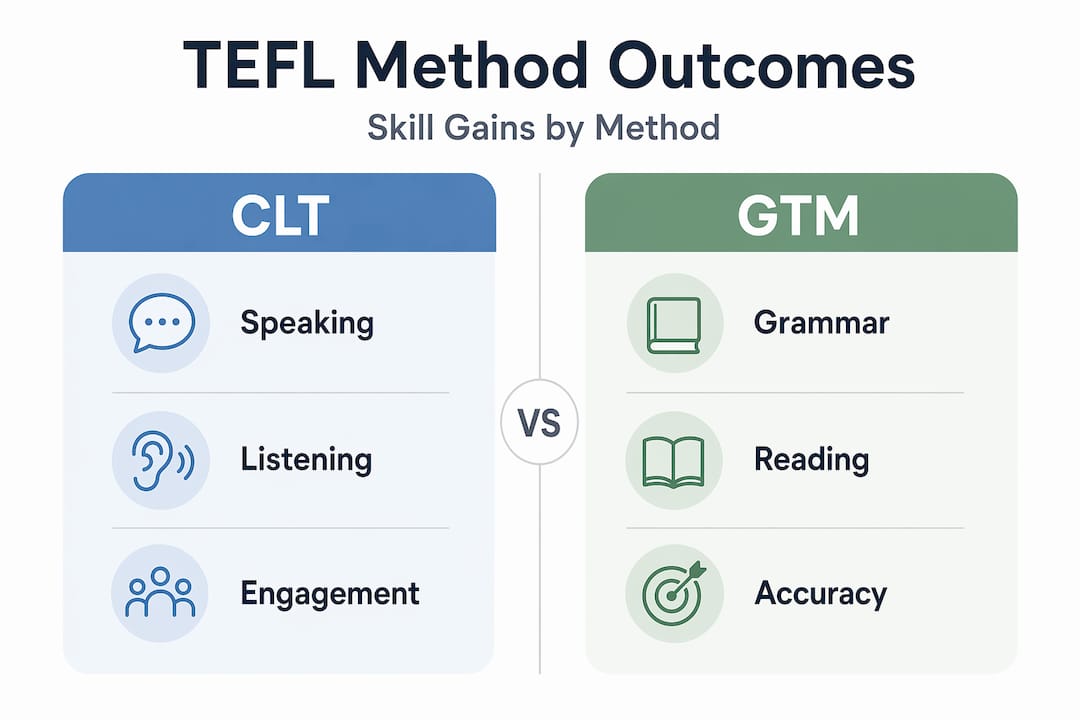
Studies comparing CLT and GTM in EFL environments provide some of the clearest evidence for this point. A quasi-experimental study conducted in Indonesia over 12 weeks with 120 participants found that CLT significantly outperformed GTM in speaking and listening outcomes, while GTM showed marginally better results in grammar and reading comprehension. That finding has real implications for how you structure lesson goals.
Pro Tip: Before selecting a method for a unit, write down the primary skill you want students to improve. That single step will immediately narrow your method choices and make lesson planning more targeted.
Comparing method effectiveness for classroom outcomes
After outlining the main method types, it is important to look at how these methods perform in real classrooms with different assessment goals in mind.
The evidence available on TEFL method effectiveness points to a consistent pattern: skill gains are method-dependent. A teacher who relies exclusively on CLT may see strong oral fluency development but weaker grammar accuracy scores. A teacher who defaults to GTM may produce students who perform well on written tests but struggle in real conversations.
Skill outcomes by method: A comparative overview
| Teaching method | Speaking gains | Listening gains | Grammar accuracy | Reading comprehension |
|---|---|---|---|---|
| CLT | High | High | Moderate | Moderate |
| GTM | Low | Low | High | High |
| Direct Method | High | High | Moderate | Moderate |
| Audio-Lingual | Moderate | Moderate | High | Low |
| TPR | Moderate | High | Low | Low |
| Task-Based Learning | High | Moderate | Moderate | Moderate |
This table reflects general trends from EFL research rather than absolute outcomes, which vary by learner profile, course duration, and instructional quality. However, the patterns are consistent enough to use as planning benchmarks.
Key evidence-based findings worth noting:
- CLT outperforms GTM in speaking and listening tasks based on research comparing both methods over a structured 12-week period with equal group sizes.
- GTM holds a marginal advantage in grammar and reading comprehension, making it a useful component in exam preparation or academic writing courses.
- Audio-Lingual drilling produces reliable gains in pronunciation and sentence pattern accuracy but contributes less to communicative flexibility.
- TPR is most effective in the early stages of language learning, particularly with children, and loses instructional value as learners advance.
One practical implication of this evidence is that benchmarks should target skill-specific outcomes rather than overall proficiency. A student who scores well on a vocabulary test may still struggle in a conversation. Assessing the right skill for the right method gives you an accurate picture of instructional effectiveness.
Understanding ESL vs EFL teaching differences also matters here because the learning environment shapes which methods are most viable. In an ESL context, students have daily exposure to English outside the classroom, which naturally supports CLT approaches. In EFL contexts, structured input through GTM or Audio-Lingual drilling may be more necessary to compensate for limited exposure. Thoughtful classroom setup strategies can further support whichever method you prioritize by arranging physical and digital resources to align with your instructional approach.
Hybrid and blended methods: Maximizing engagement and learning
Given that no method is perfect for all students or targets, many teachers successfully combine approaches to create more adaptive and effective instruction.
Blended and hybrid teaching recognizes that real classrooms contain learners with different strengths, learning histories, and goals. A single method applied rigidly across all lessons leaves gaps. Combining methods strategically fills those gaps while keeping instruction varied and engaging.

Research on hybrid instruction, including a 16-week study comparing classroom instruction with and without a supplementary digital tool, found that hybridization can produce results equal to or better than single-method instruction, particularly for practical language competencies such as using formal versus informal register appropriately.
Steps to build a hybrid teaching approach
- Identify the primary skill target for each lesson unit. A unit focused on spoken fluency needs CLT as its core, while a unit focused on accuracy in formal writing may center on GTM principles.
- Select a complementary secondary method. For a CLT-based unit, you might add Audio-Lingual drilling to reinforce the phonological accuracy of new vocabulary before using it in conversation tasks.
- Integrate a technology component where access allows. Digital tools can provide additional input outside class hours, reducing the pressure to cover everything within limited contact time.
- Plan for mixed-ability differentiation. Advanced students can take on more complex communicative tasks while lower-level students consolidate grammar structures through structured exercises.
- Evaluate skill outcomes at the unit level, not just the course level. Unit-by-unit feedback allows you to adjust the method blend before the next unit begins rather than waiting until course completion.
| Hybrid combination | Best use case | Expected outcome |
|---|---|---|
| CLT + Audio-Lingual | Speaking accuracy with fluency | Balanced oral production |
| GTM + TBL | Academic writing with real tasks | Accurate, functional writing |
| Direct Method + TPR | Young learners and beginners | Strong listening and comprehension |
| CLT + digital tool | Large classes with varied levels | Engagement and autonomous practice |
For detailed examples, blended learning examples in TEFL show how teachers have combined in-person instruction with digital resources to support learner outcomes. You can also review the structural advantages of hybrid TEFL programs and explore hybrid TEFL courses designed to train teachers in flexible, combination-based delivery.
Pro Tip: When building a hybrid approach, do not try to combine more than two or three methods per unit. Overloading a lesson with too many frameworks reduces coherence and makes it harder for students to track the learning objective.
Choosing and adapting the right method for your classroom
Once you understand the available methods and their possible combinations, the next step is to make confident, context-driven choices for your own classroom.
Method selection is not a one-time decision. It is an iterative process that responds to student feedback, assessment results, and evolving lesson goals. Method effectiveness depends on learner outcomes and assessment targets, which means the same method can perform differently with two groups of students even within the same institution.
A practical checklist for selecting and adapting methods
- Define the skill focus. Is this lesson primarily targeting speaking, listening, reading, writing, grammar, or vocabulary? Each answer points toward a different method cluster.
- Assess class size. CLT works best in smaller groups where interaction is feasible. Larger classes may require more Audio-Lingual or Direct Method approaches that can be managed at scale.
- Consider the age group. Young learners respond well to TPR and game-based CLT. Adult learners, especially those with formal education backgrounds, often engage more readily with GTM and TBL frameworks.
- Evaluate technology access. Where reliable internet and devices are available, digital-enhanced hybrid models are viable. Where infrastructure is limited, in-classroom methods must carry more instructional weight.
- Set measurable benchmarks before the lesson, not after. Define what success looks like for the specific skill you are targeting. This makes post-lesson evaluation meaningful and actionable.
- Gather feedback and adjust. After each lesson or unit, collect simple feedback from students. One or two targeted questions about what helped them learn most will yield more useful data than end-of-course evaluations alone.
Reviewing proven teaching strategies and studying hybrid learning in TEFL will give you practical frameworks for applying this checklist in real instructional settings.
Pro Tip: Keep a short teaching journal for the first three months in a new classroom. Note which methods you used, what the lesson goal was, and how well students performed on the related assessment. Patterns will emerge quickly and guide your approach more reliably than intuition alone.
Why focusing on outcomes—not just methods—matters most
There is a persistent tendency in TEFL professional development circles to treat methods as ideological positions rather than instructional tools. Teachers are sometimes trained to identify with CLT or TBL as philosophies, which can create resistance to adapting those approaches when assessment data suggests a different strategy would serve students better.
The more productive framework is to treat each method as a tool with a specific use case. A hammer is not better than a screwdriver in absolute terms; both are correct in the right situation. The same logic applies to teaching methods. CLT is not inherently superior to GTM. It is superior for specific outcomes in specific contexts, as the comparative research clearly shows.
What separates consistently effective TEFL teachers from those who plateau is the willingness to evaluate skill-specific outcomes rather than measuring only overall proficiency. A student can show strong overall test scores while still being unable to function in a job interview conducted in English. That gap reflects a method mismatch at the skill level, not a failure of the student.
Trend-chasing is also a risk. New methodologies enter the TEFL conversation regularly, often with compelling theoretical framing but limited empirical support at the classroom level. Investing time in a new framework before assessing its evidence base can divert instructional energy away from approaches that have already been shown to work. Evaluating the advantages of hybrid programs critically rather than adopting them wholesale is a more disciplined and ultimately more effective professional stance.
Flexibility, grounded in evidence rather than trend, is the defining characteristic of a skilled TEFL instructor.
Advance your skills with expert TEFL resources
Understanding teaching methods intellectually is the first step. Applying them confidently in a real classroom, while managing diverse learner needs and institutional requirements, takes structured training and practice.
TEFL Institute offers a range of TEFL certification courses designed to build exactly the kind of methodological flexibility described in this article. Whether you are preparing to teach for the first time or looking to formalize your existing experience, the courses cover practical classroom methodology, lesson planning, and learner assessment in depth. For teachers who want to expand their qualifications over time, course extensions provide a structured pathway to advanced credentials. The training is built to prepare you not just to understand these methods, but to apply them with precision and adapt them as your teaching context evolves.
Frequently asked questions
Which teaching method is best for improving speaking skills in EFL classrooms?
Communicative Language Teaching is generally most effective for speaking development because it centers instruction on real interaction and meaningful communication. Comparative research comparing CLT and GTM confirms CLT produces significantly stronger gains in speaking and listening outcomes.
What are the benefits of using hybrid or blended teaching methods?
Hybrid approaches combine the structural benefits of traditional instruction with the engagement advantages of varied input sources. A 16-week comparative study found that hybridization can produce equal or stronger results than single-method instruction, especially for practical language competencies.
How do I choose the right method for a diverse classroom?
Start by identifying each student’s primary skill gaps and lesson targets, then blend methods that address those specific needs. Method effectiveness is tied to learner outcomes and assessment targets, making context-specific selection more reliable than choosing a single default approach.
Is the Grammar-Translation Method still useful today?
GTM remains a relevant and practical tool for teaching grammar rules and reading comprehension, particularly in exam preparation contexts. Research shows GTM holds marginal advantages in grammar and reading compared to CLT, making it most effective when supplemented by communicative activities for balanced skill development.
Recommended
TEFL Institute guides

Italy
Jobs, pay and visa routes
Vietnam
Work permits and requirements
Japan
JET, ALT and eikaiwa pay
Germany
Freelance work and pay
Portugal
Jobs, pay and visa routes