United Kingdom (UK)
 United States (US)
 Canada
 South Africa
 India
India Australia
 New Zealand
 China
China Russia
 Germany
 France
 Spain
Spain Netherlands
 Vietnam
 United Arab Emirates
 Italy
Italy Poland
 Thailand
 Türkiye









 Algeria


Step by Step Lesson Planning for TEFL Educators
Step by Step Lesson Planning for TEFL Educators
TL;DR:
- Effective TEFL lesson planning begins with clear, measurable objectives and backward design to focus on desired learning outcomes. Building structured procedures, selecting appropriate materials, and reflecting after each lesson enhance teaching effectiveness and student progress. Continuous revision based on feedback transforms lesson plans into dynamic tools for professional growth.
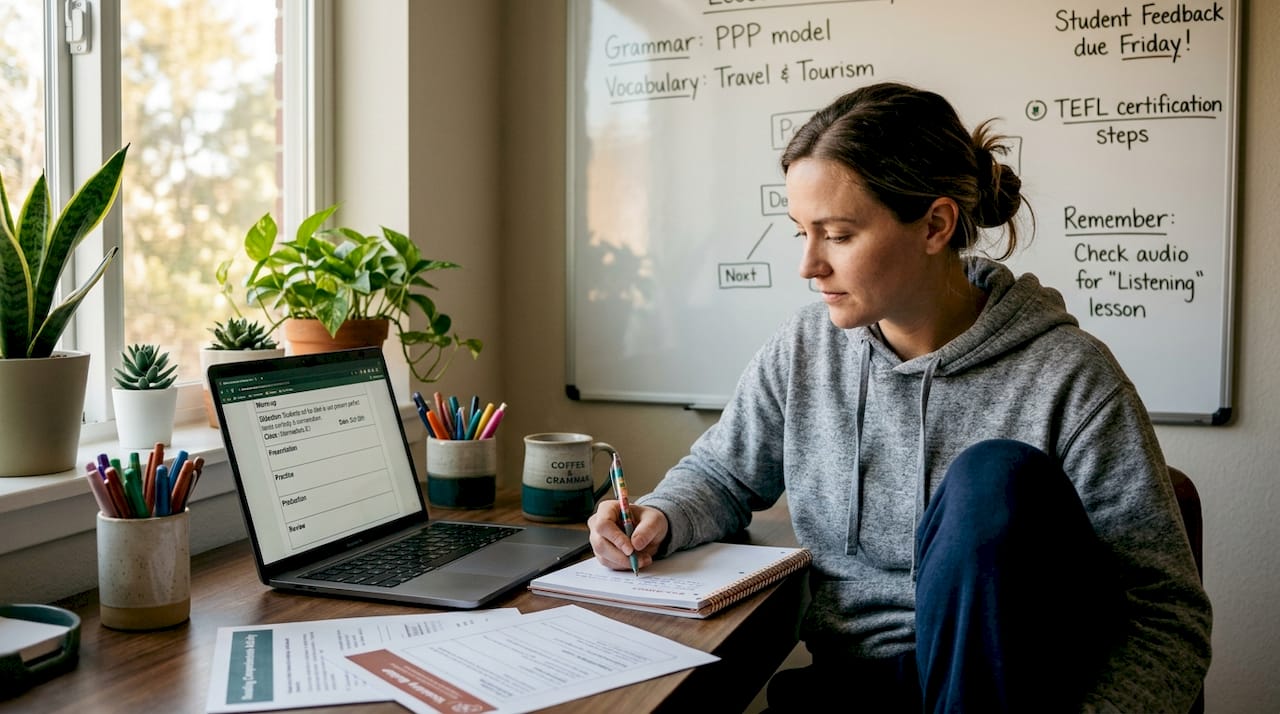
Many aspiring teachers begin their TEFL preparation with confidence, then freeze the moment they sit down to write their first lesson plan. The structure feels unclear, the options feel endless, and the result is often a document that looks busy but lacks real direction. Step by step lesson planning, which pedagogical professionals formally call instructional design, gives you a repeatable framework for building lessons that actually work. This guide walks you through every stage of the process, from setting objectives to revising your plans after class, with specific attention to language instruction and TEFL contexts.
Table of Contents
- Key Takeaways
- Step by step lesson planning: prerequisites and tools
- How to create a lesson plan step by step
- Common mistakes in lesson planning
- Iterative feedback and lesson plan revision
- My perspective on getting lesson planning right
- Build lesson planning skills with Teflinstitute
- FAQ
Key Takeaways
| Point | Details |
|---|---|
| Start with objectives | Write clear, measurable learning objectives before designing activities or choosing materials. |
| Use backward design | Plan assessments before activities to keep lessons focused on real learning outcomes. |
| Apply the PPP framework | Structure TEFL lessons around Present, Practice, and Produce stages for consistent skill progression. |
| Build in differentiation | Adjust content, process, and products within one plan to meet diverse learner needs. |
| Revise after every lesson | Treat lesson plans as evolving documents that improve through feedback and reflection. |
Step by step lesson planning: prerequisites and tools
Before writing a single activity, you need to understand the context you are planning within. This means knowing your curriculum standards, your learners’ proficiency levels, and which planning framework suits your teaching environment. Skipping this stage is one of the most common reasons first-time teachers end up with lessons that feel disconnected from real learning goals.
The role of lesson planning becomes clear when you consider what a plan actually does: it converts a broad course objective into a structured 45 to 60-minute experience for learners. Without that translation layer, you are improvising, and improvisation rarely serves language learners well, particularly at lower proficiency levels.
What to gather before you begin
- Your course syllabus or curriculum standards for the relevant level
- A learner profile including current proficiency, learning gaps, and age group
- A chosen planning framework, either PPP (Present, Practice, Produce) or backward design
- A lesson planning template, either digital or paper-based
Pro Tip: If you are just starting out, lesson planning templates save significant preparation time and help you develop a mental model for structuring lessons before you internalize the pattern.
Choosing your framework early matters. Backward design keeps lessons purposeful by prioritizing outcomes over activities, meaning you decide what students will be able to do by the end before deciding how to get them there. The PPP model, widely used in ESL and EFL settings, provides a clear three-stage structure: introduce new language, practice it in controlled contexts, then produce it independently.
| Framework | Best for | Core sequence |
|---|---|---|
| Backward Design | Outcome-focused courses | Objectives → Assessment → Activities |
| PPP | Language skill development | Present → Practice → Produce |
| Task-Based Learning | Communicative fluency goals | Pre-task → Task → Post-task |
How to create a lesson plan step by step
This is where most of the work happens. A well-structured lesson plan is not a script; it is a roadmap. It tells you where you are going, how you will know when you have arrived, and what to do if you need to take a detour. The process below reflects what Discovery Education describes as a six-step approach centered on objectives, assessment, and balanced instruction.

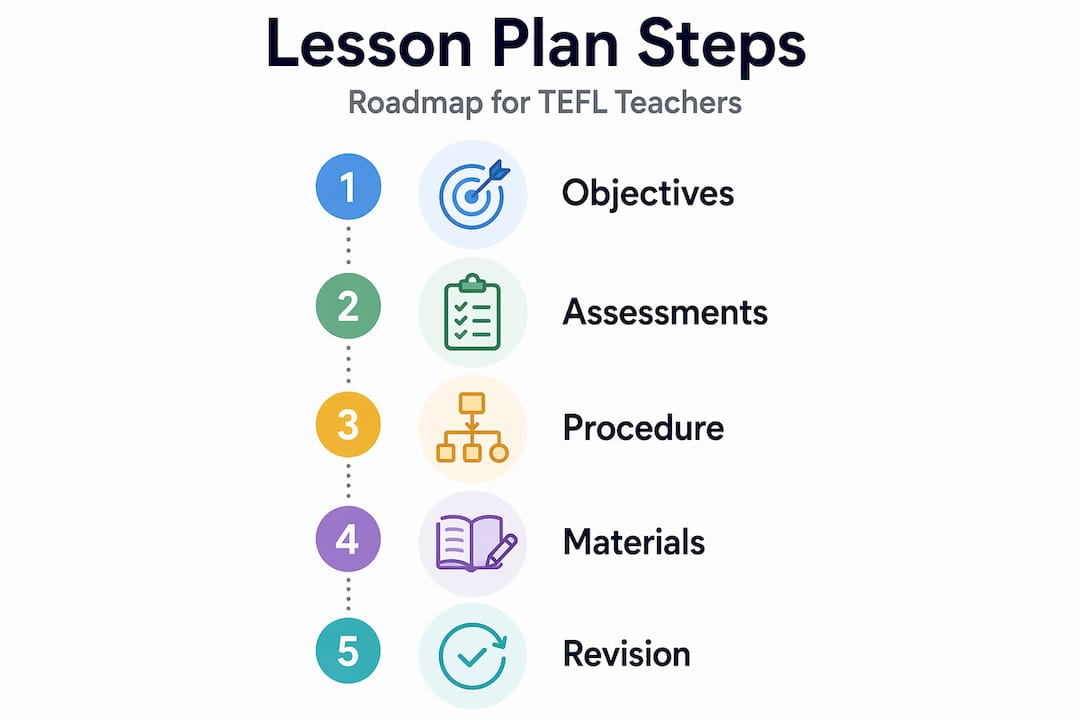
Step 1: Write your learning objectives
Start here, always. Your objective defines everything else in the plan. A strong objective follows the SMART criteria: Specific, Measurable, Achievable, Relevant, and Time-bound. For a TEFL context, an objective like “Students will use simple past tense to describe three past events orally” is far more useful than “Students will learn past tense.”
Step 2: Design your assessments first
This step surprises many new teachers. Assessment design before activities is a core principle of backward design, and it works because it forces you to define what success looks like before you plan how to reach it. Decide how you will know students have met the objective. Will you use an exit ticket, a speaking task, a written paragraph, or a brief quiz?
There are two types to consider. Formative assessments happen during the lesson, such as checking comprehension through concept check questions or monitoring pair work. Summative assessments happen at the end, such as a production task that demonstrates the target language in use.
Step 3: Structure your lesson procedure
Once your objective and assessment are set, build the lesson around them. A standard TEFL lesson procedure includes these stages:
- Introduction or hook: Activate prior knowledge and create interest in the topic. This might be a short video, a photo, or a question prompt.
- Presentation: Introduce the target language using clear context, whether through a text, dialogue, or model sentences.
- Guided practice: Students practice the language with teacher support, using controlled exercises like gap fills or sentence transformation tasks.
- Freer practice or production: Students use the language more independently through communicative activities such as role plays, discussions, or short writing tasks.
- Closure: Summarize the lesson, revisit the objective, and check that students can articulate what they learned.
Pro Tip: When writing time estimates next to each stage, build in a two-minute buffer between major transitions. New teachers almost always underestimate how long instructions and setup take, especially with multilingual groups.
Step 4: Select materials and activities
With your structure in place, select materials that directly support each stage. Common TEFL activity types include information gap tasks, jigsaw reading activities, dictogloss, and communicative drilling. The key question for each material choice is simple: does this activity move students closer to the lesson objective?
The PPP framework is particularly useful here because it maps activity types onto stages. Drilling and substitution tables suit the Practice stage; open-ended discussions and written tasks suit the Produce stage. Mixing them up creates confusion for learners who are not yet ready for freer use of new language.
Common mistakes in lesson planning
Knowing the steps is useful. Knowing where they typically break down is more useful. The following patterns appear repeatedly in early-stage lesson planning and are worth knowing before they become habits.
- Prioritizing activities over objectives: Building a lesson around a fun activity rather than a learning outcome produces engagement without progress. Every activity needs a direct link to the stated objective.
- Skipping assessment design: When assessment is not built in from the start, teachers often reach the end of a lesson with no way to know whether learning occurred.
- Ignoring learner diversity: Differentiation is not about creating separate lessons for each student. It is about making targeted adjustments to content, process, or expected output within a single plan to account for different proficiency levels or learning needs.
- No reflection phase: Lessons with no planned closure leave students without a clear sense of what they accomplished. A two-minute consolidation activity makes a measurable difference in retention.
- Poor timing estimates: Overloading a 50-minute lesson with 70 minutes of content is extremely common. Prioritize depth over breadth and cut activities before the lesson, not during it.
Structured and detailed planning raises student achievement by approximately 0.22 standard deviations, the equivalent of around four additional months of learning. The investment in careful preparation is not abstract. It shows up in measurable outcomes.
● THE HIRE WIREHiring windows close while you scroll.
Deadlines, salaries and visa notes for teaching jobs worldwide, checked against official sources and sent free every two weeks.
Get on the Wire
Managing transitions is a skill in itself. Write the instructions for each activity into your plan in advance. If you are relying on improvised explanations during the lesson, you will lose time and student attention at exactly the moment when momentum matters most. For a broader look at how classroom structure supports lesson execution, the ESL classroom management practices covered by Teflinstitute are directly relevant to this stage.
Iterative feedback and lesson plan revision
Writing a lesson plan is not a one-time event. The most effective lesson planning guide you will find, including this one, will tell you the same thing: your plan gets better every time you use it, reflect on it, and revise it. This is not a consolation. It is how lesson planning actually works in professional teaching practice.
Research from Frontiers in Education shows that pre-service teachers improve their lesson plans significantly through iterative feedback cycles involving teacher educators and peers. The key mechanism is treating the plan as a knowledge object, meaning a document under active construction rather than a finished product. Each round of feedback adds precision and practicality.
Here is how to build this into your practice:
- After each lesson, write two to three sentences noting what worked, what did not, and why. Do this immediately while the details are fresh.
- Share draft plans with a mentor, cooperating teacher, or peer before teaching them. A second set of eyes catches timing problems and unclear instructions that you will miss on your own.
- Use digital platforms such as Google Docs or shared drive folders to store and track revisions across multiple versions of the same lesson.
- Revisit revised plans two to three weeks after the first delivery. You will notice improvements you did not expect and problems that only become visible with distance.
Pro Tip: Create a simple annotation system in your plan. Use one symbol for activities that ran long, another for those that confused students, and a third for moments that generated strong engagement. Reviewing those symbols before your next planning session is faster and more informative than rereading full paragraphs of notes.
The link between feedback and growth is not theoretical. Connecting theory to practice through reflective revision cycles is a documented feature of effective teacher education. The teachers who improve fastest are not those who plan most carefully on the first attempt. They are the ones who revise most systematically after each class.
My perspective on getting lesson planning right
From what I have observed and experienced working with TEFL educators at various stages of their training, the most common mistake is not technical. It is psychological. New teachers treat their first lesson plan as a final product, something to be judged and either approved or failed. That mindset kills the learning process before it starts.
I have seen teachers with no formal pedagogical background produce genuinely effective lessons within weeks, not because they had natural talent, but because they were willing to write something imperfect, teach it, reflect on what happened, and revise. That cycle, repeated deliberately and consistently, is what actually builds planning skill.
The SMART objective framework, backward design, the PPP sequence: these are not boxes to tick. They are cognitive tools that help you make better decisions faster. Once they become automatic, lesson planning stops feeling like a burden and starts functioning as a genuine thinking practice.
My advice is to commit to the structure first, even if it feels mechanical. The flexibility and creativity come later, after you understand why each component of the plan serves the learner. A lesson plan that connects clear objectives to well-designed assessments and purposeful activities is not overcomplicated. It is precisely specific enough to teach well and adapt quickly when the class takes a different direction than expected.
— Muller
Build lesson planning skills with Teflinstitute

Teflinstitute offers structured training that moves you from theory to practical lesson design with professional guidance built in. The 120 Hour Elective TEFL Course covers instructional design fundamentals including objective writing, assessment planning, and activity sequencing for language learners. For a more extensive program, the 240 Hour Master TEFL Course integrates curriculum development, feedback-based revision practices, and advanced lesson planning frameworks. Both programs are designed to produce teachers who can plan confidently, reflect critically, and improve consistently across their careers.
FAQ
What are the first steps in creating a lesson plan?
Start by writing a clear, measurable learning objective, then design your assessments before planning any activities. This backward design sequence keeps your lesson focused on what students will actually achieve.
What is the PPP framework in TEFL lesson planning?
PPP stands for Present, Practice, and Produce. It is a widely used ESL and EFL lesson structure that introduces new language, reinforces it through controlled exercises, and then gives students the opportunity to use it independently.
How long does it take to write a good lesson plan?
An experienced teacher may take 20 to 30 minutes; a new teacher should expect 60 to 90 minutes per plan. The time decreases significantly once you have internalized a consistent planning framework and built a library of reusable materials.
Why is assessment designed before lesson activities?
Designing assessments first clarifies exactly what student success looks like before you plan how to reach it. This prevents activities from becoming busy work disconnected from the actual learning goal.
How do you improve a lesson plan after teaching it?
Write brief reflective notes immediately after class, share the plan with a peer or mentor for feedback, and revise based on what you observed. Treating plans as documents under continuous revision is a documented feature of effective teacher development.
Recommended
TEFL Institute guides

Estonia
Jobs, pay and work routes
Japan
JET, ALT and eikaiwa pay
Spain
Jobs, pay and visa routes
Italy
Jobs, pay and visa routes
Taiwan
Buxibans, pay and visas