
 United Kingdom (UK)
 United States (US)
 Canada
 South Africa
 India
India Australia
 New Zealand
 China
China Russia
 Germany
 France
 Spain
Spain Netherlands
 Vietnam
 United Arab Emirates
 Italy
Italy Poland
 Thailand
 Türkiye





 Algeria


Hybrid TEFL courses: flexible certification for aspiring teachers
Hybrid TEFL courses: flexible certification for aspiring teachers

TL;DR:
- Hybrid TEFL combines online coursework with in-person teaching practice for flexible, credible certification.
- It offers practical classroom experience similar to in-person programs at a lower cost.
- Success depends on intentional course design and proactive engagement from learners.
Aspiring English teachers often assume they must choose between a fully online TEFL course or a traditional in-person program. That binary is outdated. Hybrid TEFL courses have emerged as a structured third path, combining the scheduling flexibility of online study with the hands-on classroom practice that employers and students actually value. This article defines what a hybrid course is, compares it to other TEFL training formats, outlines its real benefits and challenges, and helps you determine whether this approach fits your goals and circumstances.
Table of Contents
- Defining hybrid courses in TEFL certification
- How hybrid TEFL courses compare to traditional and online-only paths
- Benefits of hybrid TEFL courses for aspiring teachers
- Common challenges and expert advice for succeeding in hybrid TEFL
- Is a hybrid TEFL course right for you?
- Our perspective: what most guides miss about hybrid TEFL courses
- Explore your hybrid TEFL certification options
- Frequently asked questions
Key Takeaways
| Point | Details |
|---|---|
| Hybrid means blended learning | A hybrid TEFL course merges online lessons with in-person teaching for flexible, robust educator preparation. |
| Balance of theory and practice | You gain both foundational knowledge and real classroom skills, making you better prepared and job-ready. |
| Comparable to top certifications | Hybrid TEFL is recognized as equivalent to leading in-person qualifications like CELTA, but is often more accessible. |
| Consider your learning needs | Success depends on having reliable tech access, self-motivation, and a desire for hands-on classroom experience. |
| Intention trumps format | Well-designed hybrid courses can outperform both fully online and in-person models when thoughtfully implemented. |
Defining hybrid courses in TEFL certification
A hybrid TEFL course blends online academic coursework with in-person practical teaching sessions. It is not simply an online course with a few video calls added. The structure is intentional: theory modules covering linguistics, lesson planning, and classroom management are completed online at your own pace, while supervised teaching practice takes place in a physical classroom setting with real learners.
According to the TEFL Hybrid Project, hybrid TEFL provides the flexibility of online study, including flexible start dates and durations ranging from 2 to 12 weeks, plus hands-on classroom experience equivalent to full in-person courses like CELTA, but at a more affordable and accessible price point. That combination addresses two of the most common barriers to TEFL certification: cost and scheduling.
Typical hybrid TEFL course structures include:
- Online theory modules covering grammar instruction, phonology, lesson design, and ESL (English as a Second Language) methodology
- In-person practicum sessions where candidates teach actual classes under the supervision of a qualified assessor
- Tutor feedback delivered through both online channels and face-to-face debriefs
- Flexible scheduling that allows candidates to complete online components during evenings or weekends
For a detailed breakdown of how this format works in practice, the hybrid learning TEFL guide provides additional context on course structures and what to expect at each stage.
Pro Tip: When evaluating hybrid TEFL programs, ask providers specifically how many hours are allocated to in-person teaching practice. A minimum of six observed teaching hours is widely regarded as the standard for a credible practicum component.
“Hybrid TEFL provides the flexibility of online study plus hands-on classroom experience, equivalent to full in-person courses like CELTA but more affordable and accessible for aspiring teachers.” — TEFL Hybrid Project
How hybrid TEFL courses compare to traditional and online-only paths
Having defined hybrid courses, the next step is to consider how they measure up to the more familiar TEFL training routes. Each format has distinct characteristics that suit different learner profiles, budgets, and career goals.
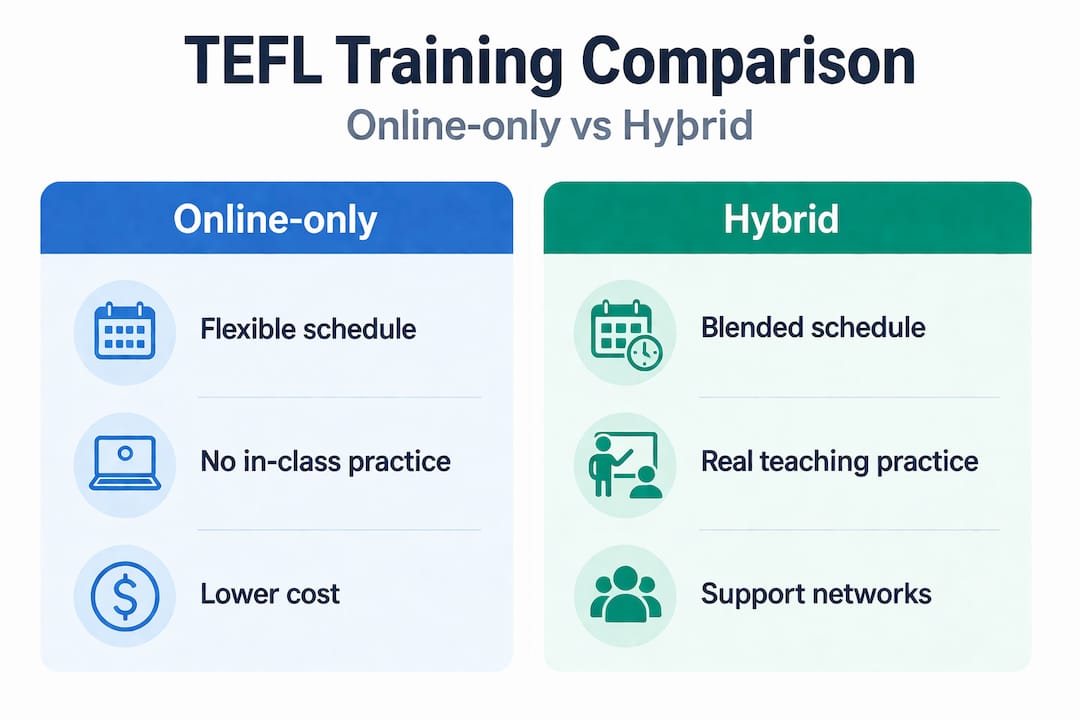
| Feature | Online-only TEFL | Hybrid TEFL | In-person TEFL (e.g., CELTA) |
|---|---|---|---|
| Schedule flexibility | High | Moderate to high | Low |
| Cost | Lowest | Moderate | Highest |
| Teaching practice | None or simulated | Real classroom hours | Real classroom hours |
| Employer recognition | Variable | Strong | Strongest |
| Start dates | Anytime | Regular intakes | Fixed cohorts |
| Completion time | 2 to 12 weeks | 4 to 12 weeks | 4 to 5 weeks intensive |
Online-only courses offer maximum convenience, but they often lack supervised teaching practice with real students. That gap matters when you apply for positions in competitive markets like South Korea, Japan, or the United Arab Emirates, where employers frequently require evidence of practical classroom experience. Fully in-person programs like CELTA deliver rigorous training but demand full-time attendance over four to five weeks, which is not realistic for candidates who are currently employed or have family commitments.
Hybrid courses address both limitations. As the TEFL Hybrid Project confirms, the format is equivalent to full in-person training in terms of certification outcomes, while remaining more accessible than traditional intensive programs.
Key advantages of hybrid over online-only:
- Candidates gain observed teaching hours, which are required by many international employers
- Feedback from qualified assessors improves lesson planning and classroom management skills faster than self-study alone
- The certification carries stronger credibility with schools and language institutes abroad
For a side-by-side analysis of how these formats affect career outcomes, the online vs in-class TEFL comparison and the online vs offline TEFL diploma guide both provide useful detail on recognition and employability.
Pro Tip: If you are targeting teaching positions in East Asia or the Middle East, confirm with your prospective employer whether they accept hybrid certification before enrolling. Most do, but requirements vary by institution and country.
If you are still weighing the two formats, the article on why choose hybrid TEFL outlines the specific scenarios where hybrid training delivers the strongest return on investment.
Benefits of hybrid TEFL courses for aspiring teachers
With the options compared, let’s examine the unique benefits hybrid courses deliver to aspiring TEFL educators. The advantages extend beyond simple convenience and touch on career readiness, financial accessibility, and skill development.
1. Flexible start dates and self-paced online study
Most hybrid programs accept new students on a rolling basis. You are not locked into a fixed cohort start date the way you would be with a CELTA course. This means you can begin your theoretical training whenever your schedule allows and schedule your in-person practicum sessions around existing work or personal commitments.
2. Lower cost without sacrificing quality
In-person intensive programs like CELTA typically cost between $1,500 and $2,500 USD, depending on location. Hybrid TEFL courses are generally priced significantly lower while still including supervised classroom practice. This makes certification accessible to a wider pool of candidates, including those in regions where intensive in-person programs are not geographically available.
3. Globally recognized certification
The TEFL Hybrid Project confirms that hybrid TEFL certification is equivalent to full in-person training and is accepted by employers worldwide. Language schools, private academies, and public school systems in Europe, Asia, Latin America, and the Middle East recognize hybrid-certified teachers.
4. Balanced skill development
Online modules build theoretical knowledge at a measured pace. In-person sessions then apply that theory in real classroom environments. This sequence, theory before practice, mirrors the pedagogical approach used in university teacher training programs and produces more confident, prepared teachers than either format alone.
5. Access to dual support networks
Hybrid students benefit from both online tutor support (available asynchronously through forums, email, and video feedback) and local in-person mentorship during practicum sessions. That dual-layer support system is particularly valuable for candidates who are new to teaching and need guidance at multiple points in their learning process.
The following ordered list summarizes the core benefits in priority order for most aspiring teachers:
- Practical classroom experience with real students
- Flexible scheduling compatible with employment or study
- Lower financial barrier compared to intensive in-person programs
- Internationally recognized certification
- Comprehensive support from both online tutors and in-person assessors
For a more detailed breakdown of these advantages, the benefits of hybrid TEFL programs resource covers each point with additional examples from teachers who have completed the format.
Common challenges and expert advice for succeeding in hybrid TEFL
Of course, all formats have their challenges. Here is what future teachers should expect with hybrid models, plus strategies for success.
Research on hybrid learning highlights several recurring issues. Synchronous hybrid delivery, where some participants attend in person while others join live online simultaneously, can create equity and technology access problems. Students without reliable internet connections or appropriate devices are placed at a structural disadvantage. HyFlex models, which give students the choice of attending in person or online on a session-by-session basis, can feel overwhelming for candidates who thrive on consistent structure.
Poor implementation is a documented risk. Research on blended education shows that hybrid formats are effective when designed intentionally, but can become draining and produce unequal participation when built around emergency setups or inadequate technology. The same research identifies 30 to 69 percent online content as the most effective proportion for hybrid learning outcomes.
Common challenges to anticipate:
- Technology requirements: Stable internet, a functioning webcam, and access to a computer are baseline requirements for the online component
- Self-discipline for online modules: Without a fixed classroom schedule, some candidates fall behind on theoretical coursework
- Balancing two learning environments: Switching between independent online study and structured in-person sessions requires organizational discipline
- Variable practicum availability: Depending on your location, finding a local practicum partner school may require advance planning
“Hybrid learning is effective when designed intentionally, producing benefits in flexibility and engagement. Poorly implemented setups lead to fatigue and unequal participation.” — Inside the Hybrid Learning Crisis
Strategies for success in a hybrid TEFL course:
- Set a fixed weekly schedule for online modules, treating them as non-negotiable appointments
- Confirm technology requirements with your provider before enrolling and test your setup in advance
- Engage actively in online discussion forums and peer feedback sessions to build community
- Use the in-person practicum sessions to ask specific questions about classroom management challenges you encountered during online study
The blended learning TEFL examples resource provides practical case studies of how teachers have navigated these challenges successfully.
Pro Tip: Before committing to a hybrid program, ask the provider how practicum sessions are organized in your region. Some programs partner with local language schools directly, while others require you to arrange your own teaching placement.
Is a hybrid TEFL course right for you?
Having considered both the advantages and the hurdles, it is time to assess whether hybrid TEFL courses match your aspirations and circumstances.
Use this checklist to evaluate your fit:
- You need schedule flexibility. You are currently employed, studying, or have caregiving responsibilities that prevent full-time attendance at an intensive program.
- You have reliable technology access. You have a stable internet connection, a computer with a webcam, and a quiet study environment for online modules.
- You want hands-on teaching practice. You recognize that supervised classroom experience is important for your confidence and your resume.
- You are self-motivated. You can complete independent study tasks without the structure of daily in-person classes.
- You have a clear career goal. You intend to teach English abroad or online and need internationally recognized certification to qualify for positions.
The following table summarizes the typical hybrid TEFL candidate profile based on available program data:
| Candidate characteristic | Typical hybrid TEFL student |
|---|---|
| Age range | 22 to 45 years |
| Current employment status | Employed part-time or full-time |
| Prior teaching experience | None to minimal |
| Primary motivation | Career change or international relocation |
| Preferred study schedule | Evenings and weekends |
| Target teaching region | Asia, Europe, Latin America, or online |
As the TEFL Hybrid Project confirms, the format is designed specifically to serve candidates who cannot commit to intensive in-person schedules but still require practical classroom credentials. If technology access concerns apply to your situation, discuss alternatives with your provider before enrolling, as some programs offer heavier in-person weighting to accommodate candidates with connectivity limitations.
The benefits of hybrid TEFL programs page includes a self-assessment tool that can help you confirm whether this format aligns with your learning style and career objectives.
Our perspective: what most guides miss about hybrid TEFL courses
Most articles about hybrid TEFL stop at listing the benefits and comparing formats. What they miss is a more fundamental point: the format itself does not guarantee quality. A hybrid course label does not automatically mean you will receive flexible, engaging, or effective training.
The critical variable is intentional course design. Research on blended education is clear that hybrid learning succeeds when the online and in-person components are deliberately integrated, not simply stacked alongside each other. When a provider builds a hybrid course by adding a practicum onto an existing online program without restructuring the curriculum, the result is often a disjointed experience that serves neither format well.
What this means practically is that you should evaluate hybrid programs not just by their certification outcomes, but by how the course is structured. Ask whether online modules explicitly prepare you for specific in-person tasks. Ask whether your assessor reviews your online work before your practicum sessions. Ask whether feedback from classroom observations informs your subsequent online learning activities. These are the markers of a genuinely integrated hybrid course rather than a loosely assembled one.
The second overlooked factor is proactive participation. Hybrid courses place more responsibility on the learner than either fully online or fully in-person formats. Online components require self-direction. In-person sessions require preparation and willingness to be observed and critiqued. Candidates who approach the format passively, completing modules without reflection and attending practicum sessions without preparation, consistently underperform relative to their potential.
The candidates who get the most from hybrid TEFL are those who treat the two components as a continuous learning cycle rather than two separate tasks. They use online study to prepare for classroom challenges, and they use classroom experience to deepen their understanding of online content. That mindset, more than any structural feature of the course, determines outcomes. The benefits of hybrid TEFL programs resource reinforces this point with data from program graduates.
Explore your hybrid TEFL certification options
If you see yourself thriving in a hybrid format, it is easy to take the next step toward certification.
TEFL Institute offers structured hybrid TEFL certification programs designed for aspiring teachers who need flexibility without sacrificing classroom credibility. Our courses combine self-paced online theory modules with supervised in-person teaching practice, producing certification that is recognized by employers in over 100 countries.
Whether you are planning to teach in Asia, Europe, Latin America, or online, TEFL Institute’s hybrid programs are structured to fit around your existing commitments. Explore our full range of hybrid TEFL courses and use our salary calculator and certification verification tools to plan your teaching career with confidence. Enrollment is open on a rolling basis, so you can start when you are ready.
Frequently asked questions
What exactly does a hybrid TEFL course involve?
A hybrid TEFL course combines online coursework covering teaching theory and methodology with in-person classroom teaching practice, providing flexible, comprehensive training equivalent to full in-person programs.
Are hybrid TEFL courses as valuable as CELTA or fully in-class training?
Yes. When well-designed, hybrid TEFL courses offer training and recognition equivalent to in-class options and are accepted by employers and schools worldwide.
What if my internet connection is unreliable — can I still take a hybrid course?
Reliable technology access is a baseline requirement for online components. Tech equity issues are a documented challenge in hybrid formats, so candidates with connectivity limitations should discuss in-person-heavy alternatives with their provider.
How much of the hybrid course is online versus in person?
Most hybrid TEFL programs allocate 30 to 69 percent of course content to online delivery, with the remainder completed through in-person classroom experience and practicum sessions.
Is a hybrid TEFL course right for me if I want to work internationally?
Yes. Hybrid TEFL provides internationally recognized certification and practical classroom teaching skills that are valued by employers in over 100 countries across Asia, Europe, Latin America, and the Middle East.
Recommended
- Hybrid TEFL: Complete Guide to Flexible Certification | TEFL Institute
- Benefits of Hybrid TEFL Programs for Future Educators
- The Essential Guide to Hybrid Learning in TEFL | TEFL Institute
- Online TEFL Course Advantages: Why They Matter for Aspiring Teachers | TEFL Institute
- Flexible work for language tutors: unlock global reach