

 United Kingdom (UK)
 United States (US)
 Canada
 South Africa
 India
India Australia
 New Zealand
 China
China Russia
 Germany
 France
 Spain
Spain Netherlands
 Vietnam
 United Arab Emirates
 Italy
Italy Poland
 Thailand
 Türkiye










 Algeria



Top resources for new TEFL teachers: tools, guides, and support
Top resources for new TEFL teachers: tools, guides, and support
TL;DR:
- A curated, credible toolkit streamlines resource selection and improves teaching outcomes.
- Essential materials include whiteboard supplies, realia, leveled readers, and multimedia aids.
- Building professional networks and joining communities accelerates growth and classroom effectiveness.
Starting a career in TEFL (Teaching English as a Foreign Language) can feel disorienting. The internet offers thousands of lesson plan sites, app recommendations, and advice columns, yet very few point new teachers toward a focused, practical starting point. Choosing the wrong materials early on wastes time and erodes classroom confidence. The right curated toolkit, built around credible, adaptable, and student-centered resources, shortens the learning curve considerably and leads to stronger outcomes for both teachers and learners. This guide walks you through every major resource category, from physical classroom materials to digital platforms and professional communities, so you can build a reliable toolkit from day one.
Table of Contents
- How to evaluate resources for new TEFL teachers
- Essential classroom materials for new TEFL teachers
- Digital tools and online resources for modern TEFL classrooms
- Top guides and resource libraries for new teachers
- Ongoing support: Professional communities, training, and mentoring
- What most resource guides get wrong about starting out
- Accelerate your TEFL career with the right training foundation
- Frequently asked questions
Key Takeaways
| Point | Details |
|---|---|
| Start with core materials | Essential classroom supplies and adaptable lesson plans are the first step for every new teacher. |
| Leverage digital tools | Blending online platforms with traditional methods boosts engagement and flexibility. |
| Tap into guidebooks | Resource libraries and teaching guides provide ready-made structure and confidence. |
| Seek ongoing support | Professional communities, mentoring, and continuous training make long-term growth much easier. |
How to evaluate resources for new TEFL teachers
Now that you know why a curated toolkit matters, let’s clarify how to evaluate and select the best resources for your teaching journey. Not every resource you find online deserves a place in your classroom. New teachers especially benefit from developing a clear filter before committing time and energy to any material.
The four core resource categories every TEFL teacher should cover:
- Lesson plans: Structured frameworks for individual classes, covering objectives, warm-ups, main activities, and wrap-up tasks
- Activity guides: Collections of games, pair work tasks, and group projects sorted by language level or skill focus
- Classroom management tools: Guides that address seating arrangements, student motivation, discipline strategies, and routine-building
- Digital tools: Platforms and apps that support lesson delivery, formative assessment, and student interaction inside and outside the classroom
When assessing any resource, apply four criteria: reliability (is it backed by established TEFL methodology?), adaptability (can it work across different proficiency levels?), engagement value (will students actively participate?), and currency (does it reflect up-to-date pedagogy?). Quality resources focus on interactive activities and lesson planning that respond to real classroom dynamics rather than theoretical frameworks alone.
Seek out resources that carry peer reviews, endorsements from recognized TEFL bodies, or links to accredited institutions. A resource recommended by a working teacher who has used it across multiple class levels is far more valuable than one that simply looks polished on a website. You can also explore guidance on using TEFL resources effectively to develop a more systematic approach to material selection.
Pro Tip: Before adopting any new resource for a full semester, pilot it with a small group or during a single lesson. Observe student response, note what adjustments are needed, and only then commit to wider use.
Essential classroom materials for new TEFL teachers
Once you know what to look for, dive into the most essential classroom materials every TEFL teacher should have at the ready. Physical and printable materials remain foundational, even as digital tools gain ground.
Core items for every TEFL teacher’s starter kit:
- Whiteboard markers and erasers: Always have multiple colors. Color-coded grammar notes and vocabulary charts improve visual retention significantly.
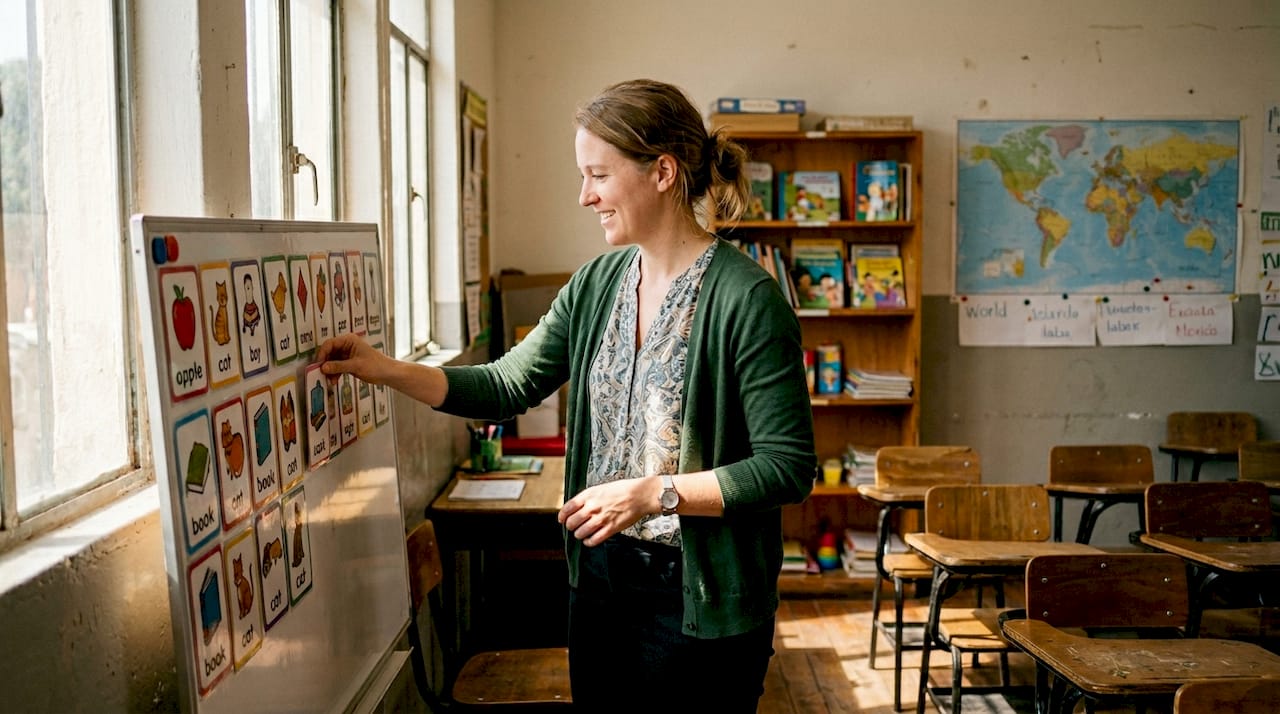
- Flashcards: Ideal for vocabulary drilling, picture-word matching, and quick warm-up activities. A set covering common nouns, verbs, and everyday situations covers most beginner and intermediate needs.
- Realia: Real-world objects brought into the classroom such as menus, maps, product labels, and receipts. Realia grounds abstract language in practical context and boosts authenticity.
- Leveled readers: Graded books matched to student proficiency levels support reading comprehension and vocabulary expansion without overwhelming learners.
- Posters and wall charts: Alphabet charts, verb tense timelines, and phonics grids give students constant visual reference points during lessons.
- Printable worksheets and games: Gap-fill exercises, word searches, board games adapted for language practice, and role-play prompt cards maintain variety across lesson types.
Hands-on materials and visual aids boost engagement for TEFL students, particularly for younger learners and those at beginner levels who rely heavily on visual and kinesthetic input. The physical classroom should function as a language-rich environment where students encounter English through multiple sensory channels simultaneously.
Multimedia resources extend beyond printed materials. Short online videos, audio clips of native speakers in natural conversation, and pronunciation podcasts all support listening skill development. When physical materials are unavailable or budgets are tight, many quality resources are accessible at no cost. Building a library of free TEFL resources from reputable providers allows new teachers to maintain classroom variety without significant financial investment. Additional classroom strategy ideas are also available through teaching tips and hacks collected from experienced practitioners.
Pro Tip: Organize printable materials by level and skill (reading, writing, listening, speaking) from the start. A well-labeled folder system saves hours of preparation time over the course of a semester.
Digital tools and online resources for modern TEFL classrooms
Classroom supplies are just the start. Today’s TEFL educators need to leverage digital solutions for flexible, interactive teaching, whether in a physical classroom, a hybrid setting, or a fully online environment.
High-impact digital tools for TEFL teachers:
- Google Classroom: Free, organized, and familiar to many students. Supports assignment distribution, feedback, and file sharing across any device.
- Flipgrid (now Flip): A video-response platform where students record short clips responding to prompts. Excellent for speaking practice outside of class time.
- Quizlet: Flashcard and quiz platform with millions of existing language-learning sets. Teachers can create custom sets aligned to lesson vocabulary.
- Kahoot! and Mentimeter: Interactive quiz platforms that gamify review sessions and check comprehension in real time.
- Forvo: A pronunciation guide database with audio recordings of words spoken by native speakers across multiple regional accents.
- YouTube and TED-Ed: Curated video content for listening comprehension, discussion starters, and cultural awareness activities.
Adaptable digital platforms enhance both virtual and in-person TEFL teaching by expanding the range of interaction formats available in any lesson. A teacher who relies only on static worksheets misses the motivational boost that well-deployed technology provides.

The table below summarizes key platforms by function, best use case, and cost:
| Platform | Primary function | Best use case | Cost |
|---|---|---|---|
| Google Classroom | Assignment and resource management | Hybrid and online classes | Free |
| Flip (Flipgrid) | Video responses | Asynchronous speaking tasks | Free |
| Quizlet | Vocabulary practice | Homework and self-study | Free/Paid |
| Kahoot! | Quiz and review games | In-class engagement | Free/Paid |
| Forvo | Pronunciation reference | Independent study | Free |
| Mentimeter | Live polling and quizzes | Formative assessment | Free/Paid |
For a more detailed introduction to managing the technical side of online teaching, the guide on must-have ESL resources covers platform selection and setup in practical terms.
Pro Tip: Blend synchronous (live) and asynchronous (self-paced) activities. For example, assign a Flip video response as homework, then use the recordings as discussion starters in the next live session. This approach doubles the productive language use your students get from a single activity.
Top guides and resource libraries for new teachers
With a tech-savvy foundation, new teachers also need in-depth resource libraries to continually guide professional growth. A single well-structured guide can save weeks of scattered searching and fill critical knowledge gaps.
“The most confident new teachers are rarely those who know the most theory. They are the ones who walk into the classroom with a clear, organized plan and a library of proven activities to draw from when the lesson needs to shift.”
Centralized guides combine lesson plans, classroom management strategies, and ongoing professional support into a single reference point, which dramatically reduces the cognitive load on new teachers managing multiple priorities simultaneously.
The table below compares common resource library types available to new TEFL teachers:
| Resource type | What it includes | Best for | Accessibility |
|---|---|---|---|
| TEFL resource guides | Lesson frameworks, differentiation tips, classroom management | New teachers needing a full toolkit | Online/Download |
| Lesson plan websites | Ready-to-use activities sorted by level and skill | Quick lesson preparation | Mostly free |
| Teachers Pay Teachers | Paid, peer-reviewed activity sets | Targeted skill-building | Low-cost paid |
| TEFL Institute blog | Articles on methodology, tips, and regional contexts | Ongoing professional development | Free |
| Publisher workbooks | Structured unit-by-unit curriculum | Long-term course planning | Paid |
Key features to prioritize in any resource library:
- Sample lesson plans covering multiple proficiency levels (A1 through C1)
- Differentiation strategies for mixed-ability classrooms
- Classroom management frameworks addressing both adult and young learner contexts
- Professional development sections that grow with you over time
A good resource guide for 2026 accounts for the current classroom landscape, including hybrid teaching, increased student digital fluency, and growing demand for communicative competence over grammar-heavy instruction. Pair any resource guide with a solid classroom management guide to address the behavioral and logistical dimensions of teaching that lesson plan collections alone cannot cover.
Ongoing support: Professional communities, training, and mentoring
Resource libraries empower solo efforts, but ongoing support networks ensure you never feel alone in your teaching journey. Teaching is a practice, and practice improves faster through feedback, reflection, and shared experience.
“Isolation is one of the biggest obstacles for new TEFL teachers working abroad. Building a professional network early, even a small one, changes the entire experience.”
Engaging with professional communities accelerates learning and helps overcome challenges that no guidebook fully anticipates. Here is a structured approach to building your support network:
- Join a TEFL professional organization. Bodies such as IATEFL (International Association of Teachers of English as a Foreign Language) and TESOL International Association offer journals, conferences, and regional chapters that connect teachers across borders.
- Attend workshops and training seminars. Many are available online and free of charge. Short skill-upgrade courses in areas like young learner instruction, business English, or exam preparation add measurable value to your profile.
- Seek formal mentoring. Some TEFL certification providers offer post-qualification mentoring. If yours does not, approach a more experienced colleague directly or look for peer mentoring schemes through professional associations.
- Participate in peer observation. Watching another teacher’s class and inviting them to observe yours generates specific, actionable feedback that self-reflection alone rarely produces.
- Engage with online communities. Reddit’s r/TEFL, dedicated Facebook groups, and LinkedIn communities for ESL educators provide real-time answers to day-to-day classroom questions from teachers at all experience levels.
Exploring a range of TEFL teaching methods through community discussions also sharpens your methodological flexibility, a quality that distinguishes adaptable teachers from those who rely on a single approach regardless of context.
Pro Tip: Choose at least one active online forum or Facebook group dedicated to TEFL and commit to posting or responding at least once a week. Consistent engagement builds your professional network and keeps you current on practical classroom strategies.
What most resource guides get wrong about starting out
Most guides for new TEFL teachers focus almost entirely on what to teach and largely ignore how a teacher’s own learning posture determines long-term success. Resources, however well curated, are passive until a teacher actively applies, adjusts, and reflects on them.
The common assumption is that accumulating more resources leads to better teaching. In practice, the opposite is often true. Teachers who work with a small, thoroughly understood toolkit consistently outperform those who collect dozens of materials they have never properly tested. A single well-structured lesson plan executed with confidence does more for student learning than five half-prepared alternatives.
There is also a tendency to treat digital tools as inherently more effective than physical ones. Data from classroom research tells a more nuanced story. Student engagement depends far less on the medium and far more on the quality of the task and the clarity of the teacher’s instruction. A well-designed flashcard activity frequently outperforms a poorly structured digital quiz, simply because the teacher understands the physical activity and can execute it with genuine energy.
New TEFL teachers should resist the pressure to look like experienced educators immediately. The productive path is systematic: start with one reliable lesson plan format, master it, then gradually expand your repertoire. Apply the same discipline to professional communities. One active, high-quality network membership delivers more value than passive membership in ten organizations. Build depth before breadth, and your confidence will grow proportionally with your practical experience.
Accelerate your TEFL career with the right training foundation
Selecting the right resources is far easier when you have a strong methodological foundation to build from.
The TEFL Institute offers a range of accredited online courses designed to give new teachers that foundation, from introductory certifications to advanced diplomas and specialist micro-credentials in areas such as business English and IELTS preparation. Each course integrates practical teaching strategies, classroom management frameworks, and access to curated resource libraries that align directly with the content covered in this article. Whether you are preparing to teach abroad, online, or in your home country, the right certification positions you to use every resource in this guide with greater skill and confidence. Explore the full course catalog at TEFL Institute and take the first structured step toward a well-supported teaching career.
Frequently asked questions
What are the best free resources for new TEFL teachers?
Free printable worksheets, online lesson plan libraries, and platforms like Google Classroom offer robust, no-cost support. Sites focused on free teacher resources also provide ready-to-use materials covering all major skill areas.
How can I improve classroom management as a new TEFL teacher?
Use structured routines, establish clear expectations from the first lesson, and draw on TEFL resource guides that include dedicated classroom management sections alongside lesson plans.
What digital tools are most useful for TEFL teachers starting out?
Google Classroom, interactive quiz apps such as Kahoot!, and video platforms like Flip support both in-person and online delivery. Teaching online successfully requires tools that handle both live instruction and independent student tasks.
How do I find mentoring or peer support as a new teacher?
Join TEFL-specific forums, LinkedIn groups, and professional organizations such as IATEFL to access mentoring programs. Consistent participation in TEFL communities builds peer relationships that provide practical, ongoing guidance throughout your career.
Recommended
- What is a TEFL resource guide: Your 2026 teaching tool | TEFL Institute
- How to Use TEFL Resources for Effective Teaching Success | TEFL Institute
- The Complete Guide to TEFL Certification in 2026: Everything You Need to Know Before You Start | TEFL Institute
- Top Ways to Find TEFL Jobs: Step-by-Step Success Guide | TEFL Institute
- Beginner Spanish guide: speak confidently in Spain