How to Find TEFL Practicum for Global Teaching Success

How to Find TEFL Practicum for Global Teaching Success

TEFL practicum teacher guides adult students

Sorting through TEFL practicum requirements can feel confusing when every program seems different and your dream of teaching in Vietnam or Colombia depends on making the right decision. Understanding each provider’s expectations, from minimum teaching hours to support structures, is key for a rewarding teaching experience. This guide helps you navigate the world of TEFL practicum by highlighting flexible practicum options and steps to verify your hours, so you can choose a certification that fits your goals and future classroom abroad.

Table of Contents

Quick Summary

Key Insight Explanation
1. Research Practicum Requirements Understand diverse program prerequisites, including teaching hours and student demographics. This ensures a better fit for your teaching goals.
2. Identify Accredited Providers Seek TEFL programs accredited by recognized bodies to ensure quality and employer recognition.
3. Evaluate Practicum Opportunities Compare teaching contexts, flexibility, and support structures to align with your career aspirations.
4. Prepare for Application Process Clarify whether your TEFL provider manages placements or if you need to find them independently to maximize opportunities.
5. Ensure Documentation Accuracy Keep thorough records of teaching hours and obtain evaluations to facilitate proper verification of your practicum.

Step 1: Research TEFL Practicum Requirements

Before you commit to any TEFL certification program, you need to understand what practicum experiences actually involve and what different programs expect from you. This research phase prevents costly mistakes and helps you select a program that genuinely matches your teaching goals and lifestyle. You’re looking for specific information about placement locations, teaching hours, student populations, and support structures that programs provide during your practical teaching experience.

Start by identifying what practicum requirements different programs specify. Most TEFL courses require between 6 and 120 hours of in-classroom teaching with real students, but the structure varies significantly. Some programs place you in established language schools where you teach English learners of various ages and proficiency levels. Others partner with international schools or corporate training centers. A few offer flexibility to arrange your own placement if you’re already living abroad or have connections in your target country. Document these specifics for each program you’re considering, noting whether placements are mandatory, optional, or hybrid arrangements where you complete some hours in a classroom setting and others online or through teaching simulations.

Next, investigate the geographic limitations and opportunities. Many TEFL programs concentrate placements in specific regions like Southeast Asia, Latin America, or the Middle East. If you’re set on teaching in Vietnam or Colombia, you need programs that actually operate there. Check whether programs allow you to complete your practicum in your home country or require you to travel. Some aspiring teachers want the full immersion experience of living abroad while teaching, while others need the flexibility to stay home for family or financial reasons. Programs differ dramatically on this point. Look into the timeline as well. Some courses let you complete the practicum component whenever works for your schedule over several months or years. Others have fixed cohort dates where everyone participates simultaneously. Your personal circumstances should drive which structure fits your life.

Also examine the support and feedback mechanisms programs offer during practicum teaching. Quality programs provide mentor teachers, regular classroom observations, constructive feedback, and opportunities to adjust your teaching approach in real-time. Poor programs might place you in a classroom and check in only at the end. Ask whether you receive formal lesson observations, written feedback, video recordings of your teaching, or peer collaboration. These elements significantly impact how much you actually develop as a teacher. Additionally, research whether the program includes training on classroom management, lesson planning, and assessment methods before you step into a classroom. You want preparation, not just placement.

Here’s a comparison of practicum support structures to help you evaluate program quality:

Support Feature High-Quality Program Low-Quality Program
Mentor Availability Regular meetings and guidance Minimal contact, rarely available
Lesson Observation Scheduled and detailed Limited or none provided
Formal Feedback Written plus verbal, ongoing One-time or generic feedback only
Classroom Management Prep Provided before teaching begins Not included or insufficient

Check the specific student demographics and class contexts you’ll teach. Will you work with young learners, teenagers, adults, or mixed age groups? Will you teach general English or specialized content like business English or examination preparation? Class sizes matter too. Teaching a conversation group of eight adult students differs completely from managing 35 teenagers in a large classroom. These details shape your actual teaching experience and determine whether the practicum builds skills relevant to your long-term goals. If you eventually want to teach corporate clients, a practicum in a massive public school won’t prepare you well. Conversely, if you’re passionate about working with children, a business English placement might feel disconnected from your purpose.

Tip Create a spreadsheet comparing three to five programs side by side, listing their practicum requirements, locations, duration, support level, and student contexts so you can easily identify which option aligns best with your career vision and life situation.

Step 2: Identify Accredited Practicum Providers

Not all TEFL practicum experiences are created equal. Your task now is to identify providers that have legitimate accreditation and a proven track record of preparing teachers effectively. Accredited providers follow quality standards, maintain accountability, and give you confidence that your certification will be recognized by schools and employers worldwide.

Coordinator and student check TEFL accreditation

Start by understanding what accreditation actually means in the TEFL world. TEFL course accreditation comes from recognized bodies that verify programs meet specific educational standards and teaching quality benchmarks. Look for providers accredited by organizations like ACCET, DEAC, or recognized national education authorities in countries where programs operate. These accrediting bodies conduct site visits, review curriculum standards, assess trainer qualifications, and ensure student support systems are robust. When a program holds accreditation, it means an independent third party has validated that the practicum component meets legitimate teaching practice standards. This matters because unaccredited programs may place you in questionable teaching environments, provide inadequate supervision, or produce certificates that employers don’t recognize. Spend time on each provider’s website looking for their accreditation badges, certifications, and official recognition statements. Legitimate programs display this information prominently because it’s a key selling point.

Next, verify the provider’s history and reputation within the teaching community. Check independent review sites where past students share honest feedback about their practicum experiences. Read what people actually say about placement quality, mentor support, and whether the certificate helped them secure teaching positions. Look for patterns in reviews. If you see consistent complaints about poor communication or placements in unqualified language schools, that’s a red flag. Conversely, if multiple reviews mention excellent mentor feedback and successful job placements afterward, that indicates a quality provider. Don’t rely solely on testimonials on the provider’s own website because those are naturally curated to be positive. Search for reviews on platforms where people post both positive and negative experiences. Additionally, connect with TEFL communities on social media and forums. Ask specific questions about which providers people recommend and why. Active TEFL communities can point you toward providers with solid reputations and away from those known for cutting corners.

Investigate whether the provider offers transparent information about their teaching partners and placement locations. Quality providers publish lists of schools and institutions where they place practitioners. You should be able to see the actual organizations, read about their profiles, and understand the teaching contexts where you’ll work. If a provider is vague about placement partners or claims they can place you anywhere without details, that’s concerning. Good providers maintain relationships with specific, vetted schools and can tell you exactly what to expect. Ask for contact information of past practitioners if possible, so you can ask them directly about their experiences. Many providers allow this because they’re confident in their program quality. Also, verify that the provider maintains ongoing contact with placement organizations and conducts quality checks. A strong practicum program includes communication between the provider, the placement school, and you throughout your teaching period, not just at the beginning and end.

Check whether the provider offers professional development and resources alongside the practicum placement. Beyond simply placing you in a classroom, do they provide lesson planning templates, assessment tools, classroom management strategies, and opportunities to observe experienced teachers? Do they offer ongoing coaching or feedback throughout your teaching period? Providers that invest in your professional development during the practicum create significantly better learning outcomes than those that just facilitate placement. Ask specific questions about the support structure. How often will you meet with a mentor? How will feedback be delivered? Will you participate in peer learning groups with other practitioners? What happens if you encounter serious challenges in your classroom? These details separate excellent providers from mediocre ones.

Tip Request a detailed program outline and sample feedback forms from any provider you’re seriously considering, then compare how thoroughly they document teaching practice and provide developmental support relative to other options you’re evaluating.

Step 3: Evaluate Available Practicum Opportunities

With accredited providers identified, you now need to compare the actual practicum options each one offers and match them to your teaching goals and personal situation. Different opportunities provide vastly different teaching experiences, and choosing wisely determines whether your practicum prepares you effectively for your target teaching context.

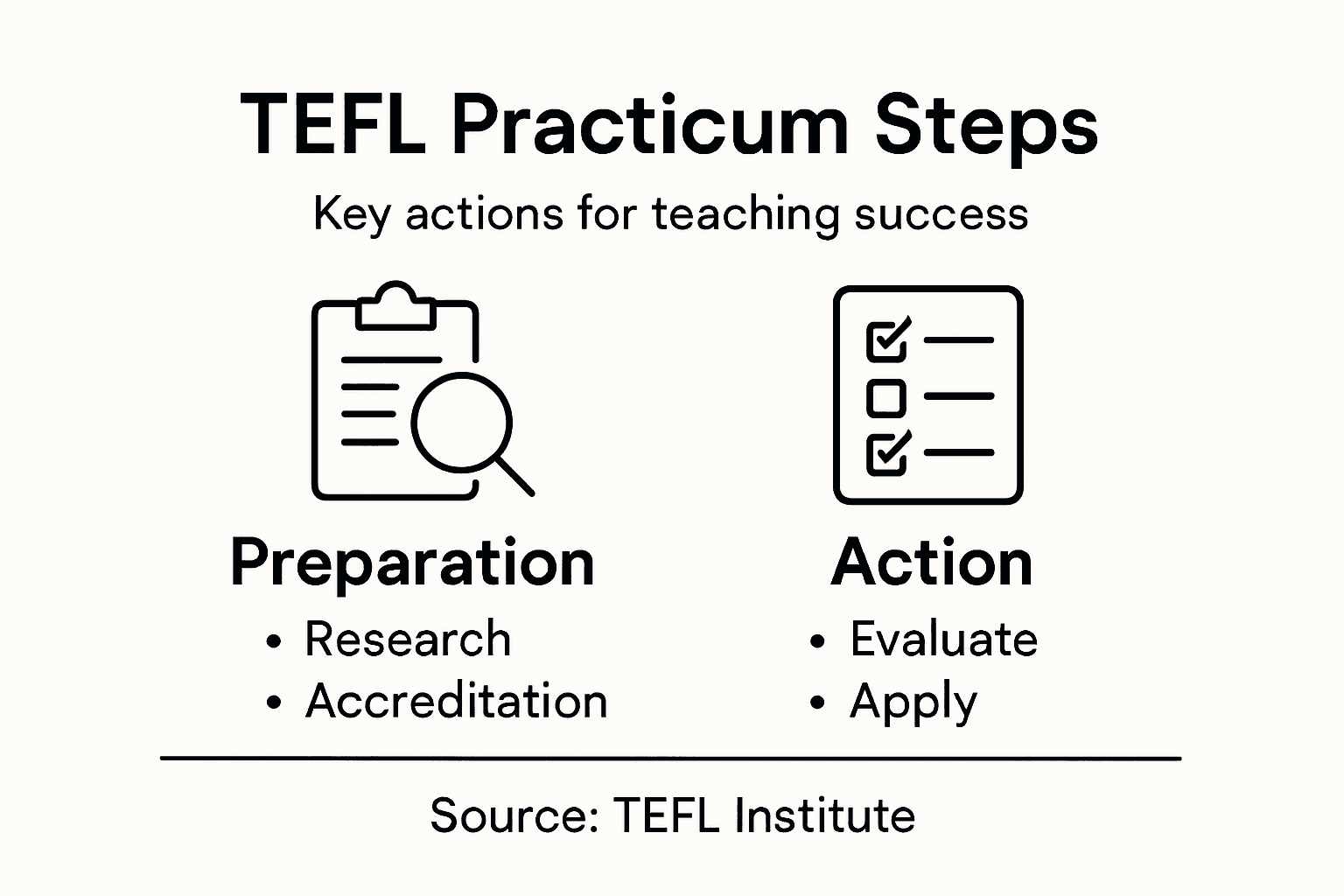
Infographic: TEFL practicum steps overview

Begin by understanding the flexibility built into each practicum option. Many programs allow in-person and online settings including tutoring, observing, or teaching ESL/EFL students in various contexts. Some programs require you to complete all hours in one setting while others permit mixing different delivery formats. If you’re currently working full-time and cannot take extended leave, an online tutoring option might work better than relocating for in-person classroom teaching. Conversely, if your goal is to experience the full intensity of managing a large classroom in an Asian school, pure online tutoring won’t give you that experience. Look at what combinations each provider allows. Can you complete part of your hours through one-on-one tutoring and part through classroom teaching? Can you observe experienced teachers to count toward your requirements? Understanding these flexibility options helps you find a program that fits your logistical constraints while still building relevant skills.

Examine the teaching contexts where each opportunity places you. Teaching private adult learners in a coffee shop in Bangkok differs completely from teaching teenagers in a structured secondary school or running conversation groups at a community center. Consider your long-term career vision. If you want to teach in international schools with structured curricula, you need practicum experience in formal educational settings with lesson planning, grading, and assessment components. If you aspire to online tutoring as your primary income, a virtual one-on-one practicum might serve you better than classroom teaching. Look at what student populations you’ll teach in each opportunity. Will you work with absolute beginners or intermediate learners? Children, teenagers, or adults? Professionals studying business English or general English learners? Each context develops different teaching competencies. A practicum teaching young learners builds skills in classroom management, visual aids, and simplified language that won’t translate directly to teaching advanced adult professionals. Match the student populations in each opportunity to your actual career aspirations.

Investigate the minimum teaching requirements for each opportunity because this impacts your development significantly. Some programs require that at least 6 of the required hours involve actual teaching or tutoring, while others demand much higher percentages of direct teaching time. Hours spent observing other teachers build your instructional awareness but don’t develop your own classroom presence and management skills. Hours spent tutoring one student one-on-one develop personalized teaching ability but not classroom management at scale. Make sure the practicum requires sufficient direct teaching hours in the context where you actually want to work. If a program allows you to fulfill most of your practicum requirements through observation rather than teaching, you’ll graduate without substantial hands-on experience. Ask providers to specify their teaching requirements explicitly and compare across options.

Consider the geographic locations and timing for each opportunity. Practicum opportunities offered through community centers and language schools in your home country differ fundamentally from placements in Southeast Asia or Latin America. Teaching abroad immerses you in the local culture and challenges you to adapt to different educational systems, student expectations, and classroom environments. Teaching at home offers convenience and lower costs but less cultural immersion. Some programs concentrate their placements in specific regions while others offer truly global options. If you have a particular country or region in mind for your teaching career, prioritize programs that operate there. Timing also matters. Some programs offer rolling practicum dates where you start whenever you’re ready, while others have fixed cohort start dates. Assess whether you need immediate flexibility or if you can work around structured timelines.

Tip Create a comparison matrix listing each practicum opportunity alongside its teaching context, student population, geographic location, minimum teaching hours, flexibility options, and cost, then score each against your specific career goals to identify which option best serves your long-term teaching vision.

Step 4: Apply for Your Preferred Practicum Placement

You’ve identified accredited providers and evaluated the opportunities available to you. Now comes the actionable phase where you submit applications and secure your placement. This step transforms your planning into concrete arrangements so you can begin your practicum teaching experience.

Start by understanding how the application process typically works. Many TEFL practitioners research local or online ESL opportunities, contact schools or organizations, and coordinate schedules to arrange their placements. Some providers handle placement coordination entirely for you, matching your profile with suitable schools or tutoring platforms. Others place responsibility on you to identify and contact teaching opportunities yourself, though they offer guidance and support. Clarify this distinction with your TEFL provider upfront. If the provider coordinates placements, you’ll complete their application process and they’ll connect you with available positions. If you’re responsible for finding your own placement, you’ll need to actively search for schools, language centers, or tutoring platforms that accept TEFL practitioners and align with your preferences. Neither approach is inherently better. Self-directed placement offers maximum control over your teaching context while provider-coordinated placement removes the burden of cold-calling schools and negotiating arrangements.

If you’re organizing your own placement, start by identifying specific schools or organizations in your target location. Research language schools in the city where you want to teach. Look at university English departments that might need conversation partners. Check community centers offering ESL classes. Identify online tutoring platforms that hire independent teachers. Create a targeted list rather than sending generic applications everywhere. Schools respond better to candidates who specifically mention their institution and explain why they want to teach there. When you contact schools directly, emphasize your TEFL certification, your teaching goals, and your availability. Be transparent about the hours you need to complete and any scheduling constraints. Many schools appreciate working with TEFL practitioners because they understand you’re serious about professional development. Your initial email or call should be professional but personable, showing genuine interest in their program and students. Follow up appropriately if you don’t hear back within a week.

If your provider coordinates placements for you, prepare a thorough profile highlighting your teaching preferences and availability. Specify the student populations you want to work with, your preferred geographic locations if options exist, and your schedule constraints. The more detailed information you provide, the better your provider can match you with suitable placements. Respond quickly to placement offers. Providers often work with multiple candidates and limited positions, so delays in your response might result in the placement going to someone else. Ask specific questions about the placement before committing to ensure it genuinely matches your needs. What are the actual classroom conditions? How many hours per week will you teach? What student proficiency levels will you encounter? What support does the school provide? These details matter significantly for your actual experience.

Once you’ve secured a placement, formalize the arrangement with written confirmation. Whether working with your provider or the school directly, get clarity on start dates, teaching schedules, location details, and any requirements you need to fulfill before beginning. Clarify payment if applicable, expectations around lesson planning, and who to contact with problems. Good documentation prevents misunderstandings later. Discuss with your provider how they’ll verify your teaching hours and provide feedback once you begin. Strong practicum experiences include regular check-ins with your TEFL provider, not just an initial placement and final certification.

Tip Before accepting any placement, request contact information for one to two previous TEFL practitioners who completed their practicum there, then reach out directly to ask about their actual experience with scheduling, student engagement, and support quality.

Step 5: Verify and Confirm Your Practicum Participation

You’ve completed your practicum teaching experience. Now you need to ensure that your participation is properly documented and verified so that your TEFL certification reflects this crucial practical component. This final step transforms your classroom hours into official credentials that employers worldwide will recognize.

Begin by understanding what verification actually requires. Verification requires detailed records of practicum hours, including types of activities completed. Your TEFL provider needs comprehensive documentation showing exactly how many hours you taught, what student populations you worked with, and what teaching contexts you experienced. This goes beyond simply reporting that you completed your hours. Keep detailed records throughout your practicum, not just at the end. Document the dates you taught, the number of students in each class, the proficiency levels you worked with, and the lesson topics you covered. If you taught multiple classes or worked with different student groups, track these separately. This documentation becomes your evidence when it comes time to verify completion. Many providers give you templates or forms to complete regularly during your practicum. Use them consistently. If your provider doesn’t offer templates, create your own spreadsheet tracking teaching dates, hours, student levels, and class sizes. This proactive approach prevents scrambling to reconstruct details weeks or months later when your memory has faded.

To help you document your practicum, here’s a summary of key verification materials:

Documentation Type Purpose Tips for Comprehensive Records
Hour Log Track teaching and activity duration Record dates, class sizes, student level
Supervisor Evaluation Validate teaching effectiveness Request detailed feedback, signed form
Lesson Topic List Showcase lesson variety Note themes and proficiency focus
Confirmation Letter Official proof of participation Obtain before leaving placement

Secure formal evaluations from your teaching supervisors or mentors while you’re still in contact with them. Supervisors or mentors may provide formal evaluations that validate both your participation and your teaching effectiveness. These evaluations carry significant weight because they come from people who directly observed your teaching. Ask your supervisor to complete an evaluation form provided by your TEFL provider, or request a letter addressing your teaching performance, classroom management skills, and professional conduct. Get this documentation before you finish your placement because supervisors are less responsive after you’ve left. The evaluation should confirm the number of hours you taught and comment on your teaching quality. This validation protects you and your provider by confirming that your practicum was legitimate and professionally conducted. If your placement was virtual or one-on-one tutoring, request written confirmation from your students or the platform coordinator verifying your teaching dates and hours.

Submit your practicum documentation to your TEFL provider according to their specific deadlines and protocols. Adhering to practicum guidelines, submission deadlines, and documentation protocols ensures that participation is confirmed and certification awarded. Different providers have different requirements. Some want all documentation submitted within 30 days of completing your practicum while others allow longer timelines. Some require original supervisor signatures while others accept digital copies. Ask your provider for their exact requirements in writing so you know precisely what documents to gather and how to submit them. Organize your materials before submitting. Compile your hour logs, supervisor evaluation, and any other required documentation into a single package with a cover sheet listing what you’re submitting. Submit everything together rather than piecemeal to avoid back and forth communication. Keep copies of everything you submit for your own records. After submission, confirm receipt and ask about your provider’s timeline for processing your practicum verification. Quality providers process practicum verification within two to four weeks and provide you with official confirmation once your participation has been verified. This confirmation becomes part of your permanent TEFL credential record and enables you to demonstrate completion to employers.

Follow up if you don’t receive confirmation within the stated timeframe. Practicum verification sometimes gets delayed if documentation is incomplete or if there are questions about your hours or supervisor evaluation. Don’t assume silence means approval. Contact your provider and ask for status updates. If issues arise, address them immediately. If your documentation is incomplete, submit the missing materials promptly. If your supervisor evaluation raises concerns, discuss these with your provider’s practicum coordinator. Quick action resolves problems that could otherwise delay your final certification.

Tip Request your practicum verification confirmation in writing immediately upon completion, then save this document in multiple secure locations since you’ll need to prove your practicum participation throughout your entire teaching career.

Take Control of Your TEFL Practicum Journey with Expert Support

Finding the right TEFL practicum can feel overwhelming with so many options for placements, accreditation, and teaching contexts to consider. The challenge lies in securing a practicum that offers real teaching experience, proper mentor support, and accreditation to boost your global teaching success. If you want to avoid uncertainty, gain confidence, and ensure your practicum fits your career goals and lifestyle, you need a trusted training partner who understands these critical requirements.

TEFL Institute empowers you to navigate these challenges effortlessly with a wide range of flexible online TEFL courses that include practicum components tailored to your needs. Whether you want to teach abroad in specific countries or online at your convenience, our accredited programs provide comprehensive practical teaching experience, expert mentor feedback, and trusted certification recognized worldwide.

https://teflinstitute.com

Start your journey now by exploring our carefully designed TEFL courses that prioritize practicum quality and career relevance. Don’t wait until uncertainty slows you down. Visit TEFL Institute today and secure the practicum experience that powers your teaching career forward. Your global classroom awaits.

Frequently Asked Questions

What are the key requirements for a TEFL practicum?

Most TEFL certification programs require between 6 and 120 hours of in-classroom teaching. Research the specific placement locations, teaching hours, and support provided by the programs you are considering to ensure they align with your teaching goals.

How do I identify accredited TEFL practicum providers?

Look for TEFL programs accredited by recognized bodies that verify programs meet educational standards. Check for accreditation badges on the provider’s website and ensure they have a solid reputation for placing teachers effectively.

What types of teaching contexts will I experience during my TEFL practicum?

Teaching contexts can vary greatly, including private language schools, international schools, or corporate training centers. Assess the student populations and class sizes you will teach to ensure they align with your long-term teaching goals.

How can I ensure my TEFL practicum is well-documented?

Keep comprehensive records throughout your practicum, including teaching hours, student demographics, and lesson topics. Ensure you have formal evaluations from your supervisors to validate your participation and effectiveness before you complete your placement.

What steps should I take to apply for my preferred TEFL practicum placement?

Begin by clarifying whether your program coordinates placements or if you need to find your own. If self-directed, create a list of specific schools or organizations to target, and personalize your communication to increase your chances of acceptance.

How can I verify that my practicum participation has been confirmed?

After completing your practicum, submit all required documentation to your TEFL provider according to their guidelines. Follow up if you don’t receive confirmation of your hours and evaluation within the specified timeframe to address any potential issues promptly.


    0
      0
      Your Cart
      Your cart is emptyBrowse Courses