

 United Kingdom (UK)
 United States (US)
 Canada
 South Africa
 India
India Australia
 New Zealand
 China
China Russia
 Germany
 France
 Spain
Spain Netherlands
 Vietnam
 United Arab Emirates
 Italy
Italy Poland
 Thailand
 Türkiye










 Algeria



Understand English Proficiency Levels for Effective TEFL
Understand English Proficiency Levels for Effective TEFL

TL;DR:
- Proficiency levels like A1 to C2 define specific learner abilities across listening, reading, speaking, and writing.
- Understanding these levels helps teachers tailor instruction and align with international exams and goals.
- Effective TEFL teaching adapts methodologies and activities based on learners’ CEFR levels to maximize progress.
Many TEFL trainees encounter terms like A2, B1, or C1 and feel uncertain about what those labels actually mean in a classroom setting. These designations are not arbitrary. They represent internationally recognized frameworks that define exactly what a learner can do with the English language at any given stage. Understanding proficiency levels is foundational to planning lessons, selecting materials, setting realistic goals, and communicating with institutions and employers. This guide explains the major frameworks, breaks down each CEFR level in practical terms, maps levels to major exams, and offers concrete teaching strategies so you can walk into any classroom with confidence.
Table of Contents
- What are English language proficiency levels?
- Breakdown of the six CEFR English proficiency levels
- Exam equivalencies: CEFR vs IELTS, TOEFL, and more
- Adapting teaching strategies for each proficiency level
- A fresh perspective: Why understanding proficiency levels is TEFL’s secret superpower
- Boost your teaching career with the right TEFL certification
- Frequently asked questions
Key Takeaways
| Point | Details |
|---|---|
| Six proficiency levels | The CEFR framework breaks down English ability into six clear levels from beginner (A1) to mastery (C2). |
| Global standards matter | Standardized levels like CEFR make it easy for teachers and students to understand goals and progress. |
| Tailored teaching is crucial | Effective English teaching means adapting your methods to each learner’s current proficiency. |
| Exam scores versus levels | Major English exams map to CEFR bands, helping set realistic learning and teaching benchmarks. |
| Strategic differentiation | Tapping into each level’s unique skills creates engaging, motivating classrooms and better outcomes. |
What are English language proficiency levels?
English language proficiency levels are standardized benchmarks that describe a learner’s ability to use English across four core skills: listening, reading, speaking, and writing. Rather than relying on subjective impressions, teachers and institutions use these frameworks to place students accurately, track progress, and align curriculum design.
Three major frameworks exist globally. The Common European Framework of Reference for Languages, known as the CEFR, is the most widely adopted system for TEFL contexts. The American Council on the Teaching of Foreign Languages, or ACTFL, is used primarily in North America and covers multiple languages. The Canadian Language Benchmarks, or CLB, serve language assessment in Canada. For TEFL teachers working internationally, the CEFR global standard is the preferred reference, particularly across Europe, Asia, and the Middle East.
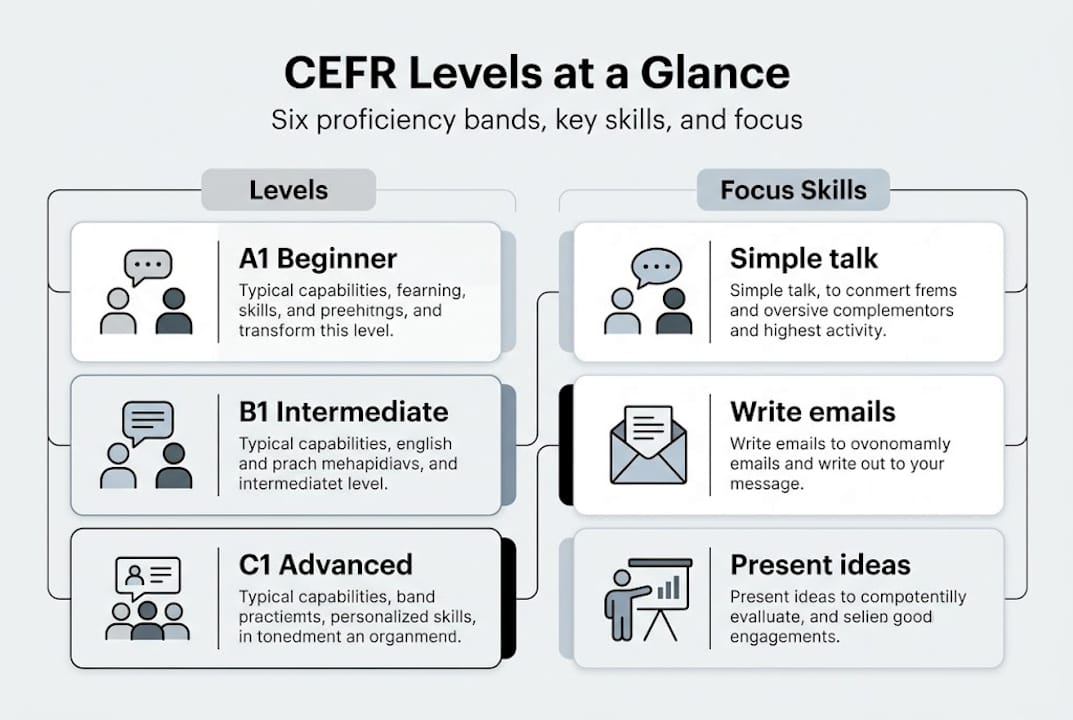
The CEFR defines six levels: A1 (Beginner), A2 (Elementary), B1 (Intermediate), B2 (Upper Intermediate), C1 (Advanced), and C2 (Proficiency). Each level comes with detailed descriptors that specify what a learner can realistically accomplish.
| Framework | Levels | Primary Region | Common TEFL Use |
|---|---|---|---|
| CEFR | A1 to C2 | Global | Yes, widely used |
| ACTFL | Novice to Distinguished | North America | Limited in TEFL |
| CLB | 1 to 12 | Canada | Canada-specific |
Using a standardized framework benefits everyone involved in language education. Key advantages include:
- Consistent communication between teachers, students, and institutions
- Clearer lesson planning and material selection
- Accurate student placement and progress tracking
- Alignment with international exams and employer requirements
- Easier curriculum design across multi-level programs
The CEFR was developed by the Council of Europe and has been adopted by educational institutions, employers, and testing bodies across more than 40 countries, making it the de facto global standard for English proficiency assessment.
For a broader look at how proficiency bands shape classroom practice, the ESL levels explained guide offers additional context for TEFL teachers at all stages.
Breakdown of the six CEFR English proficiency levels
Each CEFR level carries specific descriptors that define what a learner can do, not just what they know. This skills-based approach is what makes the framework practical for classroom teachers. The CEFR A1 to C2 levels each include detailed benchmarks for listening, reading, speaking, and writing.

| CEFR Level | Label | Est. Vocabulary | Core Ability |
|---|---|---|---|
| A1 | Beginner | 500 to 1,000 words | Basic greetings, simple phrases |
| A2 | Elementary | 1,000 to 2,000 words | Familiar topics, short exchanges |
| B1 | Intermediate | 2,000 to 3,500 words | Travel, work, routine communication |
| B2 | Upper Intermediate | 3,500 to 5,000 words | Complex topics, clear arguments |
| C1 | Advanced | 5,000 to 8,000 words | Fluent, flexible, nuanced use |
| C2 | Proficiency | 8,000 or more words | Near-native, precise expression |
The CEFR can-do descriptors specify what learners can accomplish across all four skills at each level. Here is how those descriptors translate into realistic classroom scenarios:
- A1: A learner can introduce themselves, ask for a name, and understand very slow, clear speech on familiar topics.
- A2: A learner can handle short social exchanges, describe their background, and read simple notices or menus.
- B1: A learner can manage most travel situations, write personal letters, and follow the main points of a news broadcast.
- B2: A learner can interact fluently with native speakers, produce clear detailed text, and understand complex arguments.
- C1: A learner can express ideas spontaneously, use language flexibly for academic or professional purposes, and understand implicit meaning.
- C2: A learner can understand virtually everything heard or read and summarize information from different sources with precision.
Pro Tip: Build your lesson objectives directly from can-do statements. Instead of writing “students will learn vocabulary,” write “students will be able to describe their daily routine using present simple.” This shift makes your lessons measurable and level-appropriate.
Understanding the range of learner types at each level helps teachers prepare more targeted instruction. Resources on types of English learners and specific guidance on teaching English to beginners are particularly useful for teachers working with A1 and A2 groups.
Exam equivalencies: CEFR vs IELTS, TOEFL, and more
For many learners, proficiency levels are not abstract. They connect directly to exam scores that determine university admission, visa eligibility, or job opportunities. As a TEFL teacher, understanding these equivalencies helps you set meaningful targets and communicate clearly with students about their goals.
The most common exams teachers encounter are IELTS and TOEFL. According to established exam concordance data, an IELTS score of 5.5 to 6.5 corresponds to B2, while TOEFL scores of 72 to 94 fall in the same band. An IELTS score of 7.0 to 8.0 maps to C1, equivalent to TOEFL scores of 95 to 114.
| CEFR Level | IELTS Score | TOEFL iBT Score | Cambridge Exam |
|---|---|---|---|
| A2 | 3.0 to 3.5 | Below 42 | Key (KET) |
| B1 | 4.0 to 5.0 | 42 to 71 | Preliminary (PET) |
| B2 | 5.5 to 6.5 | 72 to 94 | First (FCE) |
| C1 | 7.0 to 8.0 | 95 to 114 | Advanced (CAE) |
| C2 | 8.5 to 9.0 | 115 or above | Proficiency (CPE) |
B2 is the minimum standard required by most universities and a significant number of professional employers for English-medium study or work environments. This makes B2 a critical teaching milestone for many learners.
Typical learner goals and the level or exam score they require:
- Studying at an English-medium university: B2 minimum (IELTS 6.0 or above)
- Applying for skilled migration visas in English-speaking countries: B1 to B2
- Professional certification in healthcare or law: C1 or above
- Academic research or postgraduate study: C1 to C2
- Basic workplace communication in English: B1
Teaching toward exam goals requires specific preparation techniques. Practical tips for exam preparation can help teachers structure lessons that build both proficiency and test-taking skills. For learners preparing independently, external English test preparation resources provide additional structured support.
Adapting teaching strategies for each proficiency level
Knowing a student’s CEFR level is only useful if it shapes what happens in the classroom. Effective TEFL teachers adjust their methodology, materials, and activities based on where learners currently sit on the proficiency scale.
Core methodologies by proficiency band:
- A1 to A2 (Beginner to Elementary): Total Physical Response (TPR), visual aids, repetition drills, and controlled practice activities work best. Learners at this stage need high-frequency vocabulary and clear, predictable structures. Avoid overwhelming them with complex grammar explanations.
- B1 to B2 (Intermediate to Upper Intermediate): Task-Based Language Teaching (TBLT) becomes highly effective. Authentic materials such as news clips, podcasts, and real-world texts engage learners and expose them to natural language patterns. Role plays and structured discussions build fluency.
- C1 to C2 (Advanced to Proficiency): Debates, academic writing tasks, critical analysis of texts, and independent research projects challenge learners at this level. The focus shifts from accuracy to precision and stylistic range.
Research confirms that teaching methodologies vary by level, with TPR and visuals suited to beginners, TBLT for intermediate learners, and debate-style tasks for advanced students.
Classroom activities matched to proficiency level:
- A1 to A2: Flashcard vocabulary games, picture-based storytelling, simple fill-in-the-blank exercises
- B1 to B2: Information gap activities, listening comprehension with authentic audio, structured writing tasks
- C1 to C2: Seminar-style discussions, peer editing of extended writing, analysis of complex literary or academic texts
Pro Tip: In mixed-level classes, use scaffolding to differentiate tasks. Assign the same topic to all learners but vary the output expectations. A1 learners write three sentences; B2 learners write a paragraph; C1 learners write a structured argument. This approach keeps the class cohesive while meeting individual needs.
For further guidance, ESL teaching methodologies and engaging class activities provide practical frameworks. Teachers working with younger students will also find teaching young learners especially relevant when adapting strategies for lower proficiency bands. Aligning lessons to CEFR can-do statements is one of the most reliable methods for maintaining level-appropriate instruction across all groups.
A fresh perspective: Why understanding proficiency levels is TEFL’s secret superpower
Most teachers treat proficiency levels as an administrative tool. They use them for placement tests, report cards, and exam preparation. That is a narrow view of what these frameworks can actually do.
The real power of CEFR levels lies in how they shape motivation and goal-setting. A learner who understands they are at B1 and can see exactly what B2 looks like has a concrete, achievable target. That clarity reduces anxiety and increases persistence. Teachers who communicate this openly build more confident classrooms.
There is also a qualitative difference between levels that numbers alone do not capture. The gap between B2 and C1 is not just about vocabulary size. It is about cognitive flexibility, the ability to handle ambiguity, and the capacity to communicate nuance. Recognizing this distinction helps teachers design instruction that develops thinking skills alongside language skills.
The guide on proficiency levels reinforces this point: when teachers use can-do descriptors as learning objectives rather than just assessment criteria, students develop a stronger sense of progress and ownership over their learning. That shift in framing is what separates effective TEFL instruction from rote language drilling.
Boost your teaching career with the right TEFL certification
Understanding proficiency levels is one of the most practical skills a TEFL teacher can develop, and the right certification program ensures you are trained to apply this knowledge from day one.

The TEFL Institute offers structured courses designed to equip teachers with the frameworks, methodologies, and classroom strategies covered in this guide. Whether you are just starting out or looking to specialize, options such as TEFL courses in Newcastle and flexible course extensions allow you to build expertise at your own pace. Investing in quality TEFL training means you can confidently teach learners at every proficiency level, from A1 beginners to C2 advanced students, anywhere in the world.
Frequently asked questions
What is the difference between CEFR and ACTFL?
The CEFR is the global standard used across Europe and most TEFL contexts, while ACTFL is primarily used in North America and applies to multiple languages, not just English.
How many words does a C2 English speaker know?
A C2 user typically knows more than 8,000 words in English, enabling precise and nuanced expression across virtually all contexts.
What CEFR level do most universities or employers require?
Most universities and professional employers require at least B2 level for academic study or work in English-medium environments.
Is it possible to skip levels when learning English?
While rare, learners with high exposure or relevant prior knowledge may progress through levels more quickly, though there is no universal timeline for advancement between bands.
Recommended
- ESL levels explained: Complete guide for teachers | TEFL Institute
- Tefl Levels: Complete Guide to Differences | TEFL Institute
- TEFL Levels Explained: Choosing The Right Certification | TEFL Institute
- Complete Guide to TEFL Levels Explained Clearly | TEFL Institute
- ENS im DLR-Test: Englisch-Skills für den Test gezielt vorbereiten