

 United Kingdom (UK)
 United States (US)
 Canada
 South Africa
 India
India Australia
 New Zealand
 China
China Russia
 Germany
 France
 Spain
Spain Netherlands
 Vietnam
 United Arab Emirates
 Italy
Italy Poland
 Thailand
 Türkiye









 Algeria


TEFL job market in 2025: global trends and opportunities
TEFL job market in 2025: global trends and opportunities

TL;DR:
- The TEFL job market in 2025 remains competitive but not oversaturated, with growth in online, hybrid, and regional roles. Having recognized credentials, digital skills, and regional knowledge significantly boosts employment prospects. Teachers should carefully verify job offers to avoid scams and focus on building regional expertise for long-term success.
The TEFL job market in 2025 is larger and more varied than many teachers expect. Common fears about oversaturation or declining demand simply do not reflect current hiring data. According to the State of TEFL 2026 report, demand for qualified teachers continues to grow. Online teaching booming post-pandemic, with freelance and part-time roles paying between $8 and $40 per hour, while hybrid models are gaining traction alongside traditional in-country positions. Whether you are a first-time applicant or a seasoned educator reassessing your career path, understanding how the market has shifted gives you a clear advantage. This article breaks down the key trends, top destinations, essential qualifications, and practical safeguards every TEFL job seeker needs in 2025.
Table of Contents
- Understanding the 2025 TEFL job landscape
- Top destinations and regions for TEFL jobs
- Key qualifications and skills TEFL employers want
- Spotting scams and landing reliable TEFL positions
- Our perspective: What most TEFL job seekers still overlook in 2025
- Next steps: Building your TEFL career
- Frequently asked questions
Key Takeaways
| Point | Details |
|---|---|
| Market evolving rapidly | Online, hybrid, and global in-country roles are all growing but demand new skills from teachers. |
| Preparation beats native status | Qualified and digitally skilled candidates have the best chance to land top TEFL jobs in 2025. |
| Regional strengths vary | Asia offers stability, the Middle East offers high savings, and online TEFL boasts maximum flexibility. |
| Vigilance against scams | Thoroughly research job offers and avoid paying upfront fees to secure safe TEFL employment. |
Understanding the 2025 TEFL job landscape
The TEFL employment landscape has changed significantly since 2020. The pandemic accelerated the adoption of online instruction, and that shift has not reversed. Platforms that once supplemented classroom teaching now operate as primary employers for thousands of English teachers worldwide. What began as an emergency measure has become a permanent feature of the industry.
Role diversity is one of the most notable developments. Teachers today can choose from:
- Freelance online tutoring on platforms such as iTalki or Preply, offering schedule flexibility but requiring self-promotion
- Part-time contracted roles with language schools or corporate training providers, often blending online and in-person delivery
- Full-time in-country positions at public schools, private academies, or universities, typically offering housing stipends and visa sponsorship
- Hybrid roles combining remote instruction with occasional face-to-face sessions, increasingly common in East Asia and parts of Europe
Pay varies considerably depending on location, employer type, and your credentials. Online roles range from $8 to $40 per hour, while in-country positions in the Middle East can offer monthly salaries exceeding $3,500 with benefits included. Southeast Asia positions tend to offer lower base pay but lower living costs, making savings potential more nuanced than raw salary figures suggest.
The 2025 TEFL trends point to continued growth in both online and in-country hiring. Governments in several Asian and Latin American countries have expanded English language programs in public education, creating structured demand for qualified teachers. Corporate English training, particularly in tech and finance sectors, is also generating new full-time and contract opportunities that did not exist at scale five years ago.
Key stat: Online English teaching platforms reported consistent year-over-year user growth through 2024, and projections for 2025 indicate that demand from adult learners in non-English-speaking countries remains strong.
The market is not saturated. It is, however, more competitive at the entry level than it was a decade ago, which means preparation matters more than ever.
Top destinations and regions for TEFL jobs
With a clearer picture of job types and pay ranges, it helps to examine where opportunities are most concentrated and what each region realistically offers.
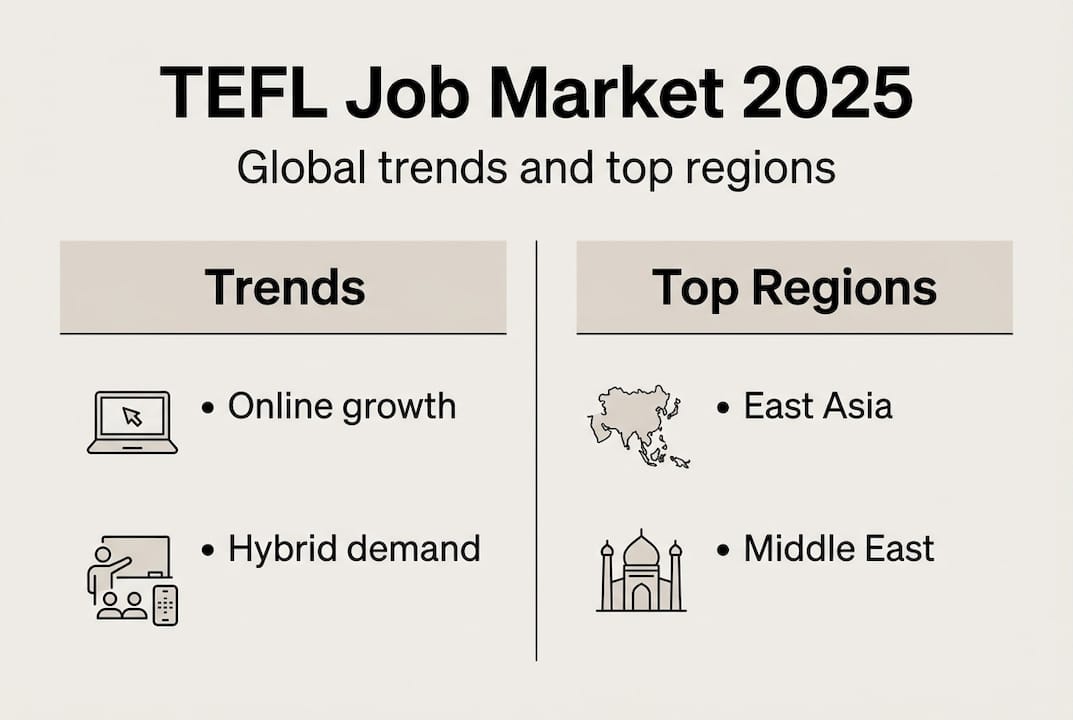
Asia offers high job volume and stability, the Middle East offers high savings potential, and online teaching provides maximum flexibility regardless of location. Each path suits a different professional profile.
Asia remains the largest single market for TEFL teachers. South Korea, Japan, Vietnam, and Thailand all maintain active hiring pipelines. South Korea’s EPIK program and Japan’s JET program are government-backed, offering structured contracts with clear benefits. Vietnam and Thailand attract teachers seeking lower barriers to entry, though salary expectations should be calibrated accordingly.

The Middle East is the top region for teachers prioritizing financial savings. Countries such as the UAE, Saudi Arabia, Qatar, and Kuwait offer tax-free salaries, furnished accommodation, and return flights. TEFL Middle East certification requirements in this region are typically more rigorous, and employers often prefer candidates with a bachelor’s degree and a recognized TEFL qualification.
Southeast Asia presents an interesting edge case. Post-tutoring ban in China redirected many experienced teachers toward Vietnam, Cambodia, and Indonesia, increasing competition but also expanding the overall market. Non-degree holders may find more accessible pathways here than in Northeast Asia or the Middle East.
| Region | Job volume | Salary range | Key requirement |
|---|---|---|---|
| East Asia | High | $1,500–$2,800/month | Degree + TEFL cert |
| Middle East | Moderate | $2,500–$4,000/month | Degree + accredited TEFL |
| Southeast Asia | High | $800–$1,800/month | TEFL cert (degree varies) |
| Online/remote | Very high | $8–$40/hour | TEFL cert + digital skills |
The US adult ESL sector is also worth noting. Demand for English instruction in adult education centers, community colleges, and workforce development programs has grown steadily, offering local opportunities for teachers who prefer to remain stateside.
Pro Tip: Research visa requirements and work permit regulations for your target country before applying. Some destinations require specific documentation before a job offer can be formalized, and delays in this process can cost you a position.
For a broader overview, the 2025 TEFL destinations guide provides country-by-country breakdowns with current hiring conditions.
Key qualifications and skills TEFL employers want
Once you have identified your target region, the next priority is ensuring your professional profile meets employer expectations. The market favors prepared candidates with credentials and digital skills, and this is not a minor distinction. It directly affects whether you receive interview invitations or get passed over.
Here are the qualifications and skills that consistently appear in employer requirements:
Hiring windows close while you scroll.
Deadlines, salaries and visa notes for teaching jobs worldwide, checked against official sources and sent free every two weeks.
Get on the Wire- Accredited TEFL certification (minimum 120 hours): This is the baseline for most positions. Accreditation from a recognized body adds credibility that unaccredited certificates cannot provide.
- Bachelor’s degree: Required for government programs in East Asia and most Middle East positions. Some online platforms and Southeast Asian schools hire without one, but a degree significantly widens your options.
- Digital platform proficiency: Familiarity with Zoom, Google Classroom, Moodle, or platform-specific tools is now expected for any online or hybrid role. Teachers who cannot navigate these tools efficiently are at a disadvantage.
- Cultural competence: The ability to adapt communication style, manage diverse classroom dynamics, and demonstrate respect for local customs is valued by employers across all regions.
- Lesson planning and assessment skills: Employers increasingly expect candidates to demonstrate structured planning ability, not just conversational fluency in English.
“Preparedness and adaptability now outpace native-speaker status as the primary markers of a strong TEFL candidate.”
Soft skills are not secondary considerations. Adaptability, patience, and the ability to give constructive feedback are qualities that experienced hiring managers actively assess during interviews and demo lessons.
Pro Tip: If you are building your TEFL digital skills, consider completing a course that incorporates online teaching methodology. Employers can tell the difference between a candidate who has studied digital instruction and one who has simply used video calling software.
For teachers targeting the Middle East specifically, reviewing the TEFL in-demand credentials for that region will clarify which certifications carry the most weight with local employers.
Spotting scams and landing reliable TEFL positions
Credentials and regional knowledge matter, but protecting yourself from fraudulent job offers is equally important. TEFL job scams are a documented and persistent problem, and new teachers are disproportionately targeted.
Scams are common in TEFL hiring. The most reliable safeguard is a combination of research, skepticism, and verification before committing to anything.
Common red flags include:
- Upfront fees: Legitimate employers do not charge teachers for placement, visa processing, or training before employment begins
- Vague contract terms: Any offer that lacks specific salary figures, working hours, or job location details warrants further scrutiny
- Pressure to decide quickly: Fraudulent employers often create artificial urgency to prevent candidates from researching the offer
- Unverifiable school or company: If a school has no online presence, no reviews, and no verifiable address, treat the offer with caution
- Communication only via personal email: Established schools use institutional email addresses
| Verification step | Why it matters |
|---|---|
| Search school name + “reviews” | Reveals past teacher experiences |
| Check provider accreditation | Confirms legitimacy of the hiring institution |
| Request a signed contract before travel | Protects against bait-and-switch offers |
| Verify visa sponsorship process | Confirms the employer has legal hiring capacity |
| Contact previous employees directly | Provides unfiltered insight into working conditions |
For detailed guidance on spotting TEFL scams and learning how to avoid bad employers, TEFL Institute maintains dedicated resources that walk through specific case studies and verification methods.
Pro Tip: Use TEFL job credibility tools to understand how employers verify your credentials. Knowing this process from the employer’s perspective helps you present your qualifications more effectively and identify which employers take accreditation seriously.
Once you have verified an offer, request a written contract before making any travel or financial commitments. A legitimate employer will not object to this request.
Our perspective: What most TEFL job seekers still overlook in 2025
The oversaturation narrative persists largely because it is easy to mistake a more competitive market for a closed one. These are not the same thing. The volume of TEFL job listings has not declined. What has changed is that employers now have more tools to evaluate candidates, and teachers who rely solely on native-speaker status or a basic certificate are finding it harder to stand out.
The real competitive edge in 2025 is the combination of traditional teaching competence with current digital fluency and cross-cultural adaptability. Preparedness and adaptability outpace native-speaker status for long-term job security. This is a structural shift, not a temporary trend.
Region-hopping in pursuit of the highest salary is another pattern that tends to backfire. Teachers who move frequently without building regional expertise or professional networks often find themselves starting over repeatedly, which limits career progression. Depth of experience in one market frequently yields better long-term outcomes than breadth across many.
Understanding the hybrid TEFL advantages of combining in-person and online instruction also positions teachers for a wider range of roles, which is increasingly relevant as employers design flexible delivery models.
Next steps: Building your TEFL career
The 2025 TEFL job market rewards teachers who arrive prepared. Understanding regional demand, holding recognized credentials, and developing digital teaching skills are the factors that separate successful applicants from those who struggle to secure reliable positions.
TEFL Institute offers a range of certification programs designed to match current employer expectations, from foundational courses to advanced diplomas with specializations in online instruction and regional teaching contexts. Whether you are preparing for your first role abroad or updating your qualifications for a more competitive market, TEFL course extensions and specialized programs provide structured pathways to stronger candidacy. For teachers in the UK, TEFL courses in Newcastle offer a practical, in-person option with full accreditation.
Frequently asked questions
Is the TEFL job market oversaturated in 2025?
The market is not oversaturated, but it is more competitive at the entry level. Candidates with credentials and digital skills consistently secure positions faster than those without them.
What qualifications do I need for the best TEFL jobs in 2025?
Most competitive roles require an accredited TEFL certificate of at least 120 hours, and many employers in Asia and the Middle East also expect a bachelor’s degree. Digital skills are increasingly expected for any online or hybrid position.
Which regions are best for TEFL jobs in 2025?
Asia offers job volume and stability, the Middle East offers the highest savings potential through tax-free salaries and benefits packages, and the online sector provides maximum flexibility for teachers who prefer remote work.
How can I identify and avoid TEFL job scams?
Verify employer reviews, avoid any offer that requests upfront fees, and confirm provider accreditation before signing anything. Scam jobs are common in TEFL hiring, and due diligence at the research stage is the most effective protection.
Recommended
TEFL Institute guides

Thailand
Visas and teaching licences
Japan
JET, ALT and eikaiwa pay
Cambodia
Pay, requirements and visas
Germany
Freelance work and pay
South Korea
EPIK, hagwons and pay