

 United Kingdom (UK)
 United States (US)
 Canada
 South Africa
 India
 Australia
 New Zealand
 China
 Russia
 Germany
 France
 Spain
 Netherlands
 Vietnam
 United Arab Emirates
 Italy
 Poland
 Thailand
 Türkiye








 Algeria


What Is the CBEST?
The CBEST is the California Basic Educational Skills Test: a three-section exam in reading, mathematics and writing that candidates can take to meet California’s Basic Skills Requirement before they are issued a teaching or services credential. It is one of nine accepted options, not the only one. The California Commission on Teacher Credentialing sets the rules.
That last sentence is the part most pages leave out, and it is the reason this page exists. Search for the CBEST and you will find test-prep sites, a registration portal and a Wikipedia entry. What you will not easily find is a straight answer to the question Google itself keeps surfacing: is the CBEST still required in California? The answer is no, not on its own, and it has not been for some years. Below is what the test actually contains, how it is scored, what it costs, the eight other routes California accepts, and one thing the CBEST does not measure at all — teaching English learners — together with where California puts that instead.
Who has to meet California’s Basic Skills Requirement
The requirement bites at five points. According to the official CBEST programme site, you must satisfy the Basic Skills Requirement if any of the following applies:
- You are applying for a first teaching credential or services credential.
- You are applying for the issuance or renewal of an Emergency Permit, such as a 30-Day Substitute Teaching Permit (other than vocational), Provisional Internship Permit, or Short-Term Staff Permit, unless you already hold a valid California teaching credential for which a baccalaureate degree is required.
- You are seeking employment in California.
- You are applying for admission to a CTC-accredited teacher preparation programme, unless you already hold a valid California teaching credential for which a baccalaureate degree is required.
- You are applying for admission to a CTC-accredited services credential programme.
Two things follow from that list. First, this is a gate on entry, not a licence in itself. Second, it catches substitute teaching permits as well as full credentials, which is why so many people meet the CBEST long before they have decided what subject they want to teach.
The nine ways to meet the Basic Skills Requirement

The programme site states that “Based on California Education Code Section 44252 and 44252.6 candidates must complete the Basic Skills Requirement through one of nine available options”. The CBEST is option one. Here are all nine, in the order the Commission lists them.
- Pass the CBEST.
- Pass a basic skills examination from another state.
- Pass all three subtests of CSET: Multiple Subjects plus the CSET: Writing Skills.
- California State University Early Assessment Program. Demonstrate proficiency on both the English and Mathematics sections, showing status as “College Ready” or “Exempt” in each section.
- California State University placement examinations. Demonstrate proficiency on both the English Placement Test (EPT) and the Entry-Level Mathematics Test (ELM).
- SAT. A score of at least 500 on the SAT English exam and a score of at least 550 on the SAT mathematics exam.
- ACT. A score of at least 22 on the ACT English exam and a score of at least 23 on the ACT mathematics exam.
- Advanced Placement. A score of 3 or higher on the College Board AP English and a score of 3 or higher on the AP Calculus or the AP Statistics exam.
- Approved college coursework, verified by a Commission-approved educator preparation programme. This is the newest route and it gets its own section below.
If you already hold qualifying SAT, ACT or AP scores from school, you may have met California’s Basic Skills Requirement years ago without knowing it. Checking that before you pay to sit anything is the cheapest half hour in the whole process.
The coursework option, and the law behind it

Option nine arrived through the Education Trailer Bill AB 130 (Chap. 44, Stats. 2021), signed on 9 June 2021, with the detail set out in the Commission’s Coded Correspondence 21–05 dated 22 July 2021. The provision allows Commission-approved educator preparation programmes to verify that a candidate has demonstrated basic skills proficiency through qualifying college coursework rather than a test.
The conditions the programme site sets out are specific:
- The coursework must come from a regionally accredited institution.
- A grade of “B” or better is required, although a B− is acceptable.
- At least three semester units, or the quarter-unit equivalent, taken for academic credit and degree applicable. Coursework applicable to an associate degree qualifies.
- Reading can be met by critical thinking, literature, philosophy, reading, rhetoric or textual analysis.
- Writing can be met by composition, English, rhetoric, written communications or writing.
- Mathematics can be met by algebra, geometry, mathematics, quantitative reasoning or statistics.
What does not count is equally specific: professional development or continuing education units, in-service training or workshops, and any course whose credits do not count toward a degree.
The practical effect is that a graduate who took a composition course, a statistics course and a literature course, and passed each with a B, may be able to have a preparation programme verify the requirement without sitting an exam at all. The decision sits with the programme, not with the candidate.
What is on the CBEST
If you do take the test, it has three sections and you must pass all three to pass the CBEST.
- Reading — 50 multiple-choice questions.
- Mathematics — 50 multiple-choice questions.
- Writing — two essays. “One topic asks you to analyze a given situation or statement” and “the other asks you to write about a specified personal experience”.
On timing, the programme site gives 1 hour and 30 minutes each for the Reading and Writing sections and 2 hours for Mathematics, with 15 additional minutes provided to complete a nondisclosure agreement and tutorial. Sections are administered in separate testing sessions, and the computer-based registration material refers to a four-hour test session.
How the CBEST is scored
Scores on each of the three sections range from 20 to 80. The passing score on each CBEST section is a scaled score of 41. There is also a total-score route: a total score of 123 for all three sections. That matters in practice, because it means a strong result in one section can carry a slightly weak result in another, provided the total clears 123 and no section falls too far.
What the CBEST costs and who administers it
The registration fee is $30 per section. The Commission on Teacher Credentialing has contracted with the Evaluation Systems group of Pearson for the development, administration and scoring of the CBEST, and registration, payment and appointments are handled on the official CBEST website. Test centre appointments are offered on a first-come, first-served basis, so availability varies by location and time of year.
CBEST at a glance: the dated data block
Data checked: 28 October 2026. Every figure below is taken from the official CBEST programme site operated in conjunction with the California Commission on Teacher Credentialing.
| Full name | California Basic Educational Skills Test |
| Purpose | One of nine options for meeting California’s Basic Skills Requirement |
| Statutory basis | California Education Code sections 44252 and 44252.6 |
| Sections | Reading, Mathematics, Writing — all three must be passed |
| Reading format | 50 multiple-choice questions |
| Mathematics format | 50 multiple-choice questions |
| Writing format | 2 essays: one analytical, one on a specified personal experience |
| Time, Reading | 1 hour 30 minutes |
| Time, Writing | 1 hour 30 minutes |
| Time, Mathematics | 2 hours |
| Additional time | 15 minutes for nondisclosure agreement and tutorial |
| Score scale | 20 to 80 for each of the three sections |
| Passing score, per section | Scaled score of 41 |
| Passing score, total route | 123 across all three sections |
| Fee | $30 per section |
| Administered by | Evaluation Systems group of Pearson, under contract to the Commission on Teacher Credentialing |
| Newest alternative route | Coursework option added by AB 130 (Chap. 44, Stats. 2021), signed 9 June 2021 |
How to cite this block: The TEFL Institute, “What Is the CBEST? California’s Basic Educational Skills Test Explained”, data checked 28 October 2026, drawn from the official CBEST programme site and the Commission on Teacher Credentialing. Fees, passing scores and the list of accepted options are set by the Commission and the California Legislature and can be amended, so confirm current figures at source before relying on them. This page is information, not legal or credentialing advice.
What the CBEST does not test: English learners
Here is the gap that matters to anyone whose interest is English language teaching. The CBEST tests your own basic reading, mathematics and writing. It says nothing whatever about whether you can teach a child who is still learning English — and in California that is not a marginal question. California handles it through an entirely separate instrument, and most CBEST pages never mention it.
That instrument is the California Teacher of English Learners (CTEL) Examination. Passing all three CTEL subtests within the last ten years is one of the ways to satisfy the requirements for an English Learner Authorization or CLAD Certificate. That authorisation covers two named services: “Specifically Designed Academic Instruction in English” and “Instruction for English Language Development”. The CTEL Examination may also be used to satisfy a portion of the requirements for a Bilingual Authorization, whose scope remains the same as for the former BCLAD Certificate.
Every TEFL opening, salary and deadline that matters.
In your inbox every two weeks. Free, no spam, unsubscribe any time.
Teacher pay by country
New TEFL openings
Programme and visa dates
What is actually on the CTEL examination
The subtest titles are the giveaway. Read them as a syllabus rather than as exam codes and they describe, almost line for line, the content of a serious English language teaching qualification.
- CTEL 1: Language and Language Development (test code 031) — 50 multiple-choice questions and 1 essay, 1 hour 45 minutes, fee $98.
- CTEL 2: Assessment and Instruction (test code 032) — 60 multiple-choice questions and 2 essays, 2 hours 45 minutes, fee $147.
- CTEL 3: Culture and Inclusion (test code 033) — 40 multiple-choice questions and 1 essay, 1 hour 30 minutes, fee $99.
All three subtests can be taken in a single six-hour computer-based session for $260. The passing score is 220 per subtest.
Language and language development. Assessment and instruction. Culture and inclusion. That is a language teaching course with a state exam wrapped around it. The point is not that one qualification substitutes for the other — it does not — but that California’s own rules locate English language teaching knowledge somewhere specific, and it is not the CBEST.
CBEST, CTEL and a TEFL certificate: what each one is for
These three get confused constantly in job adverts and forum threads, so it is worth separating them plainly.
- The CBEST is a basic skills gate for entry to California credentialing. It is about your own literacy and numeracy. It authorises nothing by itself.
- The CTEL Examination is one route toward an English Learner Authorization or CLAD Certificate, which is what lets a credentialed California teacher provide the two named English learner services.
- A TEFL certificate, including an Ofqual-regulated Level 5 qualification, trains you to teach English as a foreign language. It is the recognised currency for teaching abroad, teaching online, and private language school work.
A TEFL certificate is not one of the nine Basic Skills Requirement options, and it is not a California teaching credential. We sell TEFL courses, so it would be convenient to imply otherwise, and we are not going to. What a TEFL qualification does give you — genuinely — is the body of knowledge the CTEL subtest titles describe: how language is acquired, how to assess a language learner, and how culture shapes what happens in the room. If your destination is a California public school classroom, the credential route is the one that matters. If it is anywhere else in the world, or online, TEFL is the one that matters. Our guide to TEFL qualifications and terminology sets out where each qualification sits.
How the CBEST compares with other US teacher tests
The United States licenses teachers state by state, so the test you meet depends entirely on where you intend to teach. A quick orientation:
- CBEST — California, basic skills, one of nine accepted options.
- Praxis — the ETS test family used by many states for basic skills, subject knowledge and teaching practice. What the Praxis tests cover.
- edTPA — a performance assessment of planning, instruction and assessment, submitted from a classroom placement rather than sat as an exam. How edTPA works.
- FTCE and NYSTCE — Florida’s and New York’s own certification examination families.
And separately from all of those sit the English language proficiency tests taken by students, not teachers — Texas uses TELPAS, California uses the ELPAC. If you end up teaching English learners in a US public school, you will meet one of those every spring.
What this page does not tell you
Stated plainly, rather than left as a quiet omission:
- No test dates or registration deadlines. These change through the year and are published on the official CBEST site.
- No CSET detail. Option three refers to CSET: Multiple Subjects and CSET: Writing Skills; their content, fees and passing scores were not verified for this page.
- No retake rules or score-reporting timelines.
- Nothing about whether a specific course will be accepted under the coursework option. That judgement belongs to the Commission-approved preparation programme, not to any website.
- Nothing about individual districts, whose hiring practices sit on top of state rules.
- No full list of routes to an English Learner Authorization. The CTEL Examination is one way to satisfy the requirements; it is not presented here as the only one.
Where a figure could not be sourced to an official page, it is not in this article and it is not in the structured data behind it.
Official sources
Every link below was opened and checked on 28 October 2026.
- About the CBEST and the nine Basic Skills Requirement options — California Educator Credentialing Examinations.
- CBEST test format, timing, fees and passing scores.
- About the CTEL Examination and the English Learner Authorization.
- CTEL subtests, codes, timing and fees.
- Pearson VUE: CBEST administration.
Frequently asked questions
Is the CBEST still required in California?
Not by itself. California requires the Basic Skills Requirement, and the CBEST is one of nine accepted ways to meet it. The others include a basic skills test from another state, CSET: Multiple Subjects with CSET: Writing Skills, CSU Early Assessment Program or placement test results, qualifying SAT, ACT or AP scores, and approved college coursework verified by a Commission-approved educator preparation programme.
What is on the CBEST?
Three sections. Reading has 50 multiple-choice questions. Mathematics has 50 multiple-choice questions. Writing has two essays: one asks you to analyse a given situation or statement, the other to write about a specified personal experience. You must pass all three sections to pass the CBEST.
What is a passing score on the CBEST?
The passing score on each CBEST section is a scaled score of 41, on a scale that runs from 20 to 80 for each of the three sections. There is also a total-score route: a total score of 123 for all three sections.
How much does the CBEST cost?
The registration fee is 30 US dollars per section. Fees are set by the testing programme and can change, so check the current figure on the official CBEST site before you register.
Does a TEFL certificate let me skip the CBEST?
No. A TEFL certificate is not one of the nine options for California’s Basic Skills Requirement, and it is not a California teaching credential. TEFL qualifies you to teach English as a foreign language abroad, online or in the private sector. The CBEST is a gate on the route to a California public school classroom.
Which California test is actually about teaching English learners?
Not the CBEST. The California Teacher of English Learners (CTEL) Examination is the one built around English learners. Passing all three CTEL subtests within the last ten years is one way to satisfy the requirements for an English Learner Authorization or CLAD Certificate, which covers Specifically Designed Academic Instruction in English and Instruction for English Language Development.
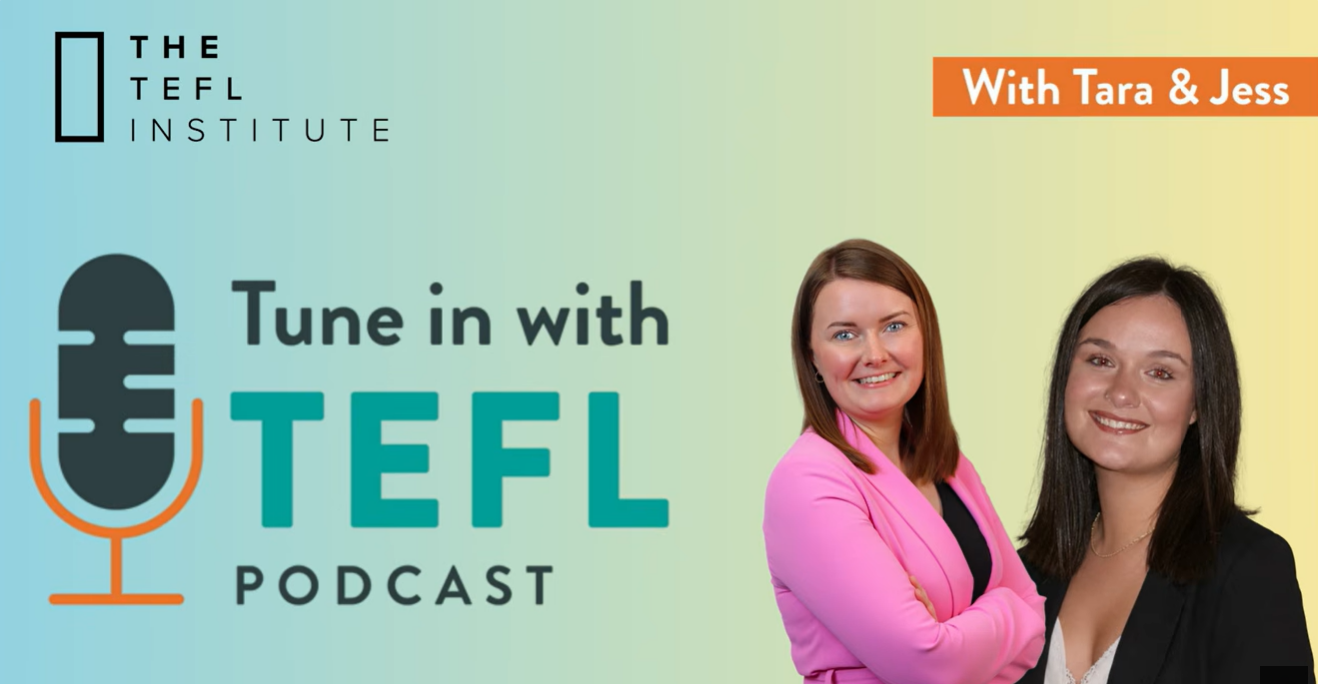
Tara and Jess talk through different TEFL and EFL topics, from finding work abroad to life in the classroom.
FAQs
Questions students ask us
Not by itself. California requires the Basic Skills Requirement, and the CBEST is one of nine accepted ways to meet it. The others include a basic skills test from another state, CSET: Multiple Subjects with CSET: Writing Skills, CSU Early Assessment Program or placement test results, qualifying SAT, ACT or AP scores, and approved college coursework verified by a Commission-approved educator preparation programme.
Three sections. Reading has 50 multiple-choice questions. Mathematics has 50 multiple-choice questions. Writing has two essays: one asks you to analyse a given situation or statement, the other to write about a specified personal experience. You must pass all three sections to pass the CBEST.
The passing score on each CBEST section is a scaled score of 41, on a scale that runs from 20 to 80 for each of the three sections. There is also a total-score route: a total score of 123 for all three sections.
The registration fee is 30 US dollars per section. Fees are set by the testing programme and can change, so check the current figure on the official CBEST site before you register.
No. A TEFL certificate is not one of the nine options for California’s Basic Skills Requirement, and it is not a California teaching credential. TEFL qualifies you to teach English as a foreign language abroad, online or in the private sector. The CBEST is a gate on the route to a California public school classroom.
Not the CBEST. The California Teacher of English Learners (CTEL) Examination is the one built around English learners. Passing all three CTEL subtests within the last ten years is one way to satisfy the requirements for an English Learner Authorization or CLAD Certificate, which covers Specifically Designed Academic Instruction in English and Instruction for English Language Development.
