

 United Kingdom (UK)
 United States (US)
 Canada
 South Africa
 India
India Australia
 New Zealand
 China
China Russia
 Germany
 France
 Spain
Spain Netherlands
 Vietnam
 United Arab Emirates
 Italy
Italy Poland
 Thailand
 Türkiye










 Algeria



Step-by-step TEFL application guide for success in 2026
Step-by-step TEFL application guide for success in 2026

TL;DR:
- Proper preparation of documents and understanding of requirements are essential for a smooth TEFL application.
- The application process involves creating a profile, submitting documents, and possibly completing assessments or interviews.
- Attention to detail and genuine motivation in personal statements and references increase chances of application success.
Starting a TEFL application can feel overwhelming, especially when you are unsure which documents to gather, which provider to trust, or what the process actually looks like from start to finish. Many aspiring teachers stall at this first stage, not because they lack the motivation, but because the path forward is unclear. This guide removes that uncertainty. Each section below walks you through a specific stage of the TEFL certification application process, from understanding the basics to knowing what to do once your application is submitted. Follow these steps carefully, and you will have a clear, manageable roadmap to certification.
Table of Contents
- Understanding TEFL: What you need before you start
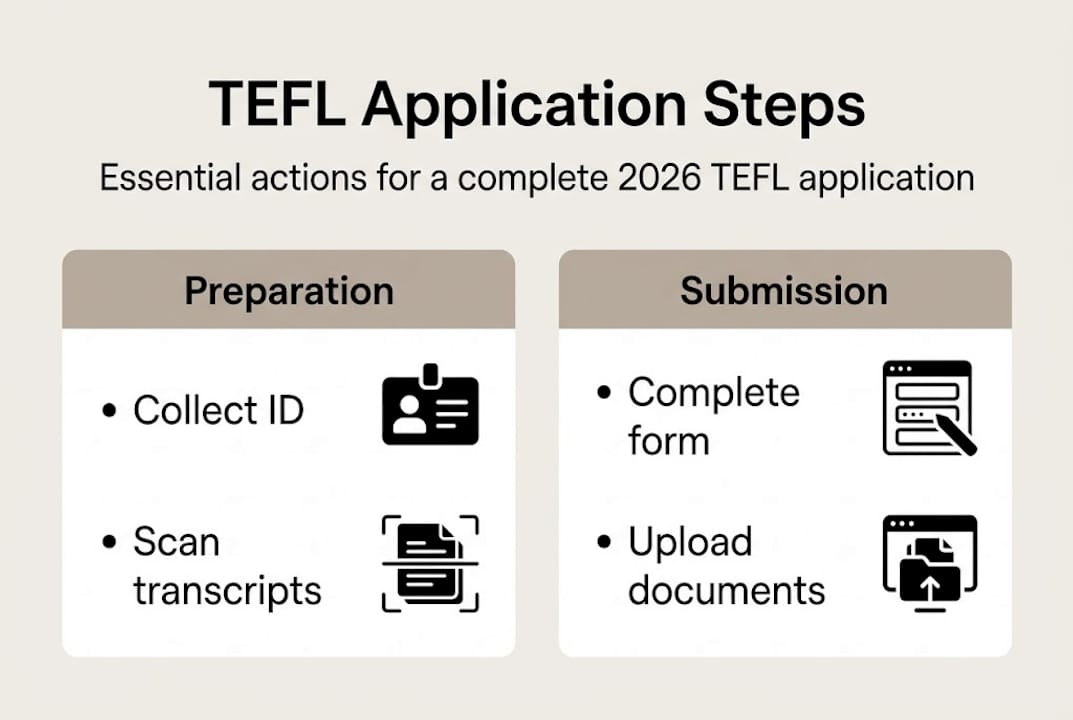
- Step 1: Preparing your application materials
- Step 2: Completing the TEFL application process
- Step 3: What to do after submitting your TEFL application
- Our hard-won lessons for TEFL application success
- Ready to launch your TEFL journey?
- Frequently asked questions
Key Takeaways
| Point | Details |
|---|---|
| Have all documents ready | Gather and scan all requirements before starting your TEFL application to save time. |
| Follow each step | Completing the process in order minimizes errors and application delays. |
| Expect a short wait | After submission, most applications are processed in 2-4 weeks, so check for updates regularly. |
| Choose accredited providers | Picking a reputable TEFL course boosts your job search after certification. |
Understanding TEFL: What you need before you start
TEFL stands for Teaching English as a Foreign Language. It is a professional certification that qualifies individuals to teach English to non-native speakers, either abroad or through online platforms. The certification is recognized by schools, language academies, and employers in over 100 countries, making it one of the most portable credentials in international education.
Understanding what TEFL certification covers is the first step before you apply. Programs typically include modules on lesson planning, grammar instruction, classroom management, and language acquisition theory. Many also include a practicum component where you practice teaching in a real or simulated environment.
Who should apply? TEFL certification is suitable for recent graduates, career changers, experienced educators expanding their qualifications, and anyone who wants to work in the global English language teaching market. The outcomes are tangible: certified teachers gain access to a broader job market, higher salary bands, and the ability to teach legally in countries that require formal credentials.
Before you begin any application, confirm you meet the general prerequisites:
- Minimum age of 18 years
- High school diploma or equivalent (a bachelor’s degree is preferred by many employers)
- Native or near-native English proficiency
- Access to a computer and stable internet connection for online programs
- No criminal record (required for visa and employment clearance in most countries)
Most providers will also ask you to submit supporting documents during the application. Here is what you should have ready:
| Document | Purpose |
|---|---|
| Government-issued ID or passport | Identity verification |
| Academic transcripts or diploma | Education level confirmation |
| Proof of English proficiency | Required for non-native speakers |
| Recent passport-style photo | Profile or enrollment record |
| Professional or academic references | Character and background verification |
Pro Tip: Before committing to any provider, verify their accreditation status. Choosing accredited TEFL programs ensures your certification is recognized by legitimate employers worldwide and protects you from investing time and money in a credential that may not be accepted.
Once you understand the value and expectations for TEFL, it is time to gather your resources.
Step 1: Preparing your application materials
With your prerequisites understood, the next step is organizing what you will need to complete your application. Preparation at this stage saves significant time later and reduces the risk of delays caused by missing or incomplete documentation.
Follow this order when assembling your materials:
- Resume or CV — Update your resume to reflect any teaching experience, tutoring, volunteer work, or relevant education. Even informal experience counts.
- Government-issued ID or passport — Ensure your documents are current and not expiring within six months.
- Academic transcripts or degree certificate — Request official copies from your institution if you do not already have them. This can take several weeks, so start early.
- Proof of English proficiency — Non-native speakers may need to provide IELTS or TOEFL scores. Check the specific requirements of your chosen provider.
- Personal statement or application essay — Most providers ask why you want to teach English and what your career goals are. Write a focused, specific response rather than a generic one.
- Professional or academic references — Identify two to three referees who can speak to your reliability, communication skills, or academic background. Notify them in advance.
For international applicants, there are a few additional considerations. If your academic documents are not in English, you will likely need certified translations. Some providers also require notarized copies of your degree or ID. Confirm these requirements directly with the provider before submission.

Non-native English speakers should pay particular attention to the proficiency requirement. This is not designed to exclude qualified candidates. It is a quality standard that ensures students receive consistent, high-level instruction. Gather your language scores early, as they are often the most time-consuming element to obtain.
The complete TEFL application checklist available through TEFL Institute outlines the exact materials required at each stage, which helps you avoid overlooking critical items.
Pro Tip: Scan and save digital copies of every document before you submit anything. Most applications in 2026 are processed entirely online, and having organized digital files means you can resubmit or share materials quickly if anything is requested again.
Step 2: Completing the TEFL application process
After assembling your materials, it is time to start the formal application itself. The detailed TEFL application steps follow a predictable sequence regardless of the provider you choose, though small variations exist between online and in-person formats.
Here is how the process typically unfolds:
- Create an account or profile on the provider’s platform. This is your application portal and where all communications will be sent.
- Complete the enrollment form with your personal details, educational background, and teaching goals. Be accurate and thorough.
- Upload your supporting documents in the formats specified. Common formats include PDF, JPEG, and PNG. Confirm file size limits before uploading.
- Complete any required assessment or interview — Some providers include a short written assessment or video interview to confirm your English level and suitability for the program.
- Review your application before final submission. Check every field and every uploaded file for accuracy.
- Submit payment — Application fees vary by provider and program level. Confirm what is included in the fee and whether it is refundable.
Submitting complete and accurate documents from the start is the single most effective way to avoid processing delays. Incomplete applications are frequently returned, which can push your start date back by weeks.
If you are deciding between application formats, this comparison may help:
| Feature | Online application | In-person application |
|---|---|---|
| Processing time | 2 to 5 business days | 5 to 10 business days |
| Flexibility | High — apply from anywhere | Limited — location dependent |
| Document submission | Digital uploads | Physical copies required |
| Interview format | Video or written | Face-to-face |
| Cost | Often lower | May include travel costs |
For those looking at teaching English abroad application tips, note that some countries require in-person document verification as part of the visa process, even if the TEFL application itself is online.
Step 3: What to do after submitting your TEFL application
Your application is submitted. Now, let’s focus on what happens next and how to maximize this stage. Many applicants make the mistake of going passive after submission, but this period is actually productive time if used correctly.
Typical waiting periods for TEFL applications range from a few days to several weeks, depending on the provider’s enrollment cycle and the completeness of your submission. Most providers will send an acknowledgment email within 48 hours of receiving your application. If you do not receive one, check your spam folder before contacting support.
Here is what to focus on while you wait:
- Check your email daily — Providers may request additional documents or clarification. A slow response on your end can delay the process significantly.
- Prepare for a potential interview — Review your personal statement and be ready to discuss your teaching goals and English language background.
- Gather any outstanding materials — If you are still waiting on transcripts or reference letters, follow up with those contacts now.
- Research job markets — Start identifying regions or countries where you want to teach. Look at salary expectations, visa requirements, and demand for English teachers.
- Avoid common TEFL application mistakes — Review your submitted materials one more time and note anything you would improve for future applications.
Pro Tip: Use this waiting period to begin reviewing English grammar fundamentals or drafting basic lesson plan frameworks. When your course begins, you will have a head start, and your early assignments will reflect stronger preparation.
Once you receive confirmation of acceptance, review the next steps from your provider carefully. This typically includes course access instructions, orientation materials, and a schedule for any live or in-person components. Resources on finding TEFL jobs after certification can also help you plan your job search timeline in parallel with your studies.
Our hard-won lessons for TEFL application success
Following the steps above will get your application submitted. But what separates a successful application from one that stalls or gets rejected is rarely a missing document. It is almost always a lack of specificity and attention to detail.
Many applicants write personal statements that are vague and interchangeable. Phrases like “I have always loved languages” or “I want to make a difference” appear in thousands of applications. Providers reviewing large volumes of submissions notice immediately when a statement lacks genuine motivation or concrete goals. Be specific about where you want to teach, why you chose that region, and what you bring to a classroom.
Another overlooked factor is the quality of your references. A reference from someone who knows you well and can speak to specific qualities is far more valuable than one from a senior contact who barely remembers working with you.
We also see applicants rush the process because they want to start quickly. That urgency often leads to errors that cause delays. Taking two extra days to review everything before submission is always worth it. The value of accredited TEFL courses is only realized when your application reflects the same standard of care the certification itself demands. Slow down, check your work, and ask someone you trust to review your personal statement before you submit.
Ready to launch your TEFL journey?
If you have worked through this guide and feel ready to take the next step, TEFL Institute offers structured support to help you move from application to certification with confidence.
Whether you are looking for TEFL courses in Newcastle with a hands-on practicum component, need to explore TEFL course extensions to build on existing qualifications, or simply want to browse the full range of options available, the TEFL Institute platform provides clear guidance at every stage. Our team is available to answer questions about specific programs, accreditation, and job placement support so you can make an informed decision before you enroll.
Frequently asked questions
Can I apply for TEFL certification if I’m not a native English speaker?
Yes, many TEFL providers accept non-native speakers who can demonstrate advanced English proficiency through recognized tests such as IELTS or TOEFL, along with meeting the standard application requirements.
How long does the TEFL application process typically take?
Most applications are processed within two to four weeks, though the timeline can vary based on the provider’s enrollment schedule and whether your submitted documents are complete.
What if I don’t meet all the requirements yet?
Many providers allow you to address gaps before finalizing enrollment. Reviewing the prerequisite requirements for TEFL in advance gives you time to obtain missing documents or contact the provider about alternative pathways.
Is an accredited TEFL course necessary for job placement?
While not universally mandatory, accredited TEFL providers are strongly preferred by schools and language academies worldwide, and accreditation can significantly improve your employment prospects in competitive markets.
Recommended
- TEFL Application Process: Step-by-Step Guide to Success | TEFL Institute
- How to Plan for TEFL Abroad: Step-by-Step Success Guide | TEFL Institute
- The Complete Guide to TEFL Certification in 2026: Everything You Need to Know Before You Start | TEFL Institute
- TEFL Job Application Workflow: Complete Guide | TEFL Institute
