

 United Kingdom (UK)
 United States (US)
 Canada
 South Africa
 India
India Australia
 New Zealand
 China
China Russia
 Germany
 France
 Spain
Spain Netherlands
 Vietnam
 United Arab Emirates
 Italy
Italy Poland
 Thailand
 Türkiye









 Algeria


Academic English Explained: Essential Guide for TEFL Teachers
Academic English Explained: Essential Guide for TEFL Teachers

TL;DR:
- Academic English is a specialized register used in higher education for informing, arguing, and synthesizing.
- Key features include formality, specialized vocabulary, nominalization, hedging, and complex sentence structures.
- Teaching effectively involves needs analysis, genre-based methods, corpus data, and focusing on academic discourse as a social practice.
Teaching English is not a single, uniform task. A TEFL teacher preparing students for university lectures, research papers, or academic presentations is working in an entirely different register than one teaching conversational phrases for travel or business small talk. Academic English carries its own vocabulary systems, structural rules, and communication conventions that require specific instructional approaches. This guide defines Academic English clearly, breaks down its core features, explains the difference between general and discipline-specific variations, and provides practical strategies that TEFL teachers can apply directly in their classrooms.
Table of Contents
- Defining Academic English: Foundations and functions
- Key features that set Academic English apart
- EGAP vs ESAP: Understanding general and specific variations
- Teaching strategies for Academic English success
- What most guides miss about Academic English and TEFL
- Take your teaching of Academic English further
- Frequently asked questions
Key Takeaways
| Point | Details |
|---|---|
| Academic English defined | Academic English is formal, objective, and built for complex communication in academic settings. |
| Distinctive features | It uses specialized vocabulary, complex grammar, and a focus on structure and clarity. |
| EGAP vs ESAP | General and subject-specific versions require differing strategies and awareness. |
| Teaching success factors | Needs analysis, genre pedagogy, authentic materials, and focused feedback are key to learner results. |
| Non-native challenges | Teachers should scaffold tasks and vocabulary to address grammar, hedging, and synthesis struggles. |
Defining Academic English: Foundations and functions
Academic English is a specific variety of the language, not simply “formal English” with longer words. As what is EAP explains, Academic English, also known as English for Academic Purposes (EAP), is the language and associated practices required for study or work in English-medium higher education. This definition matters because it anchors the concept to a specific context: universities, research environments, and academic publishing.
The practical scope of Academic English is wide. It covers the language used in:
- University lectures and seminars
- Research papers and journal articles
- Academic essays and dissertations
- Lab reports and technical documentation
- Conference presentations and academic posters
Each of these contexts shares a set of core communicative functions. Students and researchers use Academic English to inform audiences about findings, to argue positions with evidence, to summarize existing literature, and to synthesize multiple sources into a coherent line of reasoning. These functions are more demanding than those found in everyday English because they require writers and speakers to manage both content and language simultaneously.
“Academic English, also known as English for Academic Purposes (EAP), is the language and associated practices required for study or work in English-medium higher education.” This definition places EAP firmly in the context of higher education, not general communication.
For TEFL teachers, understanding this foundation changes the instructional goal. The aim is not to make students speak more formally. The aim is to equip them with the tools to participate fully in academic discourse communities.
Key features that set Academic English apart
Now that we understand what Academic English is, the specific characteristics that make it unique deserve close attention. These features are not arbitrary stylistic preferences. They reflect the epistemic standards of academic communities, meaning how knowledge is constructed, shared, and evaluated.
Academic English features include formality, objectivity, precision, complex grammatical structures, specialized vocabulary covering roughly 10% of all word tokens in academic texts, phrasal complexity through embedded noun phrases rather than clausal subordination, hedging, nominalization, and a linear structure focused on informing rather than entertaining. Language forms such as essays and reports, discourse structures including register and text organization, and functions like arguing and summarizing all operate according to discipline-specific mechanics that differ substantially from everyday communication.
Breaking these features down makes them more teachable:
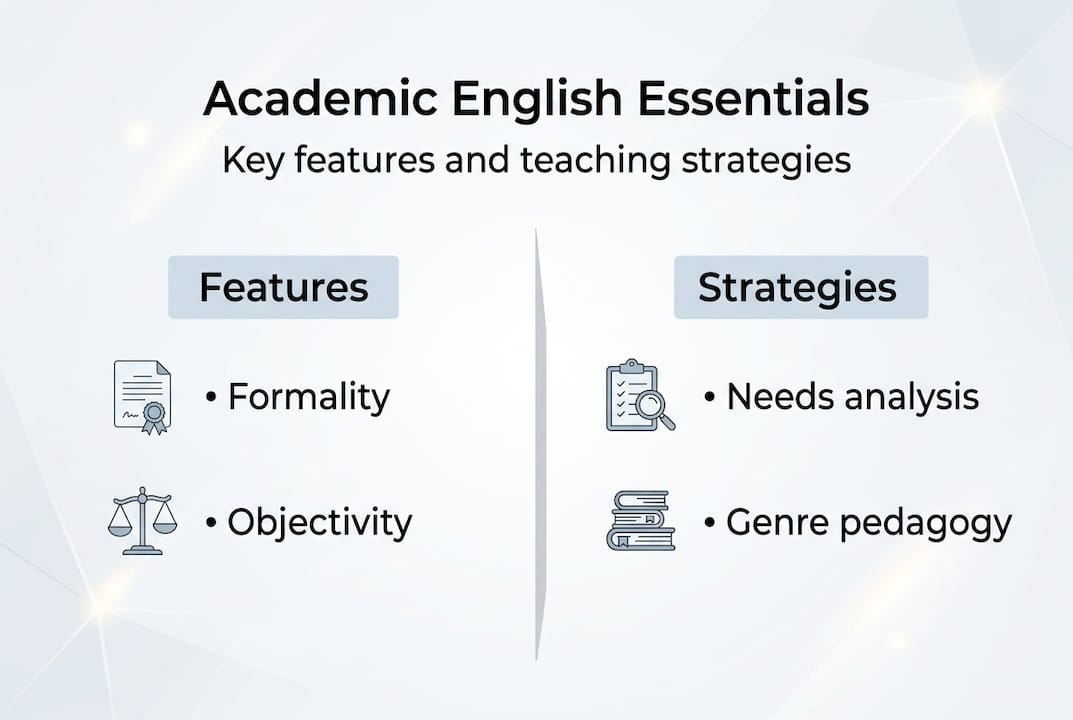
- Formality and objectivity: Academic writing avoids personal opinions stated without evidence. First-person constructions are used carefully, and passive voice appears frequently to foreground information over the author.
- Specialized vocabulary: The Academic Word List (AWL) contains approximately 570 word families that appear frequently across academic disciplines. Beyond the AWL, each discipline carries its own technical lexicon.
- Nominalization: This is the process of converting verbs or adjectives into noun forms. For example, “analyze” becomes “analysis,” and “develop” becomes “development.” Nominalization allows writers to compress complex ideas efficiently.
- Hedging: Academic writers use hedging language such as “may,” “suggests,” “appears to,” and “it is possible that” to indicate the degree of certainty in a claim. Overconfident statements are viewed as academically inappropriate.
- Phrasal complexity: Rather than linking ideas through multiple subordinate clauses, academic writing often packs information into dense noun phrases. This is a significant challenge for learners accustomed to spoken English structures.
Pro Tip: When teaching academic vocabulary, always present new terms in context rather than as isolated word lists. Use authentic sentences from journal abstracts or textbook introductions so that students see how terms function within actual academic discourse.
| Feature | Academic English | General English |
|---|---|---|
| Formality | High; avoids colloquialisms | Variable; colloquialisms accepted |
| Vocabulary | Specialized; AWL + discipline terms | Common, everyday word choices |
| Sentence structure | Complex noun phrases; nominalization | Shorter clauses; more conversational |
| Hedging | Frequent and intentional | Rare or absent |
| Purpose | Informing, arguing, synthesizing | Communicating, socializing |
Understanding these contrasts helps teachers identify where their students are likely to struggle. Most learners arrive with a solid foundation in conversational English but have little exposure to nominalization or hedging, making those areas priority targets for instruction.
EGAP vs ESAP: Understanding general and specific variations
Understanding the core features sets the stage for teachers to recognize that not all Academic English is identical. Two main branches define the landscape: EGAP (English for General Academic Purposes) and ESAP (English for Specific Academic Purposes).
EGAP targets the common academic skills and language features shared across all university disciplines. It covers essay structure, academic reading strategies, general research writing conventions, and the broad academic vocabulary that cuts across subjects. ESAP, by contrast, focuses on the language and genres specific to a particular field. A student in nursing requires very different discourse skills from one studying philosophy or mechanical engineering. As academic English research confirms, the science disciplines tend to favor complex noun groups in writing, while humanities texts show greater clause complexity, reflecting distinct disciplinary cultures.

The vocabulary benchmarks in this area are telling. Research shows that 4,000 to 8,000 word families plus proper nouns and marginal items provide 96 to 98% coverage of academic spoken English. Lexical sophistication and complex nominals per sentence are among the strongest predictors of writing quality at university level. This tells teachers that vocabulary depth matters more than sheer breadth. Quality of word knowledge, including understanding how a word inflects, collocates, and functions in different genres, outweighs simple memorization of definitions.
The EGAP versus ESAP distinction also highlights a competitive relationship between lexical diversity and phrasal complexity. As students develop more sophisticated noun phrase constructions, the range of vocabulary they use in a single text may appear narrower, simply because dense noun phrases repeat key technical terms. Teachers should understand this pattern rather than penalizing it.
Non-native speakers face specific challenges that TEFL teachers must account for:
- Grammatical complexity, particularly in long sentence constructions with multiple embedded clauses
- Hedging, which can conflict with cultural norms that favor direct, assertive communication
- Source synthesis, where learners must integrate multiple viewpoints without plagiarizing or oversimplifying
- Disciplinary register switching, especially for students moving between EGAP and ESAP contexts
Teachers who are non-native English speakers themselves often have direct personal experience with these challenges, which can be a significant pedagogical advantage. Formal training through TEFL certification for non-native speakers can help these educators structure their empathy into systematic instructional design.
Hiring windows close while you scroll.
Deadlines, salaries and visa notes for teaching jobs worldwide, checked against official sources and sent free every two weeks.
Get on the WireTeaching strategies for Academic English success
Now that you can distinguish the types of Academic English, the focus shifts to how to teach these skills effectively to diverse learners. The field of EAP has developed a substantial body of evidence-based methodologies that go well beyond traditional grammar instruction.
EAP methodologies include needs analysis, genre-based pedagogy, corpus-informed instruction, task-based learning, skills-based approaches covering reading, writing, listening, and speaking, learner-centered strategies, blended learning, explicit strategy instruction, and approaches that use input flooding with a focus on form. Promoting learning strategies such as note-taking and self-evaluation also plays a central role. Furthermore, technology integration and multimodal approaches are increasingly promising, though they require adequate teacher training to be implemented effectively.
Here is a structured approach that TEFL teachers can apply in any Academic English context:
- Conduct a needs analysis first. Before selecting materials or methods, identify what academic tasks your students actually need to perform. A graduate student preparing for a thesis defense has very different needs from an undergraduate writing their first literature review.
- Use genre-based pedagogy. Teach students the structural and linguistic conventions of specific academic genres: argumentative essays, research abstracts, case study reports. Students learn not just what to write but why certain choices are conventional in academic culture.
- Incorporate corpus-informed instruction. Online corpora such as the Corpus of Contemporary American English (COCA) allow students to see how academic words actually function in real texts. This builds accuracy and contextual understanding.
- Apply task-based learning. Design tasks that mirror real academic activities: summarizing a journal article, presenting a claim with supporting evidence, writing an annotated bibliography. Authentic tasks build transferable skills.
- Scaffold writing and feedback strategically. Rather than correcting finished drafts, guide students through planning, drafting, and revising stages. Focus feedback on one or two features at a time, such as hedging or nominalization, rather than attempting to address every error simultaneously.
Pro Tip: Use a data table to track which academic skills each student is developing. Monitoring progress in vocabulary, hedging language, and sentence complexity separately helps you identify where individual learners need the most support and plan targeted instruction accordingly.
| Teaching approach | Core focus | Best used for |
|---|---|---|
| Genre-based pedagogy | Text structure and conventions | Writing essays, reports, abstracts |
| Corpus-informed instruction | Authentic language patterns | Vocabulary and collocations |
| Task-based learning | Real academic tasks | Integrated skills practice |
| Scaffolded feedback | Staged writing development | Drafting and revision cycles |
| Blended learning | Digital and in-class integration | Flexible course delivery |
Building diverse classroom activities around these approaches keeps instruction varied and effective. Teachers can also draw on a wide range of ESL classroom activities that adapt well to an academic language context. When planning your overall course design, reviewing established ESL teaching methodologies provides a solid theoretical foundation for making informed pedagogical choices.
What most guides miss about Academic English and TEFL
Most articles about Academic English focus almost entirely on vocabulary lists and sentence structures. That is useful, but it stops short of the more consequential insight: Academic English is a social practice, not just a linguistic register. Students are not simply learning new words and grammar rules. They are learning how to participate in a community that has its own norms for evidence, citation, argument, and authority.
The danger of treating Academic English as merely “formal English” is that it produces students who can construct grammatically correct sentences but still fail to meet academic standards. A student might use impeccable formal vocabulary while making unsupported claims or failing to acknowledge counterarguments. These are not vocabulary failures. They are failures of academic discourse understanding.
There is also a persistent tendency in EAP instruction to overload students with structural complexity before they have internalized purpose. Teachers sometimes spend weeks on nominalization drills without connecting the form to the communicative function it serves. Nominalization compresses information and creates objectivity. When students understand why it exists, they learn to use it more naturally.
For TEFL teachers, the evidence consistently points toward prioritizing needs analysis and genre pedagogy as the most effective foundation. Beyond that, the integration of corpus data helps students see authentic academic language rather than idealized textbook versions. Real academic texts hedge, repeat, and vary in complexity in ways that textbooks often sanitize out of existence.
Critical literacies also demand attention in 2026 classrooms. Academic English now operates in digital environments where students must evaluate sources, navigate databases, and produce multimodal content. A student writing an academic blog post for a course or analyzing a data visualization in a seminar is engaging in Academic English in a form that most traditional EAP materials barely address. Building classroom engagement strategies that incorporate these real digital contexts prepares students more effectively than any textbook exercise alone. Teachers who treat genre, feedback, and digital context as central rather than supplementary will consistently produce more capable academic language users.
Take your teaching of Academic English further
You now have a strong grounding in Academic English and a clear picture of how to teach it effectively. The next step is ensuring your formal qualifications match the depth of knowledge you are building.

TEFL Institute offers a range of certifications and course extensions designed to support teachers at every stage of their professional development. Whether you are just starting out or looking to specialize further, structured training gives you the credentials and the methodological frameworks to teach Academic English with confidence. Explore TEFL certification course in Texas for location-specific qualification options, or browse available course extensions for TEFL to add specialized skills to your existing certification. Investing in formal training ensures that the strategies covered in this guide are backed by recognized professional credentials.
Frequently asked questions
What is the main difference between Academic English and general English?
Academic English uses more formal language, specialized vocabulary, and complex structures to communicate ideas objectively and precisely in academic contexts, unlike general English, which prioritizes natural conversation and varied registers.
How many words do learners need to master Academic English?
Research indicates that knowing 4,000 to 8,000 word families plus proper nouns and marginal items provides 96 to 98% coverage of academic spoken English used in university settings.
What are common challenges non-native speakers face with Academic English?
Non-native speakers most commonly struggle with grammatical complexity, hedging, and synthesizing information from multiple sources into a single coherent academic argument.
Are teaching strategies different for Academic English compared to general ESL?
Yes, Academic English instruction prioritizes genre-based and corpus-informed approaches tailored to specific academic tasks, which differ substantially from the communicative methods used in general ESL settings.
What is EGAP versus ESAP in Academic English?
EGAP versus ESAP distinguishes general academic English skills shared across all disciplines from discipline-specific language and genre conventions required in fields such as medicine, law, or engineering.
Recommended
TEFL Institute guides

Taiwan
Buxibans, pay and visas
China
Z visa, pay and cities
Japan
JET, ALT and eikaiwa pay
Vietnam
Work permits and requirements
Germany
Freelance work and pay