

 United Kingdom (UK)
 United States (US)
 Canada
 South Africa
 India
India Australia
 New Zealand
 China
China Russia
 Germany
 France
 Spain
Spain Netherlands
 Vietnam
 United Arab Emirates
 Italy
Italy Poland
 Thailand
 Türkiye





 Algeria


What Is Accreditation for Teaching Qualifications?
What Is Accreditation for Teaching Qualifications?

TL;DR:
- Accreditation is a formal process that confirms an educational program or institution meets recognized quality standards, impacting teachers’ employment and licensing prospects. For educators, it ensures credentials are internationally recognized, facilitates licensing, and maintains legal teaching status; lack of accreditation can limit career opportunities. The accreditation process involves application, evidence review, external evaluation, and ongoing renewal, with standards varying regionally and sectorally; verifying recognition before course enrollment is essential.
Accreditation is one of those terms that appears constantly in education circles, yet many aspiring teachers misunderstand what it actually means for their career. Understanding what is accreditation, and why it matters, is not optional if you plan to teach professionally. Accredited qualifications affect your employment prospects, your legal standing as a teacher, and your ability to work internationally. This article breaks down the definition of accreditation, explains why it matters specifically for teachers, and gives you a practical overview of how the process works from start to finish.
Table of Contents
- Key takeaways
- What accreditation means in education
- Why accreditation is important for teachers
- How the accreditation process works
- Comparing accreditation types and standards
- Applying accreditation knowledge to your course selection
- My perspective on accreditation in teacher training
- Take the next step with accredited TEFL courses
- FAQ
Key takeaways
| Point | Details |
|---|---|
| Accreditation defined | Accreditation is a formal quality assurance process that confirms a program or institution meets recognized educational standards. |
| Career impact is real | Graduates from accredited programs have up to 12% higher employment opportunities compared to those from unaccredited institutions. |
| Two types matter | Institutional and programmatic accreditation serve different purposes; understanding both helps you choose the right teaching qualification. |
| Process has clear steps | Teacher accreditation involves evidence submission, observation, and supervisor recommendations within defined timeframes. |
| Global recognition varies | Accreditation standards differ by region, so verifying legitimacy is critical when pursuing international teaching opportunities. |
What accreditation means in education
At its core, accreditation is a formal quality assurance process. An independent external body evaluates whether an institution or a specific program meets a defined set of standards. If it does, the institution or program earns accreditation status. That status signals to employers, licensing bodies, and students that the education delivered meets an accepted level of quality.
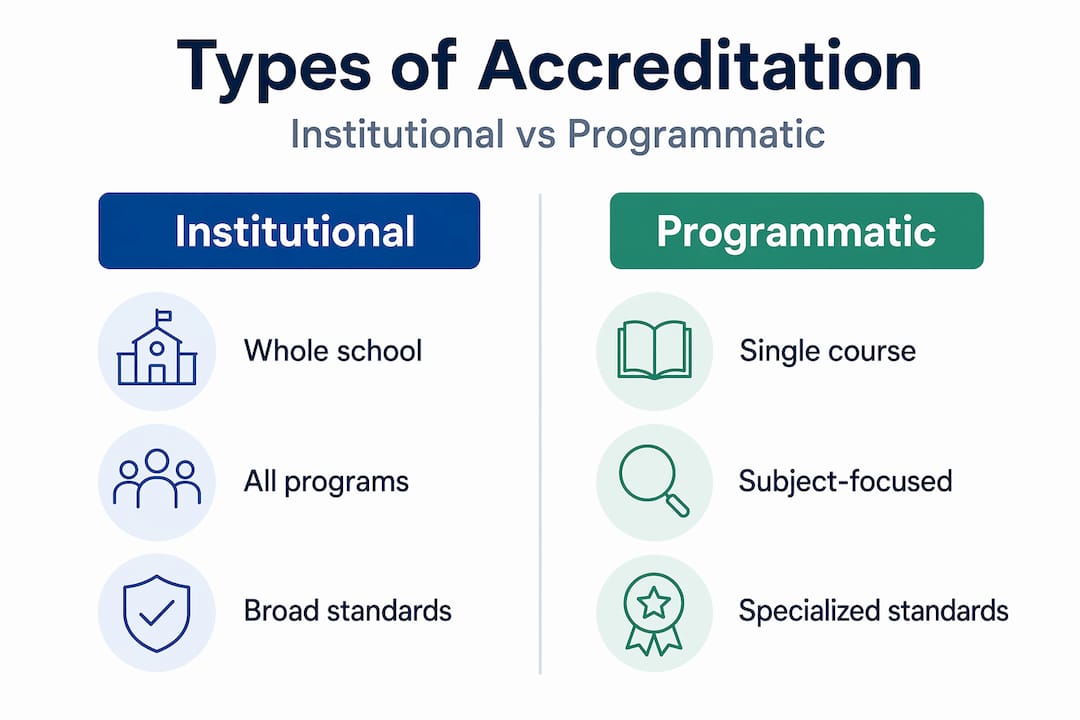
The definition of accreditation becomes clearer when you separate it into two distinct categories:
- Institutional accreditation applies to an entire college, university, or training provider. It evaluates the organization as a whole, including governance, finances, faculty qualifications, and general educational outcomes.
- Programmatic accreditation applies to a specific program or department within an institution. A teacher education program, for example, may hold programmatic accreditation from a specialized body even if the wider institution holds separate institutional accreditation.
- Regional accreditation tends to carry more weight than national accreditation in the United States, largely because regional bodies are considered more rigorous.
- Specialized accreditation covers specific professional fields, including education, nursing, and law, and is usually granted by field-specific agencies.
For teachers, the most relevant distinction is programmatic accreditation. When you enroll in a teacher training course, you want to know whether that specific program has been reviewed and approved by a recognized authority, not just whether the host institution is generally accredited. As accredited programs confirm, students benefit from education recognized by employers, which facilitates credit transfers, licensing, and financial aid eligibility.
Pro Tip: When evaluating any teaching qualification, ask the provider directly which accrediting body has reviewed the program and verify that body’s recognition with your local education authority.
Why accreditation is important for teachers
Accreditation is not simply a badge of honor for institutions. For teachers, it carries direct, practical consequences at every stage of a career.
The most immediate impact is on employment. Research shows that graduates from accredited institutions have up to a 12% employment advantage over those from unaccredited programs. Employers, particularly school districts and education departments, routinely screen candidates by whether their qualifications come from accredited providers. If your teaching credential lacks that recognition, your application may not progress regardless of your skills.

Accreditation also determines whether you can obtain a teaching license at all. In many jurisdictions, teaching licensure is explicitly tied to graduating from an accredited program. In New South Wales, Australia, for example, teachers must achieve Proficient Teacher status within a set timeframe, which involves at least 160 days of teaching experience alongside documented evidence. That pathway is only available to those who have completed qualifying, recognized programs.
Beyond initial employment, accreditation affects your long-term teaching rights. Many education systems require teachers to renew accreditation periodically. Failing to do so can result in losing the legal authority to teach. For TEFL teachers working internationally, TEFL accreditation serves a similar gatekeeping function. Employers abroad and domestically expect credentials from recognized, externally reviewed programs.
The importance of accreditation also extends to financial access. In the United States, students can only access federal financial aid if they attend an institution holding recognized accreditation. Losing accreditation triggers administrative consequences including loss of federal student aid eligibility, enrollment decline, and potential program closure. That risk alone explains why institutions treat accreditation cycles with extreme seriousness.
Pro Tip: If you are considering a teaching qualification abroad, confirm that the accrediting body is recognized not just in the country of study but also in the country where you intend to teach.
How the accreditation process works
The accreditation process for teacher qualifications is structured, evidence-based, and cyclical. Understanding its phases removes a great deal of confusion about what accreditation requires in practice.
The typical process follows these steps:
- Application and self-study. The institution or program prepares a detailed self-evaluation against the accrediting body’s published standards. This phase involves gathering data, reviewing outcomes, and identifying gaps.
- Evidence submission. Programs submit documentation supporting their claims. For individual teacher accreditation, applicants are generally required to submit 5 to 8 annotated evidence items and receive supervisor observation feedback within strict deadlines, often within 28 days.
- External review and observation. An independent review panel or evaluator assesses the submitted evidence. For teacher accreditation specifically, classroom observation is a standard requirement.
- Recommendation and decision. The accrediting body issues a formal decision based on the review. Outcomes may include full accreditation, provisional accreditation with conditions, or denial.
- Ongoing maintenance and renewal. Accreditation is not permanent. Programs and teachers must demonstrate continued compliance on review cycles that typically range from 5 to 10 years depending on the jurisdiction and accrediting body.
Many education systems now manage this process digitally. In Australia, the Electronic Teacher Accreditation Management System (eTAMS) allows teachers to compile and submit documentation electronically, track progress, and communicate with supervisors. Digital systems reduce administrative delays and create clearer audit trails throughout the process.
Comparing accreditation types and standards
Accreditation does not operate from a single, globally uniform framework. Standards differ across regions, professional fields, and types of teaching contexts. Knowing these differences helps you assess the value and recognition of any specific qualification.
| Type | Scope | Who grants it | Relevance for teachers |
|---|---|---|---|
| Institutional | Entire organization | Regional or national bodies | Confirms overall provider quality |
| Programmatic | Specific course or program | Specialized field agencies | Directly relevant to your teaching credential |
| Regional (U.S.) | Institutions within a geographic area | Six regional accrediting bodies | High prestige; often required for transfers |
| National (U.S.) | Primarily vocational/professional schools | National accrediting agencies | Accepted but may carry less weight than regional |
| International | Cross-border recognition | Global education boards | Critical for teaching abroad |
One important structural point: in the United States, accreditation operates through what is known as the Program Integrity Triad, a system involving accreditors, state governments, and federal oversight acting independently of each other. This independence creates variability. Two institutions in different states can meet different standards and still both claim accreditation. Understanding that variability helps you ask better questions when evaluating any credential.
On an international level, accreditation increasingly functions as a quality assurance passport in a globalized education market. For aspiring teachers seeking positions across borders, credentials from internationally recognized accredited programs significantly reduce recognition barriers. This is particularly relevant for TEFL teachers, whose employers in Asia, the Middle East, and Europe often require proof of external accreditation before considering applications.
Federal oversight of accreditation is also evolving. New accreditation regulations are increasing scrutiny on accreditors and student outcomes, signaling that accreditation standards will continue to tighten. Teachers and institutions preparing for this shift will be in a stronger position than those treating accreditation as a one-time checkbox.
Applying accreditation knowledge to your course selection
Understanding accreditation concepts is most useful when you put them to work in your actual decisions. Here is how to apply this knowledge practically.
- Verify before you enroll. Before committing to any teacher training program, confirm that it holds current accreditation from a recognized external body. Ask for the accrediting agency’s name, then independently verify that agency’s standing with your local education authority or a national recognition database.
- Distinguish provider accreditation from course accreditation. A training provider can be accredited as an organization while offering individual courses that have not been separately reviewed. Always check at the course level.
- Prioritize external accreditation for TEFL credentials. Not all TEFL certifications are equal. Choosing an accredited TEFL course from a recognized provider means your credential carries weight with international employers. Internal certificates from unverified providers do not offer the same assurance.
- Track your renewal obligations. Once you hold an accredited qualification or achieve teacher accreditation status, document your ongoing professional development requirements. Many jurisdictions require periodic evidence submission to maintain your status.
- Use official databases. In the U.S., the Department of Education maintains a list of recognized accrediting agencies. In Australia, NESA maintains teacher accreditation records. Use these official sources rather than relying solely on a provider’s self-reported claims.
Selecting an accredited teacher training program at the outset avoids the significant costs of having to repeat qualifications later when an employer or licensing body does not recognize your credential.
My perspective on accreditation in teacher training
I’ve worked with a wide range of aspiring teachers over the years, and one pattern stands out: most underestimate how much the accreditation of their initial qualification shapes the rest of their career. Many assume that once they complete a course and receive a certificate, the credential is inherently valid. That is not how the system works.
What I’ve found is that accreditation is not a background technicality. It is the mechanism by which your qualification connects to real-world employment, licensing, and professional standing. Teachers who skipped accreditation verification when choosing their programs often discover the problem years later, when applying for a more senior role or attempting to teach in a new country.
My honest view is that the complexity of accreditation systems, particularly the patchwork of regional, national, and international standards, leads many people to give up on understanding it. That’s a mistake. You don’t need to master every detail, but you do need to ask the right questions upfront. Which body accredits this program? Is that body recognized in my target country? When does accreditation expire?
The teachers I’ve seen build strong international careers have one thing in common. They treated their initial qualification as a foundation, chose accredited programs deliberately, and stayed on top of renewal requirements. Accreditation is not bureaucratic overhead. It is the professional infrastructure that makes a teaching career portable and credible.
— Muller
Take the next step with accredited TEFL courses
Understanding accreditation gives you a clear advantage when selecting teacher training programs. Teflinstitute offers externally accredited TEFL courses designed specifically for aspiring teachers who want credentials that are recognized by employers worldwide.

The 120 Hour Elective TEFL Course provides advanced, accredited training suited to teachers looking to build on existing qualifications. For those seeking the highest level of credential recognition, the 240 Hour Master TEFL Course delivers comprehensive, externally accredited certification with the depth that international employers expect. Both courses are structured to meet recognized accreditation standards, giving you a qualification you can rely on throughout your career.
FAQ
What is accreditation in simple terms?
Accreditation is a formal process where an independent body evaluates whether an institution or program meets defined quality standards. When a program earns accreditation, it signals to employers and licensing authorities that the education provided meets accepted professional benchmarks.
Why is accreditation important for teacher qualifications?
Accreditation directly affects your ability to obtain a teaching license, access employment opportunities, and have your credentials recognized internationally. Research shows graduates from accredited programs hold up to a 12% employment advantage over those from unaccredited institutions.
How long does teacher accreditation last?
Teacher accreditation typically operates on review cycles ranging from 5 to 10 years, depending on the jurisdiction. Teachers must maintain their status by submitting evidence of ongoing professional practice and meeting continuing professional development requirements.
What is the difference between institutional and programmatic accreditation?
Institutional accreditation evaluates an entire organization’s quality and operations, while programmatic accreditation assesses a specific course or program within that institution. For teachers, programmatic accreditation is the more directly relevant standard when choosing a qualification.
How do I verify if a TEFL course is accredited?
Ask the provider to name the specific external accrediting body, then independently verify that body’s recognition through an official national database or your local education authority. Provider self-reporting alone is not sufficient verification.