
 United Kingdom (UK)
 United States (US)
 Canada
 South Africa
 India
India Australia
 New Zealand
 China
China Russia
 Germany
 France
 Spain
Spain Netherlands
 Vietnam
 United Arab Emirates
 Italy
Italy Poland
 Thailand
 Türkiye








 Algeria


Most American teachers are surprised to learn that English instruction in Asia involves much more than just grammar and vocabulary drills. Demand for accredited TEFL certification is soaring as employers across South Korea, China, and Vietnam seek candidates who can actively bridge cultural gaps and create engaging classrooms. Understanding the realities behind common teaching myths and legal requirements gives aspiring educators the confidence to pursue rewarding opportunities both abroad and online.

Table of Contents
- Teaching English Defined And Common Myths
- TEFL Certification Types And Accreditation
- Essential Hiring Requirements In Asia
- Classroom Expectations And Realities
- Legal, Financial, And Cultural Challenges
- Growth Opportunities And Career Progression
What teaching in Asia is really like? – Key Takeaways
| Point | Details |
|---|---|
| Effective English Teaching | Focuses on a dynamic approach that includes critical thinking, cultural awareness, and personalized strategies, rather than just memorizing grammar rules. |
| TEFL Certification Importance | Accredited TEFL certifications are crucial for teaching abroad; different levels significantly impact career opportunities and earning potential. |
| Hiring Requirements in Asia | Commonly require a bachelor’s degree, TEFL certification, and preferences for native speakers; age limits and background checks are also standard. |
| Career Progression | Opportunities for advancement exist in various roles; additional qualifications and international experience are vital for long-term success. |
Teaching English Defined and Common Myths In Asia
Teaching English goes far beyond simple language instruction. At its core, English teaching represents a complex cultural and communicative exchange where educators help students develop linguistic skills while bridging international understanding. In the Asian context, this process becomes particularly nuanced, requiring teachers to navigate diverse learning environments and cultural expectations.
Contrary to popular misconceptions, effective English teaching is not about rigid grammar rules or test preparation. Academic language instruction demands a dynamic approach that balances critical thinking, communication skills, and cultural awareness. Many aspiring teachers mistakenly believe that language instruction is a one-size-fits-all process, when in reality, it requires personalized strategies tailored to individual student needs and learning styles.
Common myths about English teaching persist across the education landscape. Some believe that only native speakers can be effective instructors, while others assume that language learning is purely about memorization. In truth, successful English teaching involves creating engaging, interactive environments that encourage students to think, communicate, and express themselves confidently. Effective instructors understand that language is a living, evolving tool for connection, not just a set of grammatical structures to be mechanically learned.
Pro Tip: Develop cultural sensitivity and adaptability alongside your language teaching skills to truly connect with students and create meaningful learning experiences.
TEFL Certification Types and Accreditation
Teaching English as a Foreign Language (TEFL) certification represents a critical professional credential for educators seeking international teaching opportunities, particularly in the Asian job market. Certification levels range from basic introductory courses to advanced diplomas, each designed to equip teachers with specialized skills and knowledge needed for effective language instruction.
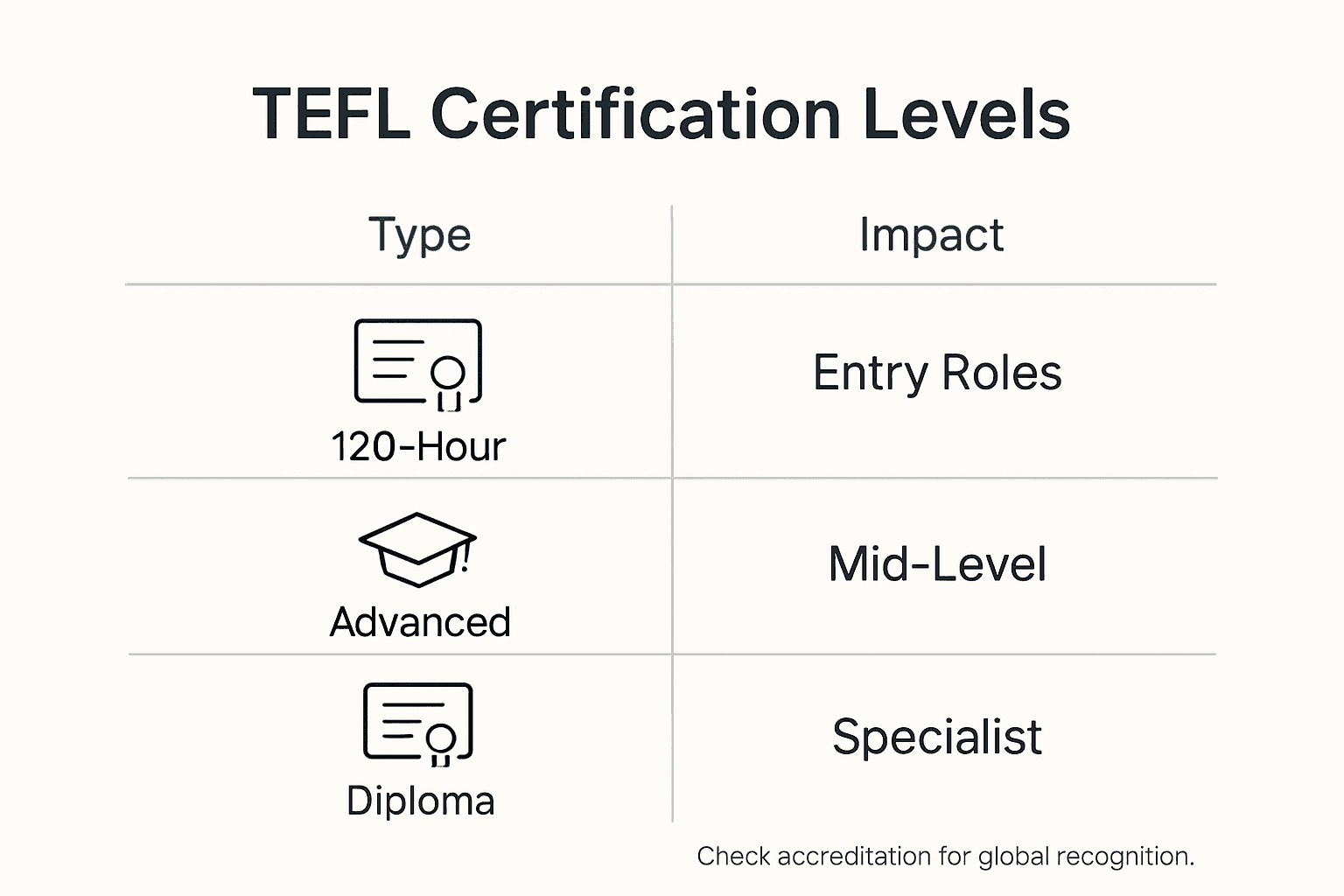
Understanding the nuanced landscape of TEFL course selection helps aspiring teachers make informed decisions about their professional development. The most common certification types include standard 120-hour TEFL certificates, which serve as entry-level qualifications, and more comprehensive TEFL diplomas that offer advanced pedagogical training. These certifications differ significantly in depth, duration, and potential career impact, with advanced credentials providing broader opportunities for higher-level teaching positions and increased earning potential.
Accreditation stands as a crucial factor when evaluating TEFL certification programs. Recognized accreditation from reputable international education bodies ensures that the certification meets global standards of quality and comprehensiveness. Prospective teachers should carefully research accreditation sources, looking for endorsements from established organizations that validate the curriculum’s rigor and international recognition. Some key accreditation bodies include the Online TEFL and TESOL Standards Agency (OTSA), the World TEFL Accrediting Commission (WTEAC), and regional educational accreditation networks.
Here’s a quick comparison of TEFL certification types and their career impact:
| Certification Type | Typical Duration | Career Impact | Common Job Roles |
|---|---|---|---|
| 120-hour TEFL Certificate | 4-8 weeks | Entry-level qualification | Language center instructor |
| Advanced TEFL Diploma | Several months | Higher-level opportunities | Lead teacher, curriculum planner |
| Master’s in TESOL | 1-2 years | Senior academic positions | Program manager, education consultant |
Pro Tip: Always verify the international recognition and specific accreditation details of your chosen TEFL certification program before investing time and resources.
Essential Hiring Requirements in Asia
Teaching English in Asia demands meeting a specific set of professional qualifications that vary across different countries and educational institutions. Comprehensive hiring standards typically include several non-negotiable requirements that aspiring educators must carefully navigate to secure meaningful employment in the region.
Most Asian countries mandate specific baseline credentials for English language instructors. These usually encompass a bachelor’s degree from an accredited university, regardless of the specific field of study. Native English speakers are often preferred, with many schools and language centers specifically seeking candidates from countries like the United States, Canada, the United Kingdom, Australia, and New Zealand. Additionally, a recognized TEFL certification with a minimum of 120 hours of training is almost universally required, demonstrating a standardized level of pedagogical preparation and language teaching competence.
Beyond academic qualifications, hiring requirements extend to personal and professional background checks. Most employers conduct thorough screenings that include criminal background investigations, health examinations, and verification of educational credentials. Age restrictions are common, with many institutions preferring teachers between 22 and 55 years old, and some countries imposing upper age limits around 60-65 years. Work visa regulations add another layer of complexity, with each country maintaining unique immigration policies that require careful navigation and precise documentation.
For reference, see how major Asian countries compare on hiring requirements and benefits:
| Country | Minimum Degree | Age Limit | Typical Benefits |
|---|---|---|---|
| South Korea | Bachelor’s | 62-65 | Housing, airfare, bonus |
| Japan | Bachelor’s | 60-65 | Travel allowance, bonus |
| China | Bachelor’s | 60-65 | Housing, health insurance |
| Vietnam | Bachelor’s | Usually 60 | Allowance, contract bonus |
Pro Tip: Prepare a comprehensive digital portfolio with authenticated copies of all educational certificates, background check documents, and professional references to streamline your hiring process in Asian job markets.
Classroom Expectations and Realities
Teaching English in Asian classrooms requires a nuanced understanding of cultural dynamics and educational expectations that often differ dramatically from Western pedagogical approaches. Classroom management becomes a critical skill that extends far beyond traditional language instruction, demanding cultural sensitivity and adaptive teaching strategies.

Every TEFL opening, salary and deadline that matters.
In your inbox every two weeks. Free, no spam, unsubscribe any time.
Teacher pay by country
New TEFL openings
Programme and visa dates
Teacher expectations significantly shape student learning outcomes, particularly in diverse Asian educational contexts. Many Western educators arrive with preconceived notions about classroom interaction, only to discover that student engagement, participation, and learning styles vary dramatically across different Asian countries. In countries like Japan and South Korea, students typically demonstrate more reserved classroom behaviors, valuing collective harmony and respectful interactions, while classrooms in China and Vietnam might feature more competitive and interactive learning environments.
Navigating these cultural nuances requires more than linguistic competence. Successful English teachers must develop cross-cultural communication skills that allow them to read subtle social cues, understand hierarchical dynamics, and create inclusive learning spaces that respect local educational traditions while introducing communicative language teaching methods. This means adapting lesson plans, understanding non-verbal communication signals, and recognizing that students’ educational backgrounds profoundly influence their classroom expectations and learning approaches.
Pro Tip: Invest time in understanding the specific cultural and educational context of your teaching location before designing your classroom strategies and interaction models.
Legal, Financial, and Cultural Challenges
Teaching English in Asia presents a complex landscape of legal and professional challenges that extend far beyond traditional classroom instruction. Prospective educators must navigate a multifaceted environment of regulatory requirements, cultural expectations, and economic realities that can significantly impact their professional experience.
The socio-political dynamics of English language teaching in Asia reveal intricate challenges that intersect legal, financial, and cultural domains. Work visas represent a critical hurdle, with each country maintaining unique immigration policies that demand meticulous documentation and compliance. Financial considerations vary dramatically across different Asian markets, with salary ranges and compensation structures differing substantially between countries like South Korea, Japan, China, and Southeast Asian nations. Some regions offer competitive packages with housing allowances, while others provide more modest compensation that requires careful financial planning.
Cultural challenges are equally significant, with legal and professional expectations varying widely across different Asian contexts. Many countries impose strict regulations about teacher qualifications, including age restrictions, mandatory health screenings, and specific educational credential requirements. These regulations are not merely bureaucratic formalities but reflect deep-seated cultural approaches to professional education and international employment. Language schools and educational institutions often have complex internal policies that require nuanced understanding and adaptive professional behavior.
Pro Tip: Consult multiple sources, including official government websites and experienced expatriate networks, to develop a comprehensive understanding of the legal and cultural requirements specific to your target teaching destination.
Growth Opportunities and Career Progression
Teaching English in Asia represents more than a temporary professional experience—it offers a strategic pathway for career development with multiple progression routes for ambitious educators. The international teaching landscape provides numerous opportunities for professional growth that extend far beyond traditional classroom roles, enabling dedicated professionals to build sophisticated and dynamic careers.
Professional advancement typically follows several strategic pathways. Entry-level teachers can progress from standard language center positions to more prestigious roles such as lead instructors, curriculum developers, and academic administrators. Many educators transition into specialized niches like business English training, test preparation instruction, corporate language consulting, or international education management. Countries like South Korea, Japan, and China offer particularly robust career development ecosystems, with opportunities for teachers to advance into senior academic positions, educational consulting, and even international education policy roles.
Advanced credentials play a crucial role in career progression. Teachers who invest in additional qualifications such as master’s degrees in TESOL, specialized diplomas, and advanced TEFL certifications position themselves for higher-level positions with increased responsibilities and compensation. Some professionals leverage their international teaching experience to transition into related fields like international business training, cross-cultural communication consulting, educational technology development, and international student recruitment. The skills developed through teaching English abroad—including cross-cultural communication, adaptability, and language expertise—are highly transferable across multiple professional domains.
Pro Tip: Strategically document your international teaching experiences, collect professional recommendations, and continuously update your skills to maximize your long-term career potential in global education.
Unlock Your Asian Teaching Career with Expert TEFL Certification
The challenges of navigating diverse Asian hiring requirements, understanding cultural classroom dynamics, and securing recognized credentials can feel overwhelming. This article highlights the critical need for a well-accredited TEFL certification and cultural adaptability to succeed in Asia’s competitive English teaching market. If you want to overcome age limits, visa hurdles, and varied employer expectations while expanding your career prospects abroad then acquiring an advanced TEFL diploma or specialized training is essential.
Take control of your teaching journey now by exploring the comprehensive online TEFL courses at TEFL Institute. Our programs cover foundational 120-hour certificates through advanced diplomas and niche options like IELTS preparation designed to meet international accreditation standards. With flexible study formats and practical modules, you can set yourself apart and confidently meet Asia’s exacting hiring criteria. Visit TEFL Institute’s landing page to start your certification today and open doors to rewarding opportunities across South Korea, Japan, China, Vietnam, and beyond.
Frequently Asked Questions
What is TEFL certification?
TEFL certification stands for Teaching English as a Foreign Language. It is a professional credential that qualifies individuals to teach English abroad, especially in non-native English-speaking countries.
What are the types of TEFL certifications available?
TEFL certifications typically range from basic 120-hour certificates to advanced diplomas. The 120-hour certification serves as an entry-level qualification, while advanced diplomas offer comprehensive training for higher-level teaching opportunities.
Why is accreditation important for TEFL certification programs?
Accreditation ensures that a TEFL certification program meets recognized standards of quality and comprehensiveness. Valid accreditation from reputable organizations assures prospective teachers that their qualifications will be recognized internationally.
What are the typical hiring requirements for English teachers in Asia?
Most hiring requirements include a bachelor’s degree from an accredited university, a recognized TEFL certification with a minimum of 120 hours of training, and often preference for native English speakers. Background checks and documentation for work visas are also common.
Recommended

Tara and Jess talk through different TEFL and EFL topics, from finding work abroad to life in the classroom.