

 United Kingdom (UK)
 United States (US)
 Canada
 South Africa
 India
India Australia
 New Zealand
 China
China Russia
 Germany
 France
 Spain
Spain Netherlands
 Vietnam
 United Arab Emirates
 Italy
Italy Poland
 Thailand
 Türkiye





 Algeria


What Is the Communicative Approach in ESL Teaching?
What Is the Communicative Approach in ESL Teaching?

TL;DR:
- The communicative approach emphasizes meaningful interaction and authentic communication over form-focused grammar drills. It improves speaking, listening, and engagement while developing sociolinguistic and discourse skills in ESL learners. Effective implementation relies on teacher training, task design, and balancing fluency with accuracy.
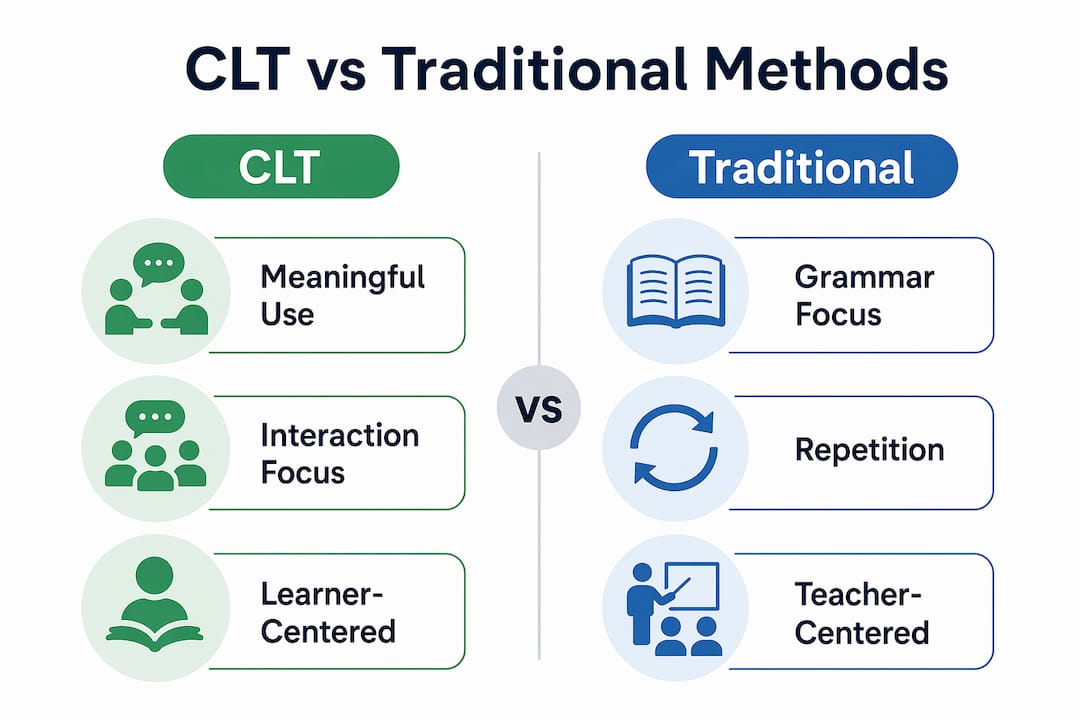
The communicative approach is defined as a learner-centered language teaching philosophy that prioritizes meaningful interaction as both the method and goal of language learning. Known formally as Communicative Language Teaching (CLT), it shifts from form-focused methods dominant before the 1970s, such as grammar-translation and audiolingualism, toward building communicative competence across four domains: linguistic, sociolinguistic, discourse, and strategic. Rather than drilling isolated grammar rules, CLT places students in authentic communication tasks where language use has real purpose. For ESL educators and aspiring teachers, understanding what the communicative approach is, and how to apply it, is one of the most practical investments in professional development available today.
What is the communicative approach and its core principles?

CLT is an approach, not a method. This distinction matters more than it first appears. A method prescribes specific activities and sequences. An approach provides a philosophical framework that guides why language is taught and what success looks like. Teachers shape their activities around communication goals rather than following a rigid lesson script. Mistakes occur most often when educators treat CLT as a fixed formula rather than a guiding philosophy.
The four core principles of communicative language teaching are:
- Meaning before form. Language is introduced in context, with functional meaning taking priority over grammatical accuracy at the outset. Students learn to express ideas before perfecting the structures behind them.
- Authentic language use. Tasks reflect real-life communication scenarios, such as negotiating, describing, persuading, or narrating, rather than contrived textbook drills.
- Fluency over accuracy initially. Natural language production is encouraged without constant interruption. Correcting every error immediately inhibits fluency development and discourages student participation.
- Learner-centered roles. The teacher facilitates communication rather than dominating it. Students take ownership of interaction, and the teacher sets conditions then steps back.
Pro Tip: You do not need to overhaul your entire curriculum to start using CLT. Adapting a single existing activity to meet one of these four principles is a legitimate and effective starting point.
Communicative competence, the target outcome of CLT, covers more than grammar. It includes sociolinguistic competence (knowing what is appropriate in a given social context), discourse competence (connecting ideas coherently across sentences), and strategic competence (managing communication breakdowns). A student who can construct a grammatically perfect sentence but cannot hold a conversation lacks communicative competence by CLT standards.
How effective is the communicative approach in 2026?
A 2026 systematic review of CLT in EFL classrooms confirms that CLT significantly improves students’ speaking, listening, and overall classroom engagement. This finding is consistent across multiple national contexts, which suggests the approach has genuine transferability. However, the same review identifies less consistent effects on reading, writing, and grammar accuracy, particularly when implementation is weak or teacher training is insufficient.
The table below summarizes what the research shows across key skill areas:
| Skill area | CLT effectiveness | Key variable |
|---|---|---|
| Speaking | High | Task design and student talk time |
| Listening | High | Use of authentic audio and interaction |
| Engagement | High | Learner-centered activity structure |
| Reading | Moderate | Dependent on text authenticity |
| Writing | Moderate | Requires staged feedback integration |
| Grammar accuracy | Variable | Context, training, and curriculum fit |
Effectiveness also depends heavily on teacher training, class size, and curriculum constraints. A teacher with limited CLT preparation working in a large exam-driven class will produce different results than a trained practitioner with smaller groups and flexible syllabi. CLT is versatile but not one-size-fits-all. Its success depends on alignment between the approach and the specific learner environment.
The research also distinguishes between “strong” CLT, where students communicate exclusively in the target language from the start, and “weak” CLT, where language is taught before being applied communicatively. Most effective teachers operate between these two poles, integrating communicative activities progressively rather than applying full immersion immediately. This middle-ground approach produces more consistent outcomes across diverse classroom settings.
What are common misconceptions about communicative language teaching?
The most persistent misconception about CLT is that it eliminates grammar instruction. Grammar is taught as a communication tool tied to real tasks, not in isolation. For example, the past simple tense is introduced in the context of storytelling, not as an abstract paradigm to memorize. Grammar serves the learner’s communication needs rather than existing as an end in itself.
A second misconception is that CLT means no correction. Correction is part of CLT, but timing is critical. Feedback given at appropriate stages, rather than mid-utterance, preserves fluency while still addressing accuracy. A practical approach is to note errors during communicative activities and address them in a dedicated feedback phase after the task concludes.
The following challenges are common for teachers implementing CLT for the first time:
- Exam-driven curricula. Many national syllabi prioritize grammar and reading comprehension for standardized tests, which can conflict with CLT’s fluency focus. Teachers often need to negotiate space for communicative activities within fixed course structures.
- Mixed-ability classes. CLT tasks that work well for intermediate learners can frustrate beginners or bore advanced students. Task design must account for proficiency range.
- Time constraints. Communicative activities take longer than grammar drills. Teachers frequently underestimate how much time pair and group work requires when managed properly.
- Teacher talking time. If the teacher speaks for the majority of class time, CLT principles are being violated. The teacher’s role is to set up communication and then observe, not to dominate the discourse.
Pro Tip: Record a 10-minute segment of your lesson and calculate how many minutes you spoke versus your students. If your talk time exceeds 40% of the segment, restructure the activity to transfer more speaking to learners.
How to use the communicative approach in your ESL classroom
Applying CLT practically does not require a complete curriculum redesign. The following steps provide a structured path for educators at any experience level:
- Audit your current activities. Identify which tasks already involve student interaction and which are teacher-led. Mark the interactive ones as CLT-compatible and build from there.
- Introduce authentic materials. Replace textbook dialogues with real-world texts, audio clips, or video segments. Authentic materials expose students to natural language variation and register. Resources on classroom vocabulary activities can support this shift without requiring major preparation time.
- Design information-gap tasks. Activities like “Describe and Draw,” where one student describes an image and another draws it without seeing the original, create genuine communicative need. Neither student can complete the task without real interaction.
- Stage your feedback. Allow students to complete communicative tasks without interruption. Collect errors during the activity and address them in a structured feedback phase afterward.
- Pair CLT with other methods. CLT works well alongside Task-Based Language Teaching (TBLT) and the Presentation-Practice-Production (PPP) model. The PPP model, for instance, provides a structured grammar presentation phase before students apply language communicatively in the production stage.
- Vary interaction patterns. Rotate between pair work, small groups, and whole-class discussion. Each format develops different aspects of communicative competence and prevents over-reliance on a single interaction type.
For engaging ESL activities that align directly with CLT principles, Teflinstitute provides a practical library of classroom-tested options. Role plays, information exchanges, and opinion-sharing tasks all meet the communicative criteria of authentic purpose and meaningful interaction.
How does the communicative approach compare to other ESL methods?
CLT occupies a distinct position among ESL methodologies. The table below compares it to four commonly used approaches:
| Method | Primary focus | Teacher role | Student role | CLT compatibility |
|---|---|---|---|---|
| Grammar-Translation | Accuracy and translation | Central authority | Passive recipient | Low |
| Audiolingualism | Pattern repetition and drilling | Model and corrector | Imitator | Low |
| Total Physical Response (TPR) | Comprehension through action | Commander | Responder | Moderate |
| PPP (Presentation-Practice-Production) | Staged grammar to use | Presenter then facilitator | Active in production | High |
| TBLT (Task-Based Language Teaching) | Task completion through language | Facilitator | Negotiator | Very high |
Grammar-translation and audiolingualism both treat language as a system to be mastered before use. CLT inverts this: language is learned through use. TPR shares CLT’s emphasis on meaning and comprehension but limits productive output. PPP and TBLT are the most compatible with CLT because both involve communicative production as a core component. For a broader overview of ESL teaching methods, Teflinstitute covers how these approaches fit together in practice.
CLT is most effective with learners who have at least basic vocabulary and phonological awareness. Complete beginners may need structured input before CLT activities become productive. Advanced learners benefit most from the approach’s emphasis on sociolinguistic and discourse competence, areas that form-focused methods rarely address. For listening-focused applications, Spanish listening comprehension strategies offer a useful parallel for understanding how communicative input shapes receptive skills across languages.
Key takeaways
Communicative Language Teaching is the most research-supported approach for developing speaking fluency and classroom engagement in ESL contexts, provided it is implemented with proper teacher training and task design.
| Point | Details |
|---|---|
| CLT is a philosophy, not a method | It guides lesson purpose rather than dictating specific activities or sequences. |
| Grammar is still taught in CLT | Grammar is contextualized within communicative tasks, not eliminated from instruction. |
| Correction timing matters | Staged feedback after tasks preserves fluency while still addressing accuracy. |
| Strong vs. weak CLT | Most effective teachers blend both approaches rather than applying either extreme. |
| Teacher talk time is a key metric | If the teacher speaks more than students, CLT principles are not being applied correctly. |
Why I think most teachers underestimate CLT’s flexibility
After working with ESL educators across a range of contexts, the most common mistake I observe is treating CLT as an all-or-nothing commitment. Teachers either attempt full communicative immersion from day one and struggle with classroom management, or they dismiss CLT entirely because their curriculum is exam-focused. Both responses miss the point.
CLT is a framework that tolerates adaptation. A grammar lesson can still be communicative if students use the target structure to exchange real information rather than fill in blanks. A test-preparation class can incorporate CLT principles through discussion tasks that build the discourse competence students need for speaking components. The approach does not require abandoning structure. It requires redirecting structure toward communication.
The teachers I have seen apply CLT most effectively share one habit: they consistently ask whether their students are doing more talking than they are. That single question, applied honestly at the end of each lesson, produces more improvement than any methodology course. Prioritize student voice, design tasks with genuine communicative purpose, and treat grammar as a tool rather than a destination. The results follow.
— Muller
Deepen your CLT skills with Teflinstitute

Teflinstitute offers structured professional development for educators who want to apply communicative language teaching with confidence. The 120 Hour Elective TEFL Course covers practical CLT strategies alongside broader ESL methodology, giving you the theoretical grounding and classroom tools to implement the approach effectively. For educators seeking a more extensive qualification, the 240 Hour Master TEFL Course provides externally accredited training across the full range of ESL methodologies, including communicative pedagogy at an advanced level. Both courses are available online and designed to fit around existing teaching commitments.
FAQ
What is the communicative approach in simple terms?
The communicative approach is a language teaching philosophy where students learn by using the language for real communication rather than memorizing grammar rules in isolation. The goal is to develop communicative competence across speaking, listening, reading, and writing.
Does CLT mean no grammar teaching?
No. Grammar is taught contextually within communicative tasks rather than as abstract rules. For example, past simple is introduced through storytelling activities, not paradigm memorization.
What are the main benefits of the communicative approach?
A 2026 systematic review confirms CLT significantly improves speaking, listening, and student engagement. It also develops sociolinguistic and discourse competence that form-focused methods do not address.
How is CLT different from the grammar-translation method?
Grammar-translation teaches language as a system to be analyzed and translated before use. CLT teaches language through use, prioritizing meaningful interaction from the start and treating accuracy as a product of communication rather than a prerequisite for it.
Can CLT work in exam-focused classrooms?
Yes, with adaptation. Teachers can incorporate communicative tasks within exam-preparation syllabi by designing discussion and information-exchange activities that build the speaking and discourse skills tested in exams like IELTS and TOEFL.