
 United Kingdom (UK)
 United States (US)
 Canada
 South Africa
 India
India Australia
 New Zealand
 China
China Russia
 Germany
 France
 Spain
Spain Netherlands
 Vietnam
 United Arab Emirates
 Italy
Italy Poland
 Thailand
 Türkiye








 Algeria


What Is Teacher Reflection? A Guide for Educators
What Is Teacher Reflection? A Guide for Educators
TL;DR:
- Teacher reflection is a disciplined, evidence-based process that transforms teaching experience into ongoing professional growth. It involves analyzing teaching decisions and outcomes through four modes—during, after, before, and examining underlying beliefs—to improve instructional effectiveness. Systematic reflection enhances adaptability, supports career advancement, and yields better student learning in diverse educational contexts.
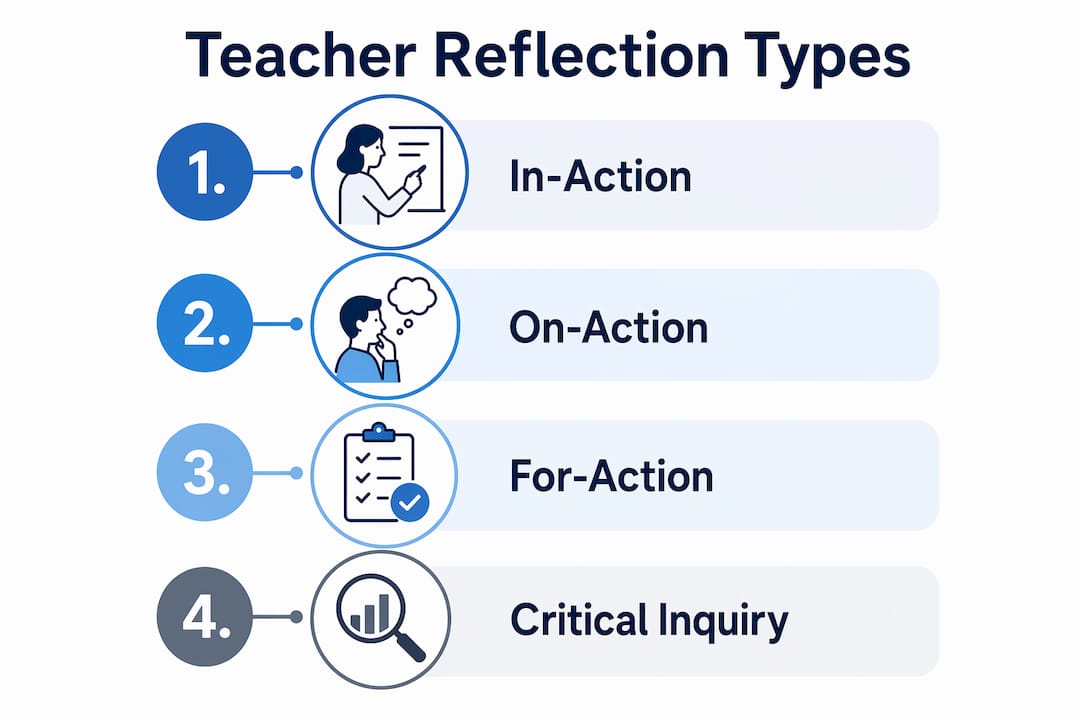
Teacher reflection is a deliberate, structured process of analyzing and evaluating one’s teaching practice to improve instructional effectiveness and student learning outcomes. Known formally as reflective teaching, this practice draws on four recognized modes: reflection-in-action, reflection-on-action, reflection-for-action, and reflection-within. Each mode serves a distinct purpose, and together they form a continuous cycle of professional inquiry. For educators at any career stage, understanding this process is the foundation of sustained growth in the classroom.

What is teacher reflection and why does it matter?
Teacher reflection is defined as a purposeful, evidence-based evaluation of teaching decisions, methods, and outcomes. It is not casual self-criticism or end-of-day second-guessing. Reflective teaching requires drawing on four distinct data sources: students’ perspectives, colleagues’ perceptions, personal teaching experience, and published research or educational theory. Each source provides a different angle on what is working and what needs adjustment.
The four modes of reflection give structure to this process. Reflection-in-action occurs during a lesson, when a teacher notices that students are confused and adjusts the explanation in real time. Reflection-on-action happens after the lesson, reviewing what occurred and why. Reflection-for-action is the most proactive mode. It uses evidence gathered from previous lessons to plan deliberate improvements before the next class begins. Reflection-within is the deepest form, examining the values, beliefs, and assumptions that shape a teacher’s entire professional identity.
What separates reflective teaching from routine teaching is intentionality. Experience alone without structured reflection leads to repetition rather than growth. A teacher who has delivered the same lesson for ten years without examining its effectiveness has not gained ten years of professional development. Structured reflection converts experience into learning.
What are the main models and types of teacher reflection?
Several frameworks help educators organize their reflective practice. The most widely cited is Donald Schön’s model, which distinguishes between reflection-in-action and reflection-on-action. Schön’s framework, introduced in The Reflective Practitioner (1983), established that expert professionals do not simply apply theory to practice. They think critically while acting and revise their understanding based on what they observe.
A more detailed framework is the 5R Model, which structures reflection across five progressive stages:
- Reporting: Describing what happened in the lesson without judgment
- Responding: Identifying your immediate emotional or cognitive reaction
- Relating: Connecting the experience to prior knowledge or teaching situations
- Reasoning: Analyzing why the outcome occurred, using theory or evidence
- Reconstructing: Planning a revised approach based on the analysis
The 5R Model is particularly useful for written reflection because it prevents teachers from stopping at surface-level description. Many educators write reflective journals that only cover the first two stages, which limits the depth of insight they gain.
| Reflection type | Focus | When it occurs |
|---|---|---|
| Reflection-in-action | Real-time adjustment | During the lesson |
| Reflection-on-action | Post-lesson analysis | After the lesson |
| Reflection-for-action | Proactive planning | Before future lessons |
| Reflection-within | Values and identity | Ongoing, dispositional |
Critical reflective inquiry goes further than any single model. It requires challenging one’s assumptions and examining how context, culture, and institutional structures shape teaching decisions. Surface-level reflection asks “What did I do?” Critical reflection asks “Why did I do it, and whose interests does it serve?”
Pro Tip: When starting a reflective journal, use the 5R Model as a template for each entry. Write one paragraph per stage. This structure prevents you from stopping at description and pushes you toward genuine analysis and planning.
How do teachers effectively practice reflection?
Effective reflection requires both the right tools and the right conditions. Reflection is most productive in psychologically safe environments that encourage honest sharing without fear of judgment. This applies whether you are reflecting alone or with colleagues.
The most commonly used tools and techniques include:
- Reflective journals: Written records of teaching experiences, analyzed using a structured framework like the 5R Model or Gibbs’ Reflective Cycle
- Video review: Recording lessons and watching them back to observe patterns in pacing, questioning, student engagement, and classroom management
- Peer observation: Inviting a trusted colleague to observe a lesson and provide structured feedback using a classroom observation protocol
- Student feedback: Collecting written or verbal responses from learners about what helped them understand and what created confusion
- Teaching inventories: Structured self-assessment questionnaires that prompt reflection on specific instructional behaviors
Timing matters as much as method. Reflection before a lesson focuses on preparation and anticipating student needs. Reflection during a lesson requires the in-action awareness that Schön described. Reflection after a lesson is where most teachers spend the majority of their reflective time, and it feeds directly into reflection-for-action planning.
Two common pitfalls undermine the process. The first is superficial reflection, where a teacher notes that a lesson “went well” or “did not go well” without identifying specific causes or implications. The second is confirmation bias, where a teacher only notices evidence that supports existing beliefs about their practice. Both errors produce the illusion of reflection without the substance.
Pro Tip: After collecting student feedback, look specifically for patterns in what confused learners, not just what they enjoyed. Confusion data is more instructionally useful than satisfaction data.
Why is teacher reflection critical for professional development?
Reflective practice is not optional for educators who want to grow. Reflective teaching is linked to improved instructional effectiveness and is a requirement for credentials like National Board Certification in the United States. This connection between reflection and formal recognition signals that the profession treats self-evaluation as a core competency, not a supplementary skill.
“Reflection is synonymous with education itself. It requires active cultivation, not passive accumulation of classroom hours.” — Eastern Washington University
The benefits of teacher reflection extend directly to students. When teachers systematically examine which instructional strategies produced understanding and which produced confusion, they make more targeted adjustments. This is especially significant in diverse classrooms where students bring different language backgrounds, learning profiles, and prior knowledge. Reflection enables teachers to move beyond one-size-fits-all instruction toward genuinely responsive teaching.
Engaging in reflection strengthens teacher professional identity, builds a sense of empowerment, and produces positive student learning outcomes. This finding matters because teacher motivation and retention are persistent challenges in education systems globally. Reflection gives teaching work meaning beyond task completion. It connects daily classroom decisions to a larger professional purpose.
For TEFL educators specifically, reflection is the mechanism through which teaching practice evolves across different cultural and linguistic contexts. A lesson that works effectively with adult learners in South Korea may require significant adaptation for young learners in Brazil. Structured reflection after each teaching context builds the adaptive expertise that experienced ESL educators demonstrate.
Career advancement in education also depends on documented reflective practice. Professional portfolios, performance reviews, and certification renewals increasingly require teachers to demonstrate not just what they taught, but how they analyzed and improved their teaching over time.
What challenges do educators face with teacher reflection?
Reflection does not come automatically to most teachers. Reflection requires cultivating specific dispositions: open-mindedness, responsibility, and wholeheartedness. These are not personality traits that teachers either have or lack. They are professional habits developed through deliberate practice over time.
The most common barriers to meaningful reflection are:
- Time constraints: Teachers cite lack of time as the primary obstacle to regular reflection. The solution is not finding extra time but integrating reflection into existing routines, such as spending five minutes after each lesson writing one observation and one question.
- Personal bias: Teachers naturally interpret classroom events through the lens of their existing beliefs. Peer observation and student feedback provide external data that counteracts this tendency.
- Superficial habits: Many teachers default to evaluating whether students appeared engaged rather than analyzing whether learning occurred. Shifting the focus from student behavior to student understanding requires a deliberate change in reflective questions.
- Isolation: Teaching is often a solitary profession. Without colleagues to share observations with, reflection can become circular and self-confirming. Professional learning communities and mentoring relationships provide the external perspectives that deepen individual reflection.
- Institutional culture: Schools or programs that do not prioritize reflective practice make it harder for individual teachers to sustain the habit. Advocating for structured reflection time in professional development programs addresses this at the organizational level.
The most effective strategy for overcoming these barriers is collaboration. Peer observation partnerships, co-teaching arrangements, and structured professional learning communities all create accountability and provide the diverse perspectives that make reflection genuinely productive.
Key takeaways
Teacher reflection is a structured, evidence-based process that converts teaching experience into professional growth, requiring deliberate use of multiple data sources and recognized frameworks.
| Point | Details |
|---|---|
| Four modes of reflection | In-action, on-action, for-action, and within each serve a distinct purpose in the reflective cycle. |
| Multiple data sources | Effective reflection draws on student feedback, peer input, personal experience, and educational theory. |
| Highest-impact mode | Reflection-for-action produces the greatest improvement by using evidence to plan future lessons proactively. |
| Tools that support reflection | Journals, video review, peer observation, and student feedback each provide different types of insight. |
| Professional development link | Reflective teaching is tied to National Board Certification and measurable gains in instructional effectiveness. |
Reflection as a professional discipline, not a personal habit
I have worked with educators at many stages of their careers, and the pattern is consistent. Teachers who treat reflection as a structured professional discipline improve faster and adapt more effectively than those who treat it as informal self-assessment. The difference is not talent or experience. It is method.
What most articles on this topic understate is the courage required for genuine critical reflection. Examining your own assumptions about which students can succeed, why certain groups disengage, or whether your preferred teaching style actually serves your learners is uncomfortable work. Open-mindedness in reflection is not a soft skill. It is a professional obligation.
I have also observed that reflection acts as a stabilizing force when educational contexts shift. Curriculum changes, new assessment frameworks, and evolving student demographics all create pressure on teachers. Educators with a strong reflective practice adapt because they already have a habit of examining evidence and revising their approach. Those without it tend to default to familiar methods regardless of whether those methods fit the new context.
The ESL classroom is a particularly demanding environment for this reason. Language learners are sensitive to instructional clarity, pacing, and cultural responsiveness in ways that make reflective adjustment not optional but necessary. Teachers who reflect systematically on their ESL practice build a toolkit that works across contexts. Those who do not tend to repeat the same approaches and wonder why results vary.
— Muller
Advance your teaching with Teflinstitute’s reflective practice courses
Teflinstitute integrates reflective teaching methods directly into its professional development courses, giving educators the frameworks and feedback structures needed to grow systematically.

The 120 Hour Elective TEFL Course provides advanced training that incorporates evidence-based reflection techniques alongside practical instructional strategies. For educators seeking a more thorough certification, the 240 Hour Master TEFL Course offers externally accredited training with a structured focus on iterative teaching improvement. Both courses are designed for working educators who want to connect reflective inquiry to real classroom outcomes and career advancement in ESL education.
FAQ
What is the definition of teacher reflection?
Teacher reflection is a deliberate, structured process of analyzing one’s teaching decisions, methods, and outcomes to improve future instructional effectiveness. It draws on student feedback, peer input, personal experience, and educational theory as data sources.
What are the four types of teacher reflection?
The four types are reflection-in-action (during a lesson), reflection-on-action (after a lesson), reflection-for-action (planning improvements before future lessons), and reflection-within (examining underlying values and professional identity).
How does teacher reflection improve student outcomes?
Reflective practice produces positive student learning outcomes by enabling teachers to identify which strategies produced understanding and adjust their instruction accordingly, rather than repeating ineffective approaches.
What tools support effective teacher reflection?
Effective reflection tools include reflective journals, video recordings of lessons, peer observation protocols, student feedback surveys, and structured teaching inventories. Each tool captures a different dimension of teaching practice.
Is teacher reflection required for professional certification?
Yes. Reflective teaching is a requirement for credentials such as National Board Certification in the United States, and it is embedded in professional development standards across most education systems globally.
Recommended
TEFL Institute guides

Japan
JET, ALT and eikaiwa pay
Thailand
Visas and teaching licences
Estonia
Jobs, pay and work routes
Vietnam
Work permits and requirements
Spain
Jobs, pay and visa routes