

 United Kingdom (UK)
 United States (US)
 Canada
 South Africa
 India
India Australia
 New Zealand
 China
China Russia
 Germany
 France
 Spain
Spain Netherlands
 Vietnam
 United Arab Emirates
 Italy
Italy Poland
 Thailand
 Türkiye








 Algeria


What Is ELT? English Language Teaching Explained

TL;DR:
- ELT primarily refers to English Language Teaching, a global industry that focuses on instructing non-native speakers in English. It encompasses diverse environments, methodologies, and learner groups, emphasizing communicative competence over rote memorization. The field plays a crucial role in connecting individuals to international opportunities and cross-cultural exchanges worldwide.
The term ELT appears in two very different fields, which causes more confusion than most people expect. In data engineering, ELT stands for Extract, Load, Transform. In education, what is ELT refers to something entirely different: English Language Teaching, the global practice of instructing non-native speakers in the English language. This article focuses exclusively on the educational meaning. You will find a clear ELT definition, an explanation of related terminology, an overview of core teaching methodologies, and a look at why this field carries so much weight around the world.
Table of Contents
- Key takeaways
- What is ELT: definition and scope
- ELT terminology: ESL, EFL, and TESOL explained
- Core ELT methods and techniques
- The global significance of ELT
- My perspective on ELT’s evolution
- Start your ELT career with the right certification
- FAQ
Key takeaways
| Point | Details |
|---|---|
| ELT means English Language Teaching | It is the recognized abbreviation for teaching English to non-native speakers across global education contexts. |
| ELT is a broad umbrella term | It covers ESL, EFL, and TESOL contexts and is most commonly used in British and international English. |
| Communicative competence is central | Effective ELT goes well beyond grammar drills and focuses on real-life language use and interaction. |
| ELT has massive global reach | Programs like the British Council’s TeachingEnglish have reached over 10 million teachers worldwide. |
| Certification matters for ELT careers | Recognized qualifications like TEFL are the standard entry point for teaching English professionally. |
What is ELT: definition and scope
ELT stands for English Language Teaching, defined formally as the activity and industry of teaching English to speakers of other languages. The term is widely used in British and international educational contexts, though its application extends across every continent where English instruction takes place.
The scope of ELT is broader than most newcomers anticipate. It encompasses classroom teachers in public schools, private language academies, online tutoring platforms, corporate English training programs, and university-level language departments. ELT also includes the professionals who develop curricula, write textbooks, train other teachers, and conduct research into language acquisition. This is not a single job title. It is an entire industry.
In terms of learner populations, ELT serves:
- Adults seeking professional development or immigration readiness
- Children and teenagers in formal school systems
- University students preparing for academic study in English
- Business professionals requiring English for international communication
- Refugees and migrants building language skills for daily life
What distinguishes modern ELT from older language instruction models is the shift away from rote memorization and toward communicative competence. The goal is no longer just grammatical accuracy. Learners need to interact meaningfully, interpret context, and produce language in real situations.
Pro Tip: If you are evaluating whether ELT is the right career path, look at the breadth of the field. You can specialize in business English, young learners, academic writing, or test preparation. The field offers significant room for professional focus.
ELT terminology: ESL, EFL, and TESOL explained
One of the first challenges for anyone entering the ELT field is the acronym confusion that surrounds it. ELT, ESL, EFL, and TESOL are all related, but they are not interchangeable. Understanding the distinctions helps you make better decisions about which certification or teaching context fits your goals.
| Acronym | Full term | Primary context |
|---|---|---|
| ELT | English Language Teaching | Broad umbrella term, common in British and international use |
| ESL | English as a Second Language | Teaching English in a country where English is the dominant language |
| EFL | English as a Foreign Language | Teaching English in a country where English is not the primary language |
| TESOL | Teaching English to Speakers of Other Languages | Common in North American contexts; often used for certification programs |
| TEFL | Teaching English as a Foreign Language | Certification-specific term, commonly used for teaching abroad |
ELT functions as the overarching category. Whether you are teaching ESL in the United States, EFL in South Korea, or working on a corporate English program in Brazil, you are working within the ELT field. The sub-terms indicate context and geography, not fundamentally different teaching goals.
TESOL and TEFL tend to appear more in certification and program naming. In North America, TESOL is the standard professional term, while TEFL is more common in the UK and for overseas teaching programs. Knowing this distinction matters when you are comparing credentials or job listings across regions.
The ELT ecosystem also includes teacher trainers, educational content creators, curriculum designers, and researchers. If you want to understand the difference between ESL and EFL in practical teaching terms, the distinction comes down to the learning environment and what role English plays in the learner’s daily life.
Pro Tip: When reading job postings, pay attention to whether a role specifies ESL, EFL, or simply “English teacher.” These labels signal the teaching environment and the type of certification the employer expects.
Core ELT methods and techniques
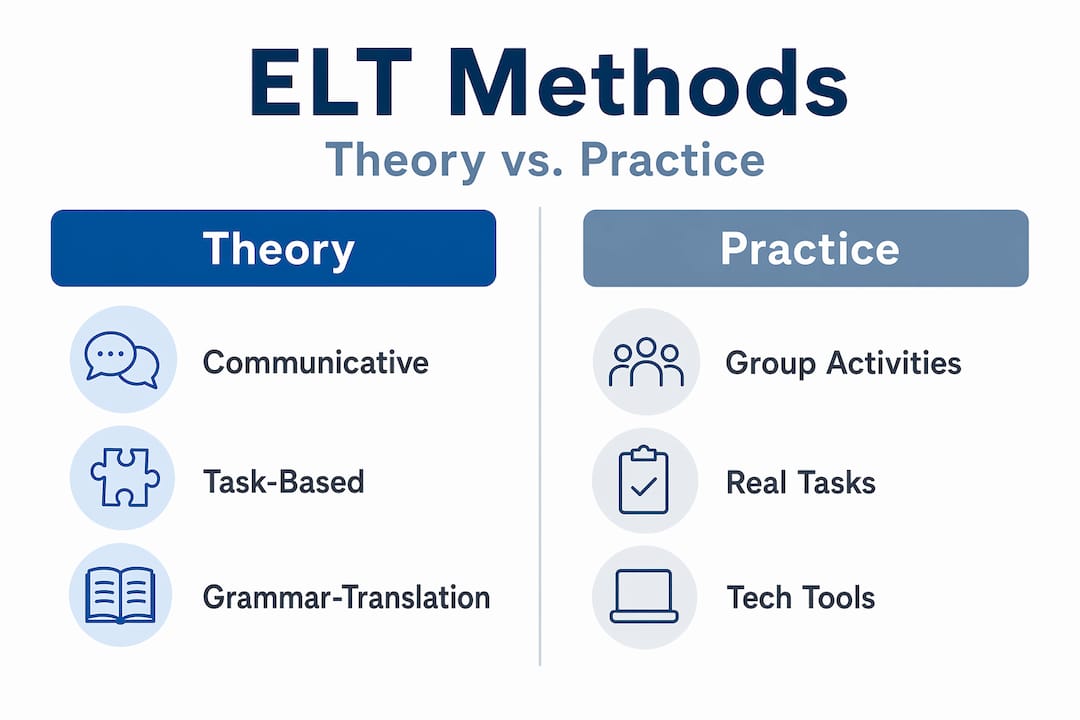
How teachers actually deliver instruction is where ELT theory becomes practice. Several established methodologies guide how English is taught effectively, and most experienced educators draw from more than one approach depending on the learner group and context.

Communicative language teaching
Communicative Language Teaching (CLT) is the dominant framework in contemporary ELT. It prioritizes language as a tool for real communication rather than a system of rules to memorize. Lessons focus on interaction, task completion, and meaning-making. A learner might practice negotiating a price, giving directions, or writing a professional email because these are the situations they will actually encounter.
Task-based learning
Task-Based Language Teaching (TBLT) structures lessons around a central task, such as planning an event or solving a problem. Grammar and vocabulary instruction emerge from the task rather than being taught in isolation. This approach has strong research support for building fluency because learners are focused on communication outcomes rather than correctness alone.
Grammar-translation method
This older method, which dominated language classrooms for most of the 20th century, centers on translating texts and studying grammatical rules explicitly. While largely replaced by communicative approaches in modern ELT, it still appears in some academic and exam-preparation contexts where precise reading and writing skills are prioritized.
Effective ELT pedagogy does not require rigid adherence to a single method. Experienced teachers blend approaches based on:
- Learner age and proficiency level
- Whether English is present in the learners’ daily environment
- The specific goals of the course (conversation, academic writing, exam prep)
- Class size and available resources
- Cultural context and learner expectations
Technology has become a core component of modern English language training. Digital platforms allow teachers to deliver content asynchronously, use multimedia materials, and track learner progress with data. Online teaching has expanded the reach of ELT significantly, giving learners in remote areas access to qualified instruction and giving teachers access to platforms to teach English online that were not available a decade ago.
Learner-centered instruction is the principle underlying all of these methods. ELT recognizes that adults and children learn differently, that motivation varies, and that linguistic backgrounds shape how learners process English. Adapting instruction to those realities is not optional. It is the defining quality of effective teaching.
Every TEFL opening, salary and deadline that matters.
In your inbox every two weeks. Free, no spam, unsubscribe any time.
Teacher pay by country
New TEFL openings
Programme and visa dates
The global significance of ELT
ELT is not simply an educational practice. It functions as infrastructure for participation in the global economy, international research, and cross-cultural exchange. English has become the predominant language of international business, science, aviation, and diplomacy, which means proficiency in English directly affects individual opportunity.
“ELT enables learners to connect with cultures, ideas, and real-life communication on a global scale.” — Detroit Bureau, Comprehensive ELT Guide
English proficiency is increasingly treated as a prerequisite for global employability. Employers in multinational contexts routinely require demonstrated English ability, and universities worldwide conduct instruction in English to attract international students. ELT is the mechanism that makes that access possible for non-native speakers.
The scale of the field reflects this demand. The British Council’s TeachingEnglish program alone has reached millions of educators across India, with plans for continued expansion. This kind of investment signals how seriously governments and international organizations treat English language education as a development priority.
ELT also carries cultural weight. Classrooms become spaces for cross-cultural exchange, where learners encounter ideas, literature, and perspectives from English-speaking communities while sharing their own. This exchange is one of the more underappreciated benefits of ELT. The ELT job market reflects this global reach, with demand for qualified teachers spanning Asia, Latin America, the Middle East, Europe, and online platforms serving learners everywhere.
The challenges are real as well. Standardizing quality across contexts is difficult when resources, training levels, and learner needs vary so widely. Teachers in under-resourced settings often work without reliable materials or institutional support. Addressing these gaps is an ongoing responsibility for the field.
My perspective on ELT’s evolution
I’ve spent considerable time working within and observing the ELT field, and one thing stands out clearly: the educators who struggle most are those who entered the field with a narrow definition of what ELT actually is. They expected to teach grammar and correct pronunciation. What they encountered was a complex, culturally loaded interaction that required adaptability, empathy, and genuine curiosity about their learners.
In my experience, the most effective ELT professionals are the ones who treat terminology as a starting point rather than a destination. Understanding what ESL, EFL, and TESOL mean is useful. Knowing how those distinctions play out in a real classroom with real learners who have real stakes is what actually matters.
What I find most encouraging about the current state of ELT is the growth of collaborative teacher networks. The idea that ELT professionals work in communities of practice beyond their individual classrooms is becoming more normalized. Teachers are sharing resources, comparing methodologies, and challenging assumptions across borders in ways that were simply not possible before.
The future of this field will belong to teachers who can adapt to technology without losing the relational core of what good instruction looks like. The acronyms will keep shifting. The fundamentals of connecting with learners and supporting meaningful language development will not.
— Muller
Start your ELT career with the right certification
If this overview of what English Language Teaching involves has confirmed that teaching is the direction you want to pursue, the next step is getting qualified.

Teflinstitute offers internationally recognized TEFL certification through online and in-person formats, with flexible scheduling designed to fit around existing commitments. Programs range from foundational TEFL courses for those entering the field to advanced electives and a 30-hour IELTS teacher training course for those looking to specialize. Teflinstitute also offers structured internship programs that provide hands-on classroom experience alongside certification. Whether you are exploring teaching English as a career for the first time or looking to formalize existing experience, recognized credentials from Teflinstitute provide the professional standing that employers and institutions across the ELT field expect.
FAQ
What does ELT stand for in education?
ELT stands for English Language Teaching. It is the standard abbreviation for the field and industry dedicated to teaching English to non-native speakers.
How is ELT different from TEFL or ESL?
ELT is the broad umbrella term covering all contexts of English language instruction. TEFL refers specifically to teaching English as a foreign language, typically abroad, while ESL describes teaching English in a country where it is the dominant language. These are sub-categories within ELT.
What qualifications do you need to work in ELT?
Most ELT positions require at minimum a TEFL or TESOL certification. Some roles, particularly at universities or in teacher training, expect a degree in linguistics or education as well.
What methods are used in ELT classrooms?
The most widely used approaches include Communicative Language Teaching, Task-Based Language Teaching, and learner-centered instruction. Teachers typically combine methods based on learner needs, proficiency levels, and course objectives.
Why is ELT considered globally significant?
ELT provides access to English proficiency, which directly affects employability, educational opportunity, and participation in international communication. With the British Council’s programs reaching millions of teachers across major markets, the field operates on a scale that reflects its importance as a global education priority.
Recommended

Tara and Jess talk through different TEFL and EFL topics, from finding work abroad to life in the classroom.