

 United Kingdom (UK)
 United States (US)
 Canada
 South Africa
 India
India Australia
 New Zealand
 China
China Russia
 Germany
 France
 Spain
Spain Netherlands
 Vietnam
 United Arab Emirates
 Italy
Italy Poland
 Thailand
 Türkiye





 Algeria


Classroom Games for Teaching English PDF: Top Picks
Classroom Games for Teaching English PDF: Top Picks

TL;DR:
- Printable PDF classroom games enhance ESL learning by promoting active student participation and targeting specific language skills. Effective games, like “I Have, Who Has?” for vocabulary and Jeopardy for grammar, require clear objectives, full-class participation, and well-defined card counts for optimal engagement. Proper planning, timing, and post-game reflection are essential to maximize their pedagogical impact and support language acquisition.
Classroom games for teaching English in PDF format are printable, ready-to-use resources that increase student engagement and language acquisition through structured, interactive play. The most effective formats include “I Have, Who Has” synonym chains, printable escape rooms, and Jeopardy-style grammar reviews. Platforms like Teach Starter, Twinkl, Teachers Pay Teachers, and Song Activity Factory publish these materials as downloadable PDFs that require minimal prep and deliver measurable language practice. This article identifies the top game types, explains what makes each one pedagogically sound, and gives you a clear framework for selecting and implementing them in your ESL classroom.
What makes classroom games for teaching English PDF effective?
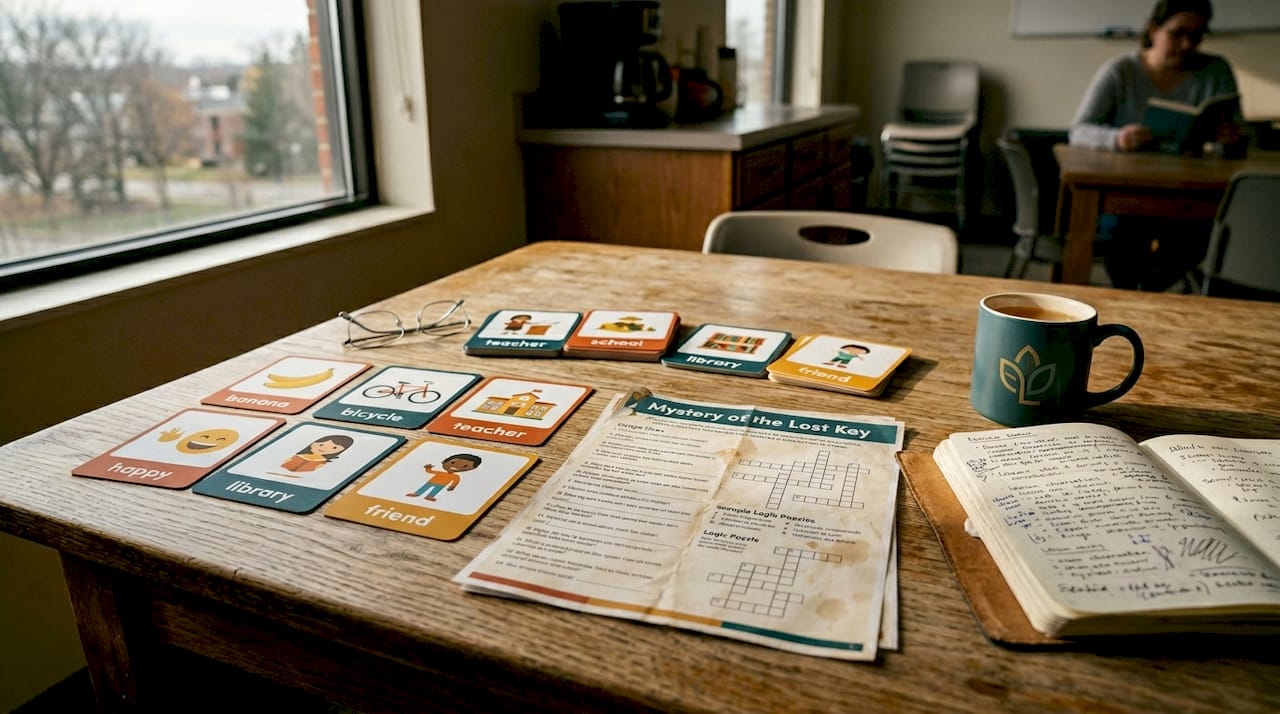
An effective PDF classroom game does more than fill time. It creates repeated, structured opportunities for students to produce or decode language in a low-stakes setting. The game mechanics must directly elicit the target language skill, whether that is speaking, reading, or grammatical accuracy.
Key selection criteria include:
- Clear learning objectives. Every game should map to a specific skill: vocabulary recognition, grammar accuracy, or spoken fluency. Different game types naturally encourage different language outputs, so matching the mechanic to the objective is non-negotiable.
- Whole-class or team participation. Games where only two students interact at a time leave the rest of the class disengaged. Prioritize formats that keep all students active simultaneously or in rapid rotation.
- Printable, self-contained instructions. A PDF that includes setup notes, rules, and answer keys reduces teacher prep time and allows the game to run with minimal intervention.
- Specified card or question count. Resources that state exact quantities, such as 32 clue cards, allow you to plan timing accurately and assign speaking roles without overrun.
- Adaptability across levels. The best printable ESL games include differentiation notes or can be modified by swapping vocabulary sets without redesigning the format.
Pro Tip: Before printing any PDF game, check whether it includes both a full-color and a black-and-white version. Eco-print options, like those offered by Twinkl, reduce costs significantly when you are printing for 30 students.
Games tied to explicit learning goals produce repeated active participation rather than passive distraction. That distinction separates a pedagogically sound game from a time-filler.
1. “I Have, Who Has?” synonym and vocabulary games
“I Have, Who Has?” is a whole-class chain game where each student holds a card stating a word or phrase they “have” and a clue they must read aloud to prompt the next student. Teach Starter’s “I Have, Who Has?” Synonym Game downloads as a full-color PDF with 32 clue cards plus instructions, designed specifically for whole-class engagement. Every student speaks at least once, which makes this one of the most participation-dense formats available.
The vocabulary and listening demands are simultaneous. Students must decode the synonym clue they hear, match it to the word on their card, and respond in a complete sentence structure. This combination of receptive and productive language use in a single activity is what makes the format so efficient for ESL classrooms. The game suits levels from A2 upward and works particularly well as a warm-up or vocabulary review before a writing task.
2. Printable escape room games for adjective vocabulary
Escape room games translate the puzzle-solving format into a classroom activity where students decode clues to “unlock” the next stage. Twinkl’s ESL Printable Escape Room targeting adjectives of appearance comes with multiple printable pages in both full-color and eco black-and-white versions, making it practical for regular classroom use.
The pedagogical strength of this format is its narrative constraint. Students must use a fixed vocabulary set to progress through the puzzle, which means the language is not optional. Maintaining a fixed vocabulary set during play is critical for coherence and prevents students from bypassing the target language entirely. This game suits A2 to B1 learners and works well in small groups of three to four students, which encourages peer negotiation in English.
Pro Tip: Run the escape room as a timed competition between groups. The time pressure increases authentic communication as students negotiate meaning quickly rather than defaulting to their first language.
3. Jeopardy-style grammar review games
Jeopardy-style games organize grammar content into a point-value board where teams select categories and answer questions to earn scores. The “Parts of Speech Jeopardy” format covers pronouns, adjectives, nouns, verbs, and prepositions with step-by-step gameplay rules built into the presentation, making it accessible even for teachers new to the format.
The competitive scoring structure keeps students focused during grammar review, a topic that often loses engagement in traditional drill formats. Teachers Pay Teachers ESL Jeopardy games take this further with click-to-reveal and scoring features that reduce teacher workload and maintain class focus. The “FUN Irregular Past Tense Verbs Jeopardy Game” on Teachers Pay Teachers is a strong example, covering irregular verb forms with built-in answer checking. This format suits B1 and above and pairs well with a short grammar explanation at the start of the lesson.
4. Song-based ESL lesson packs with PDF guides
Song Activity Factory publishes complete ESL lesson packs built around current music, combining PDF instruction guides with linked digital components. The Bruno Mars ESL Lesson at B2 level includes an instructions PDF linking to Google Slides, an assessment pack, and running guidance for a 65-minute class with grammatical focus on modals and conditionals. That level of scaffolding is unusual in free or low-cost ESL resources.
Song-based lessons work because authentic audio input reduces the artificiality that students often feel in grammar-focused activities. The narrative simulation format in this pack asks students to engage with the song’s context as a story, which generates genuine communicative tasks rather than isolated exercises. This format suits upper-intermediate to advanced learners and is particularly effective for speaking and writing integration within a single lesson.
5. True/false and spot-the-difference printable games
True/false games present statements about a text, image, or audio input, and students must identify accuracy and correct errors. Spot-the-difference activities pair two near-identical images and require students to describe discrepancies using target vocabulary. Both formats are low-prep, high-output activities that work well as interactive classroom games for vocabulary consolidation.
The spot-the-difference format is particularly effective for teaching descriptive language and spatial prepositions. When run as a paired information-gap activity, where each student holds a different image, it creates genuine communicative need. Students cannot complete the task without speaking in English, which is the defining feature of a well-designed language game. Free printable versions are available through resources like Ashley Yeo’s printable worksheets, which offer similar visual discrimination tasks suitable for younger learners.
6. How to implement PDF classroom games effectively
Effective implementation determines whether a game produces language learning or just noise. The preparation and execution steps below apply across all the formats covered in this article.
Preparation steps:
- Print materials the day before and organize them by group or student to avoid confusion during setup.
- Read through the PDF instructions fully before class. Games with multiple stages, like escape rooms, require you to understand the sequence before students begin.
- Identify the exact language objective the game addresses and state it explicitly to students before play begins.
During the game:
- Set a visible timer. Most PDF games run optimally between 10 and 20 minutes. Beyond that, energy drops and the language focus weakens.
- Monitor group work actively. Circulate and note errors for a brief feedback slot after the game ends.
- Avoid stopping the game to correct errors in real time. Post-game feedback preserves the communicative flow that makes games effective.
Pro Tip: Combine a PDF game with a short written reflection task immediately after play. Ask students to write three sentences using vocabulary or grammar from the game. This consolidates learning and gives you a quick formative assessment without additional prep.
For a broader catalog of ESL classroom games organized by skill and level, Teflinstitute’s resource library provides structured lists aligned with TEFL methodology.
7. Where to find and compare downloadable ESL PDF game resources
| Platform | Game type | Best for | Limitation |
|---|---|---|---|
| Teach Starter | “I Have, Who Has?” vocabulary chains | Whole-class vocabulary practice | Subscription required for full access |
| Twinkl | Printable escape rooms | Small-group vocabulary tasks | Quality varies by contributor |
| Teachers Pay Teachers | Jeopardy grammar reviews | Grammar accuracy review | Paid resources; quality varies |
| Song Activity Factory | Song-based lesson packs | Upper-intermediate speaking and grammar | Requires digital component alongside PDF |
| Ashley Yeo | Visual discrimination printables | Young learners, vocabulary | Limited grammar focus |
Teach Starter and Twinkl both offer free tiers with limited downloads, which is sufficient for trialing a game format before committing to a subscription. Teachers Pay Teachers operates on a per-resource purchase model, which suits teachers who need a specific game type rather than a broad library. Song Activity Factory’s free lesson packs represent strong value for B1 and above classrooms given the depth of scaffolding included.
For language learning activities that extend beyond English-specific platforms, broader foreign language resources can supplement your PDF game library with additional formats and age-appropriate materials.
Key takeaways
PDF classroom games for ESL teaching are most effective when the game mechanic directly matches the target language skill and every student participates actively throughout.
| Point | Details |
|---|---|
| Match mechanic to skill | Use “I Have, Who Has?” for speaking vocabulary, escape rooms for decoding, Jeopardy for grammar accuracy. |
| Check card and question counts | Resources specifying exact quantities, like 32 clue cards, allow precise lesson timing and inclusive participation. |
| Use built-in scoring features | Jeopardy games with click-to-reveal answers reduce teacher workload and sustain student focus. |
| Combine PDF with digital components | Song Activity Factory packs link PDF guides to Google Slides for a richer, multi-modal lesson experience. |
| Debrief after every game | A short post-game writing or speaking task consolidates language gains and provides formative assessment data. |
Why game selection matters more than game quantity
The most common mistake I see ESL teachers make is treating PDF games as interchangeable. A teacher downloads five different games, rotates through them weekly, and wonders why vocabulary retention is not improving. The problem is not the games. It is the absence of alignment between the game mechanic and the lesson objective.
“I Have, Who Has?” and a Jeopardy board are not the same tool. One demands continuous listening and spontaneous speaking. The other rewards recall under competitive pressure. Using both in the same week without a clear rationale dilutes the effect of each. The stronger approach is to select one game format per unit, use it consistently across two or three lessons, and then assess whether students have internalized the target language before switching formats.
I also think teachers underestimate the value of printable PDFs in low-resource settings. A well-designed PDF game from Twinkl or Teach Starter can run without internet access, a projector, or any digital infrastructure. That reliability matters in contexts where technology is inconsistent. The best ESL classroom games are the ones you can actually run on any given day, not the ones that depend on a stable Wi-Fi connection.
Finally, duration discipline is underrated. Most PDF games have an optimal window of 12 to 18 minutes. Running a game past that point does not increase learning. It decreases it. Set a timer, stop the game at the right moment, and use the remaining time for structured feedback. That sequence, game plus debrief, is what separates a language activity from a language lesson.
— Muller
Advance your ESL teaching with professional TEFL training

Knowing which games to use is one part of effective ESL teaching. Understanding the pedagogical principles behind game-based learning, classroom management, and lesson sequencing is what makes those games consistently productive. Teflinstitute offers accredited courses designed for exactly this purpose. The 120-hour elective TEFL course covers interactive teaching methods including activity-based learning frameworks. For deeper professional development, the 240-hour master TEFL course provides externally accredited training across the full range of ESL methodology. Teachers focused on exam preparation contexts can also explore the IELTS instructor training course for specialized skills in that area.
FAQ
What are the best PDF games for ESL vocabulary teaching?
“I Have, Who Has?” synonym games from Teach Starter and printable escape rooms from Twinkl are among the most effective PDF formats for vocabulary teaching. Both require students to actively use target words rather than passively recognize them.
How do I choose a PDF classroom game for my English lesson?
Select a game whose mechanic directly produces the language skill you are targeting: speaking chains for vocabulary, puzzle decoding for reading, and point-scoring boards for grammar accuracy. Check that the resource specifies card or question counts so you can plan timing accurately.
Are printable ESL games effective for grammar review?
Jeopardy-style grammar games with built-in answer-checking and scoring, such as those on Teachers Pay Teachers, are effective for grammar review because the competitive format sustains focus and the structured question format reinforces accuracy. They work best as a review tool after direct instruction, not as an introduction to new grammar.
Where can I download free PDF games for teaching English?
Teach Starter and Twinkl both offer free-tier downloads. Song Activity Factory provides complete lesson packs at no cost for many titles. Teachers Pay Teachers has free resources alongside paid ones, and a filtered search by price will surface them.
How long should a classroom game last in an ESL lesson?
Most PDF classroom games run optimally between 10 and 20 minutes. Extending beyond that point typically reduces language focus and student engagement. Follow the game with a short debrief or written consolidation task to maximize learning outcomes.