

 United Kingdom (UK)
 United States (US)
 Canada
 South Africa
 India
India Australia
 New Zealand
 China
China Russia
 Germany
 France
 Spain
Spain Netherlands
 Vietnam
 United Arab Emirates
 Italy
Italy Poland
 Thailand
 Türkiye









 Algeria


Cultural competence: A practical guide for TEFL teachers
Cultural competence: A practical guide for TEFL teachers
TL;DR:
- Cultural competence in TEFL involves developing self-awareness, cultural knowledge, and adaptive communication skills through ongoing reflection and interaction.
- While competence focuses on structured skills, humility emphasizes lifelong openness and critique of power dynamics, ensuring continuous growth.
Respectful behavior in a multicultural classroom is a starting point, not a destination. Many aspiring TEFL teachers assume that being polite and open-minded is sufficient when working with learners from diverse backgrounds. In reality, cultural competence is a structured, evidence-based set of skills that goes far beyond courtesy. It involves self-awareness, targeted knowledge, adaptive communication, and a genuine commitment to continuous learning. This guide defines cultural competence clearly, walks through the leading frameworks used in education, addresses the important debate around cultural humility, and provides actionable classroom strategies grounded in research.
Table of Contents
- Defining cultural competence: The basics and why it matters
- How cultural competence develops: The five-step framework
- Cultural competence vs. cultural humility: Why the difference matters
- Culturally responsive teaching: Strategies and TEFL examples
- What most TEFL articles miss about cultural competence
- Advance your TEFL journey with cultural competence
- Frequently asked questions
Key Takeaways
| Point | Details |
|---|---|
| Definition matters | Cultural competence means possessing the attitudes, skills, and knowledge for positive cross-cultural interactions. |
| Ongoing process | Developing cultural competence is a lifelong, evolving journey for all teachers. |
| Framework in action | A five-step model guides TEFL teachers through awareness, knowledge, skill, encounters, and desire. |
| Mindset shift | Cultural humility expands competence into a daily practice of growth and learning. |
| Classroom application | Reflective, culturally responsive teaching directly improves student engagement and inclusion. |
Defining cultural competence: The basics and why it matters
Let’s begin by defining the term and its practical classroom relevance before exploring frameworks and techniques.
Cultural competence is commonly described as a set of behaviors, attitudes, and/or policies that enable effective work and interaction in cross-cultural situations. This definition, drawn from public health and education research, applies directly to TEFL classrooms where teachers regularly navigate differences in communication styles, learning expectations, and social norms.
For TEFL teachers, cultural competence operates at what researchers call the “system level.” This means it is not just an individual personality trait. It is a combination of teachable skills that include self-awareness about your own cultural assumptions, structured knowledge of other cultures, and strong interpersonal tools for clear cross-cultural communication. Understanding multicultural education basics gives you a useful foundation before applying these ideas in a TEFL context.
“Cultural competence is not a fixed attribute that teachers either have or lack. It is a dynamic capacity that develops through reflection, study, and sustained interaction with learners from different backgrounds.”
Teachers who build this capacity report stronger rapport with students, fewer communication breakdowns, and measurably better student outcomes. The practical classroom implications are significant. Consider a scenario where a teacher provides direct written correction on an essay from a student whose culture treats written feedback from authority figures as deeply personal criticism. Without cultural knowledge, that teacher may interpret the student’s withdrawn behavior as disengagement when it actually reflects a culturally conditioned response to perceived shame. Understanding cultural sensitivity best practices helps teachers identify exactly these kinds of moments before they become barriers to learning.
The core components of cultural competence for TEFL teachers include:
- Self-awareness: Recognizing your own cultural biases, assumptions, and communication defaults
- Cultural knowledge: Building accurate, nuanced understanding of students’ backgrounds without relying on stereotypes
- Interpersonal skill: Adapting communication, feedback, and instruction to suit different cultural contexts
- Institutional awareness: Understanding how policies and classroom structures may unintentionally favor some cultural groups over others
- Responsiveness: Adjusting teaching practice in real time based on student cues and feedback
These components together define what the role of a TEFL teacher increasingly demands in globally diverse classrooms.
How cultural competence develops: The five-step framework
Having defined cultural competence, let’s unpack how teachers can actually build it step by step.
A widely used framework in cultural-competence education is that competence is developed through continuing processes that include cultural awareness, cultural knowledge, cultural skill, cultural encounters, and cultural desire. This model was developed by Josepha Campinha-Bacote and has been adopted across healthcare, education, and social services. Its strength lies in positioning competence as an ongoing process rather than a checklist.
Here is how each step applies specifically to TEFL instruction:
- Cultural awareness: Examine your own cultural identity and recognize how it shapes your teaching expectations. Ask yourself which communication styles you consider “normal” and why.
- Cultural knowledge: Actively study the cultural backgrounds of your students. This includes learning about educational traditions, family roles, religious observances, and attitudes toward authority in different cultures.
- Cultural skill: Practice adapting your instruction based on what you know. This could mean changing how you deliver feedback, adjusting group work structures, or selecting materials that reflect diverse experiences.
- Cultural encounters: Seek regular, intentional interactions with people from different cultures. Cultural immersion in teaching accelerates this process by placing you in sustained, real-world contexts where you must navigate cultural difference continuously.
- Cultural desire: Cultivate genuine motivation to grow. This is arguably the most important step, because competence built only from obligation tends to be shallow and inconsistent.
| Framework step | TEFL classroom activity | Expected outcome |
|---|---|---|
| Cultural awareness | Reflective journal on your own teaching assumptions | Identify unconscious biases |
| Cultural knowledge | Research students’ home countries before the course begins | More relevant lesson content |
| Cultural skill | Adapt feedback style based on student cultural norms | Reduced miscommunication |
| Cultural encounters | Attend cultural events or seek diverse peer groups | Broader real-world perspective |
| Cultural desire | Set professional development goals around cultural growth | Sustained, motivated learning |
Pro Tip: Preparing thoroughly before teaching abroad shortens the time it takes to move through the early steps of this framework. Teachers who research their destination’s cultural norms before arrival demonstrate noticeably higher cultural skill from the first week of teaching.
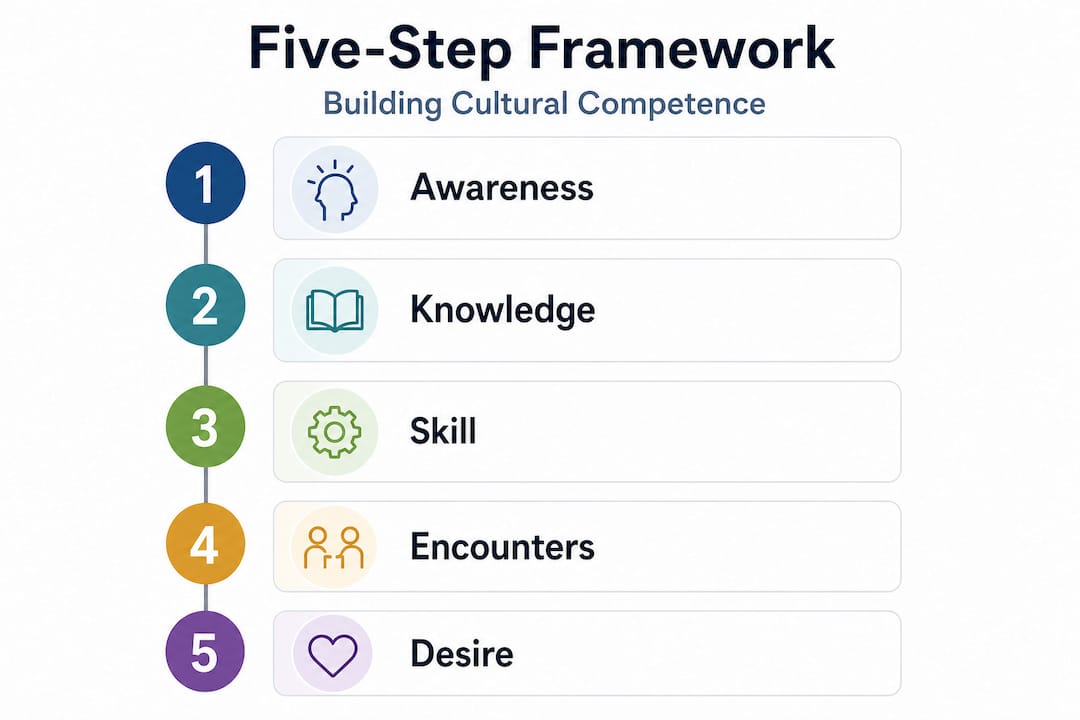
The framework makes clear that cultural competence is not linear. Teachers cycle back through awareness, knowledge, and skill as they encounter new students, new cultural contexts, and new challenges. This cycling is a sign of growth, not failure.
Cultural competence vs. cultural humility: Why the difference matters
Understanding the development process, it’s crucial to consider the latest thinking: what if “competence” isn’t quite enough?
There is a significant expert debate in the academic literature. Many fields distinguish cultural humility from cultural competence, arguing that humility may be a more appropriate educational goal because it emphasizes ongoing self-evaluation and critiques of power imbalances. The concern is that the word “competence” implies a finish line: a point at which a teacher can declare themselves culturally competent and stop growing. Cultural humility rejects that finish line entirely.
Cultural humility means maintaining an ongoing posture of openness, recognizing that your knowledge of any culture is always incomplete, and acknowledging that power dynamics between teacher and student can shape every classroom interaction. This is particularly relevant in TEFL settings where the teacher’s language, English, holds significant global prestige and economic power. That power dynamic does not disappear because a teacher is polite or well-intentioned.

| Dimension | Cultural competence | Cultural humility |
|---|---|---|
| Core definition | A set of achievable skills and behaviors | A lifelong orientation of openness and self-critique |
| Teacher behavior | Learn, apply, adapt | Continuously question, reflect, and revise |
| View of knowledge | Knowledge is buildable and applicable | Knowledge is always partial and context-dependent |
| Response to mistakes | Identify skill gap, correct it | View mistakes as learning opportunities, not deficits |
| Power awareness | Addresses it as one component | Centers it as a fundamental issue in all interactions |
| Long-term outcome | Increased effectiveness | Sustained growth and stronger student-teacher relationships |
For aspiring TEFL teachers, the practical takeaway is this: use the competence framework to build structured skills, but adopt the humility mindset to sustain your growth over a career. Understanding the essential TEFL skills required for effective teaching includes both the technical capacity to adapt and the personal disposition to keep questioning your assumptions.
“Cultural humility reframes the goal of cross-cultural teaching as lifelong openness, self-critique, and actively working to reduce the effects of power imbalances in relationships with learners.”
This is not a call to abandon structured learning. It is a call to treat every classroom as an ongoing research environment where both teacher and student are contributors to shared understanding.
Culturally responsive teaching: Strategies and TEFL examples
Now that you understand the importance of lifelong growth and humility, let’s look at practical ways to bring cultural competence to life in your classroom.
Culturally responsive teaching in education goes beyond generic competence to include reflective practice and vigilance about stereotypes and microaggressions. This distinction matters because well-meaning teachers sometimes cause harm through low-level, unexamined assumptions about students based on nationality, ethnicity, or language background.
Vigilance against microaggressions is not about policing language. It is about developing awareness of patterns. For example, consistently mispronouncing a student’s name after multiple corrections sends an unintended message about whose identity is worth the effort of learning. Similarly, assuming that students from collectivist cultures will always prefer group work can itself become a form of stereotyping.
Practical strategies for culturally responsive TEFL instruction include:
- Learn and use students’ names correctly: Ask students directly how they pronounce their name and practice it. This signals respect and builds trust early.
- Audit your teaching materials: Review course materials for cultural assumptions. Texts, images, and examples that center only Western cultural references can alienate students whose backgrounds differ.
- Ask students directly: Build regular, structured opportunities for students to share input on what is working and what is not. Exit tickets, anonymous feedback forms, and brief reflective discussions all serve this purpose.
- Adjust participation structures: Some students come from educational traditions where speaking without being called on is disrespectful. Others come from traditions that reward verbal assertiveness. Vary your classroom interaction formats to accommodate both.
- Reflect after each lesson: Keep a brief teaching journal. Note moments of confusion, unexpected student reactions, or instances where a lesson landed differently than planned. These notes are raw material for growth.
Developing advanced TEFL techniques increasingly means integrating culturally responsive practices as a core teaching competency rather than an optional add-on. The development of key competences in teaching teams shows that structured reflection and peer feedback accelerate cultural responsiveness significantly.
Pro Tip: Culturally responsive teaching is a skill set, not a personality type. Teachers who treat it as a teachable, improvable practice make measurably faster progress than those who believe cultural sensitivity is either innate or impossibly complex. Approach it the same way you would approach learning a new instructional methodology: with structure, practice, and feedback.
What most TEFL articles miss about cultural competence
With practical strategies in hand, it’s time to look at what most TEFL resources overlook: the true mindset behind ongoing cultural competence.
Most TEFL resources present cultural competence as a topic to cover during pre-service training, then move on. This framing is misleading and, in practice, counterproductive. For aspiring TEFL teachers, a workable way to think about cultural competence is as an ongoing, teachable set of dispositions and practices combining self-awareness, knowledge, and interaction skills rather than a one-time “achieved” status.
The teachers who develop the strongest cultural competence over time are not necessarily the ones who traveled widely or studied linguistics. They are the ones who remain genuinely curious about what they do not know. They expect to make mistakes. They treat student feedback, including feedback that is uncomfortable, as essential professional data rather than personal criticism.
This mindset shift is harder than learning a new grammar framework. It requires tolerance for ambiguity and a willingness to be wrong in front of students. Consider the experience of non-native English speaking teachers who navigate cultural competence from a different position than native speakers. Resources focused on TEFL for non-native speakers often highlight that these teachers already possess valuable cross-cultural insight from their own language learning experience, which is itself a form of cultural knowledge worth recognizing and building on.
The most important lesson is this: every classroom encounter is an opportunity to learn about culture, power, and communication. Teachers who approach each lesson with that frame grow consistently. Those who treat cultural competence as a credential they once earned stagnate. Lifelong intercultural learning is not an abstract ideal. It is a practical, observable habit that distinguishes the most effective TEFL teachers from their peers.
Advance your TEFL journey with cultural competence
If you’re ready to take cultural competence further, here’s how TEFL Institute can support your journey.
Building cultural competence is an ongoing process, and the right training environment makes all the difference. TEFL Institute offers structured programs designed to help aspiring and experienced teachers develop the practical skills, reflective habits, and cultural knowledge required for effective instruction in diverse classrooms.
Whether you are exploring TEFL courses in Newcastle, considering options through TEFL certification in New York, or looking to deepen your existing qualifications through TEFL course extensions, TEFL Institute provides flexible pathways to advance your teaching career. Our programs integrate real-world classroom preparation with evidence-based pedagogy, ensuring that cultural competence is embedded throughout your training, not treated as an afterthought.
Frequently asked questions
What are the main components of cultural competence for TEFL teachers?
The main components are cultural awareness, knowledge, skill, encounters, and desire, as outlined in leading educational frameworks. Each component builds on the others in a continuous, dynamic process rather than a fixed sequence.
Is cultural competence a skill you can master and finish?
No, cultural humility research indicates that treating competence as a finish line is a common error. Effective teachers treat it as a lifelong practice of self-reflection, openness, and adaptation.
How does cultural competence help TEFL teachers avoid classroom misunderstandings?
Culturally competent behaviors allow teachers to anticipate how cultural differences may shape student responses to instruction, feedback, and participation norms, reducing the likelihood of unintentional offense or exclusion.
What’s the difference between cultural competence and culturally responsive teaching?
Culturally responsive teaching applies reflective practice and microaggression awareness on top of foundational competence, making it a more dynamic and classroom-specific form of cultural adaptation.
Recommended
TEFL Institute guides

Germany
Freelance work and pay
Italy
Jobs, pay and visa routes
Spain
Jobs, pay and visa routes
Taiwan
Buxibans, pay and visas
Cambodia
Pay, requirements and visas