

 United Kingdom (UK)
 United States (US)
 Canada
 South Africa
 India
India Australia
 New Zealand
 China
China Russia
 Germany
 France
 Spain
Spain Netherlands
 Vietnam
 United Arab Emirates
 Italy
Italy Poland
 Thailand
 Türkiye









 Algeria


What Is Blended Learning? A Guide for Educators
What Is Blended Learning? A Guide for Educators
TL;DR:
- Blended learning combines face-to-face teaching with online activities within a unified course design. It empowers student agency, requiring deliberate instructional restructuring to replace some in-person contact effectively. Proper design, model selection, and professional development are crucial for maximizing its benefits and avoiding passive learning pitfalls.
Blended learning is defined as an instructional approach that formally integrates face-to-face teaching with online learning activities within a single, unified course design, giving students measurable control over the time, place, path, or pace of their learning. Also referred to as hybrid learning or mixed-mode instruction, the model was formally theorized by Bonk and Graham in 2006 and has since become one of the most widely adopted frameworks in K-12 and higher education. The blended learning definition is not simply about adding a learning management system to an existing course. It requires a deliberate restructuring of how instruction is delivered, where online components replace some face-to-face contact rather than merely supplement it. For educators and administrators evaluating how to modernize their programs, understanding the distinction matters considerably.
What is blended learning and how does it work?
Blended learning works by distributing instructional activities across two environments: a physical classroom and a digital platform. The two environments are not independent. Online and offline activities must be intentionally designed as interdependent parts of a unified learning experience, not treated as separate or additive modules. A student might watch a recorded lecture on a platform like Google Classroom or Canvas before class, then use face-to-face time for discussion, problem-solving, or skills practice. This reversal of the traditional homework model is one of the most recognizable blended learning examples in practice.

The core mechanism is student agency. When learners control when and where they engage with online content, they develop self-regulation skills that transfer across subjects. This is why blended approaches are used from elementary schools through graduate programs and corporate training environments. The model scales because the underlying principle, giving learners structured autonomy within a coherent course design, applies regardless of subject or level.
What are the main models of blended learning?
Several distinct models exist, and choosing the right one depends on your institutional context, student population, and available technology.
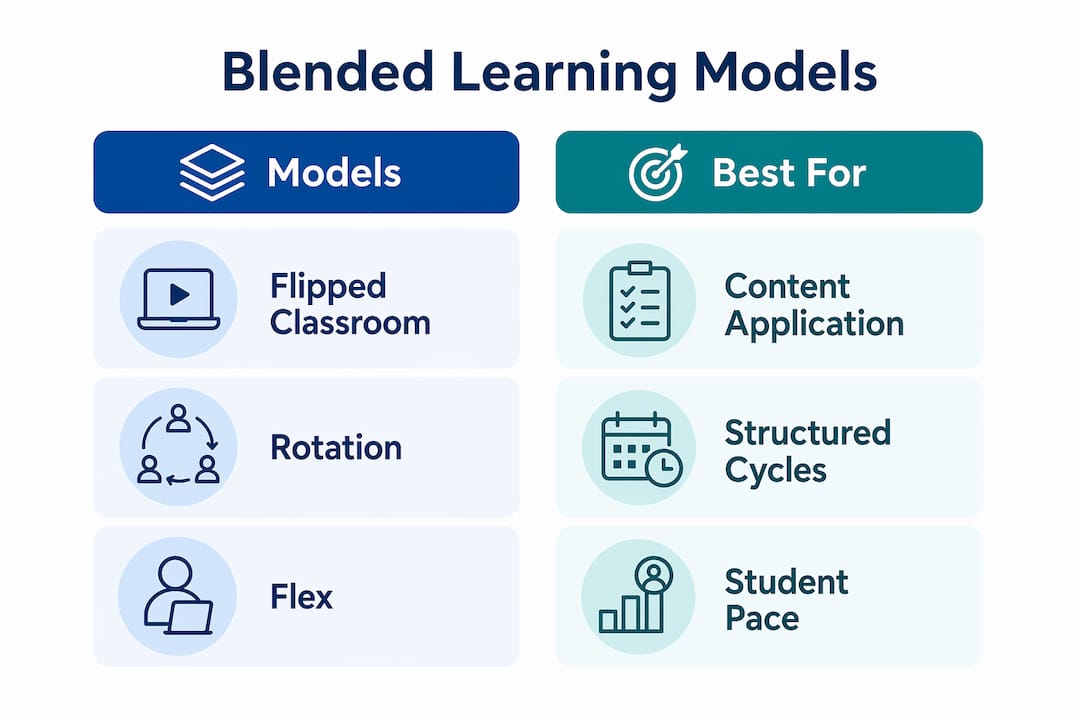
| Model | Online/Offline Balance | Best For |
|---|---|---|
| Flipped Classroom | Content online, application in class | Secondary and higher education |
| Rotation Model | Students rotate between online and face-to-face stations | K-12 classrooms |
| Flex Model | Primarily online, with on-demand teacher support | Self-directed learners |
| Enriched Virtual | Mostly online, with required in-person sessions | Distance learners needing some contact |
Each model distributes the online and offline components differently. The rotation model, for example, works well in elementary settings where a teacher manages small groups at different learning stations simultaneously. The flex model suits older students or adult learners who can manage their own schedules. The enriched virtual model is common in higher education, where students complete most coursework online but attend periodic seminars or labs.
Key distinctions between models include:
- Degree of online independence: Flex and enriched virtual models demand higher student self-regulation than rotation models.
- Teacher role: In the flipped classroom, the teacher shifts from lecturer to facilitator. In the rotation model, the teacher manages multiple simultaneous activities.
- Technology requirements: Some models require robust LMS platforms like Moodle, Blackboard, or Canvas; others function with simpler tools.
- Grade-level suitability: Rotation models are more structured and suit younger learners; flex models are better aligned with adult or higher education contexts.
For a practical breakdown of how these blended learning examples apply specifically to TEFL contexts, Teflinstitute provides targeted guidance for language educators.
What are the benefits and challenges of blended learning?
The advantages of blended learning are well-documented across multiple educational levels. A 2025 Frontiers in Education study found that students report higher learning satisfaction in blended programs compared to traditional instruction, particularly in teaching quality and ethics education. That finding signals more than student preference. It suggests that the structural flexibility of blended models produces measurable improvements in perceived instructional quality.
Additional benefits include:
- Personalized instruction: Teachers can use digital dashboards to identify which students are struggling before class begins, enabling targeted small-group intervention.
- Operational efficiency: Reduced physical materials costs and automated progress tracking lower administrative burden for institutions.
- Teacher visibility: Digital platforms enable real-time checks and timely instructional adjustments, preventing students from falling behind unnoticed.
- Engagement: Students who control their learning pace report higher motivation, particularly in asynchronous online segments.
The challenges are equally real. Initial setup is labor-intensive, requiring educators to develop new competencies in managing both synchronous and asynchronous instruction alongside real-time data analysis. Technology readiness varies widely across student populations, and institutions that underestimate this risk create inequitable learning conditions. The most underappreciated risk, however, is passive learning. Poorly designed online content produces disengaged students who click through material without genuine cognitive engagement.
Pro Tip: Before launching a blended course, audit your existing face-to-face content and identify which segments genuinely benefit from in-person interaction. Move only the content that works better asynchronously online. This prevents the common mistake of digitizing everything and losing the relational depth that classroom time provides.
How to design and implement effective blended learning courses
Effective blended course design follows a clear sequence. Skipping steps, particularly the alignment phase, is the most common reason blended programs underperform.
- Define learning objectives first. Every online and offline activity must trace back to a specific, measurable outcome. Objectives drive the choice of delivery format, not the other way around.
- Map the interdependencies. Decide which concepts require face-to-face discussion, which are suited to self-paced video or reading, and how each online activity prepares students for the next in-person session.
- Select appropriate technology. Platforms like Canvas, Moodle, or Google Classroom each offer different assessment and tracking features. Choose based on your formative assessment needs, not familiarity alone.
- Build in formative checkpoints. Use quizzes, discussion boards, or short reflective tasks within the online component to generate data before class. This data informs how you use face-to-face time.
- Scaffold student self-regulation. Student readiness and digital literacy critically affect blended learning success. A phased approach, starting with a flipped classroom model before moving to more independent flex structures, builds student capacity gradually.
- Evaluate and iterate. Collect student feedback after the first iteration and adjust the balance of online and offline components accordingly.
A critical design principle from the University of California, Davis is that the online component must replace some face-to-face contact, not simply add to it. This distinction separates genuine blended learning from technology-enhanced traditional instruction. Many educators mistake uploading slides to an LMS for blended course design. True integration requires rethinking the entire course architecture.
Pro Tip: Start with one unit or module rather than redesigning an entire course. Pilot the blended structure, collect data on student performance and satisfaction, then expand. This reduces the upfront workload and produces a more refined final design.
For broader instructional design strategies, Teflinstitute’s resources on ESL teaching methodologies offer frameworks applicable across blended and traditional contexts.
How does blended learning impact student autonomy and engagement?
Student autonomy is both the primary benefit and the primary risk of blended learning. When students control their pace and path through online content, they develop metacognitive skills that improve performance across subjects. Blended learning empowers students with control over their learning environment and enhances personalized instruction in ways that fully synchronous models cannot replicate.
The risk emerges when online content lacks coherence or purpose. Students who encounter disjointed resources, videos without clear objectives, or discussion prompts disconnected from class activities, disengage quickly. Research from getting students engaged online confirms that purposeful task design is the single most reliable predictor of sustained online engagement.
| Autonomy Factor | Impact on Engagement | Educator Response |
|---|---|---|
| Flexible pacing | Increases motivation for self-directed learners | Set minimum progress checkpoints |
| Choice of learning path | Builds ownership and reduces anxiety | Provide structured choice menus |
| Asynchronous access | Accommodates diverse schedules | Monitor completion data weekly |
| Immediate feedback | Reduces frustration and builds confidence | Use auto-graded formative quizzes |
Teacher visibility remains the counterbalance to student independence. Digital platforms that surface completion rates, quiz scores, and time-on-task data allow educators to identify disengaged students before they fall irreversibly behind. This proactive intervention model is one of the clearest advantages of hybrid learning over fully online or fully face-to-face instruction.
Key takeaways
Blended learning succeeds when online and offline components are designed as a single, interdependent system, not as parallel tracks that happen to share a course title.
| Point | Details |
|---|---|
| Blended learning definition | Integrates face-to-face and online instruction within one unified course design. |
| Model selection matters | Choose rotation, flipped, flex, or enriched virtual based on student age and digital readiness. |
| Design before technology | Align all activities to learning objectives before selecting platforms or tools. |
| Teacher visibility is critical | Use LMS data to identify struggling students early and intervene proactively. |
| Start small and iterate | Pilot one unit before redesigning an entire course to reduce workload and improve quality. |
Why blended learning demands more than a platform subscription
Most educators I have worked with approach blended learning as a technology problem. They acquire a platform, upload their existing materials, and expect the structure to do the pedagogical work. It does not. The transformation blended learning requires is instructional, not technical.
What I have found consistently is that the educators who implement blended learning most effectively are those who treat the online component as a genuine redesign opportunity rather than a digitization project. They ask which activities genuinely benefit from synchronous human interaction and which are better suited to self-paced engagement. That question forces a level of instructional clarity that improves the face-to-face sessions too, not just the online ones.
The competency gap is real. Managing dual environments, analyzing student data between sessions, and designing coherent asynchronous content all require skills that most initial teacher training programs do not cover. This is not a reason to avoid blended approaches. It is a reason to invest in structured professional development before launching them. Educators who build these competencies incrementally, starting with a single flipped unit, then expanding, consistently report better outcomes than those who attempt full-course redesigns from the start.
Blended learning is not a shortcut to better teaching. It is a framework that rewards careful design with measurably better student outcomes. The educators who benefit most are those who approach it as a long-term practice, not a one-semester experiment.
— Muller
Advance your teaching with Teflinstitute’s blended programs
Teflinstitute offers certification courses designed for educators who want to apply blended learning principles directly to their teaching practice. The 120 Hour Advanced TEFL Course incorporates blended methodologies, giving you practical experience with the same instructional models covered in this article.
For educators seeking a more extensive qualification, the 240 Hour Master TEFL Course provides externally accredited certification with a strong focus on modern instructional design, including hybrid and blended delivery. Both programs are structured to fit around existing teaching commitments, making professional development accessible without requiring a career pause. Teflinstitute’s flexible course formats reflect the same principles of learner autonomy that define effective blended learning.
FAQ
What is the blended learning definition in simple terms?
Blended learning combines face-to-face classroom instruction with online learning activities within a single course, giving students some control over the time, place, path, or pace of their learning. The online component must replace some in-person contact, not simply add to it.
How does blended learning differ from hybrid learning?
Hybrid learning and blended learning are often used interchangeably, though some institutions use hybrid to describe courses where some students attend in person while others join remotely. Blended learning specifically refers to the integration of online and face-to-face activities within a redesigned course structure.
What are the most common examples of blended learning?
The flipped classroom, rotation model, flex model, and enriched virtual model are the four most widely implemented blended learning examples. The flipped classroom, where students engage with content online before class and apply it in person, is the most commonly adopted model in secondary and higher education.
What are the main benefits of blended learning for students?
Students in blended programs report higher satisfaction compared to traditional instruction, benefit from personalized pacing, and develop self-regulation skills. Teacher visibility through digital platforms also allows for faster, more targeted intervention when students struggle.
Is blended learning suitable for all age groups?
Blended learning is adaptable across age groups, but the model must match student digital literacy and self-regulation capacity. Rotation models with structured stations suit younger learners, while flex and enriched virtual models are better aligned with adult and higher education contexts.
Recommended
TEFL Institute guides

South Korea
EPIK, hagwons and pay
Japan
JET, ALT and eikaiwa pay
Italy
Jobs, pay and visa routes
Portugal
Jobs, pay and visa routes
Germany
Freelance work and pay