

 United Kingdom (UK)
 United States (US)
 Canada
 South Africa
 India
India Australia
 New Zealand
 China
China Russia
 Germany
 France
 Spain
Spain Netherlands
 Vietnam
 United Arab Emirates
 Italy
Italy Poland
 Thailand
 Türkiye









 Algeria


Inclusive teaching: methods, strategies, and real impact
Inclusive teaching: methods, strategies, and real impact

TL;DR:
- Inclusive teaching goes beyond legal requirements, emphasizing student-centered approaches that embrace diversity and promote a sense of belonging for all learners. It involves designing flexible curricula and using frameworks like UDL, culturally responsive teaching, and scaffolding to meet diverse needs without lowering academic standards. Overcoming implementation challenges requires ongoing reflection, proper measurement, and fostering positive teacher mindsets to sustain inclusive practices effectively.
Many educators assume inclusive teaching is primarily a legal obligation, a set of accommodations reserved for students with documented disabilities. That assumption misses the point entirely. Inclusive teaching refers to student-centered pedagogical approaches that purposefully embrace diversity and foster an environment in which all students feel valued and supported in their learning process. For English language teachers, this distinction is not academic. It reshapes how you design lessons, how you interact with learners, and how you measure success in a classroom that is almost always more diverse than any single teaching method can address on its own.
Table of Contents
- Defining inclusive teaching and its core principles
- Key methodologies: Frameworks for inclusive classrooms
- Practical strategies for English language classrooms
- Challenges, measurement, and impact in real classrooms
- Why most “inclusive teaching” guides fall short—and what actually works
- Advance your inclusive teaching journey with TEFL Institute resources
- Frequently asked questions
Key Takeaways
| Point | Details |
|---|---|
| Inclusive teaching is broad | It means designing for and valuing every student’s differences, not just accommodating special needs. |
| Frameworks drive success | Universal Design for Learning and culturally responsive teaching are proven methods to support all learners. |
| Practical strategies matter | Scaffolding, adapted assessments, and valuing multilingualism improve engagement and learning for ELLs. |
| Measurement is nuanced | Success is more than test scores—look for belonging and participation, especially with neurodiverse students. |
| Mindset powers inclusion | Teachers’ beliefs directly impact the effectiveness of inclusive practices in the classroom. |
Defining inclusive teaching and its core principles
Inclusive teaching is not a single technique or a checklist item. It is a pedagogical orientation, a deliberate commitment to designing learning experiences that work for the widest possible range of students, not just those who fit a narrow academic profile.
A common misconception separates “regular” learners from those who “need extra support.” This deficit-based view treats inclusion as remediation. The broader, asset-based approach recognizes that every student brings cultural knowledge, linguistic history, and lived experience that can enrich the learning environment. The goal is not to fix individual learners but to expand the curriculum’s reach so more students can access it.
Instructors who teach inclusively design course content, pedagogy, and classroom activities that acknowledge and address the diverse lived experiences and learning needs of all students, integrating diverse materials and active learning strategies. This applies directly to ESL and EFL classrooms, where student backgrounds span dozens of countries, languages, and educational cultures.
The following comparison illustrates the difference between narrow and broad definitions of inclusive teaching:
| Dimension | Narrow (deficit-based) | Broad (asset-based) |
|---|---|---|
| Focus | Students with identified needs | All learners |
| Goal | Accommodate limitations | Build on existing strengths |
| Curriculum design | Adapted after the fact | Designed for flexibility from the start |
| Teacher role | Fixer or modifier | Facilitator and co-learner |
| Outcome measure | Compliance with accommodations | Engagement and equitable achievement |
The core principles that define inclusive teaching in English language classrooms include:
- Valuing diversity as a resource, not a barrier
- Fostering a sense of belonging for every student, regardless of background or ability
- Curriculum flexibility that allows multiple paths to the same learning goals
- High expectations for all students, supported by the tools they need to meet those expectations
- Ongoing reflection by the teacher on biases, assumptions, and instructional choices
Understanding these principles forms the basis for selecting the right ESL teaching methodologies and staying current with ESL teaching trends that reflect how the field is evolving.
Key methodologies: Frameworks for inclusive classrooms
With a clear understanding of the core principles, let’s look at the frameworks that make inclusive classrooms possible.
Key methodologies include Universal Design for Learning (UDL), culturally responsive teaching, differentiated instruction, scaffolding, peer collaboration, and technology integration for English Language Learners (ELLs). Each framework addresses a different dimension of inclusion and can be combined for greater effect.
Universal Design for Learning (UDL) is a proactive approach. Rather than modifying lessons after noticing a student is struggling, UDL builds multiple access points into every lesson from the start. In an EFL setting, this might mean providing both written and audio instructions, offering visual vocabulary supports, and giving students a choice in how they demonstrate understanding, whether through speaking, writing, or visual presentation.
Culturally responsive teaching connects academic content to students’ cultural backgrounds and lived experiences. In a multilingual classroom, this means selecting texts and topics that reflect the diversity of the group, acknowledging students’ home languages as legitimate and valuable, and avoiding materials that center only one cultural perspective.
Differentiated instruction allows teachers to adjust content, process, product, and learning environment based on student readiness, interests, and learning profiles. This does not mean creating thirty different lesson plans. It means building lessons with enough variation that students at different proficiency levels can all participate meaningfully.
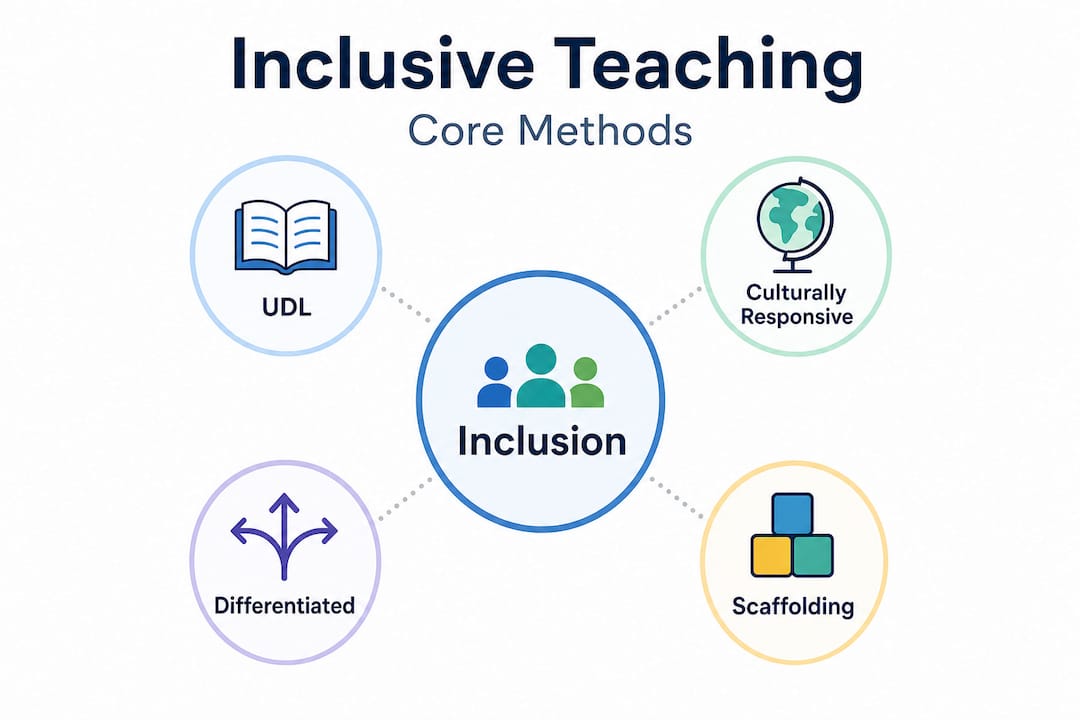
Scaffolding is particularly critical in language classrooms. It involves providing temporary support structures, such as sentence frames, visual organizers, glossaries, or worked examples, that help students access content they could not reach independently. As students develop skills, scaffolds are gradually removed.
The table below maps each methodology to the student needs it addresses most directly:
| Methodology | Primary student need addressed | Example in EFL classroom |
|---|---|---|
| UDL | Varied learning profiles | Multiple formats for instructions and assessment |
| Culturally responsive teaching | Cultural relevance and identity | Texts from students’ home countries |
| Differentiated instruction | Mixed proficiency levels | Tiered tasks for the same topic |
| Scaffolding | Language access gaps | Sentence frames and graphic organizers |
| Peer collaboration | Social integration and language practice | Structured pair and group work |
| Technology integration | Accessibility and engagement | Captioned videos, translation tools |
To implement these frameworks effectively, consider this structured sequence:
- Audit your current materials for cultural bias, language accessibility, and assumed background knowledge.
- Identify the primary barriers your students face: linguistic, cognitive, social, or logistical.
- Select two or three frameworks that directly address those barriers before adding more.
- Build flexibility into assessments so students can demonstrate understanding in different ways.
- Gather student feedback regularly and adjust your approach based on what they report.
Pro Tip: When introducing any new inclusive framework, start with the methodology that directly increases student talk time. ELLs benefit most from proven ESL strategies that prioritize oral participation, which builds both confidence and language proficiency simultaneously. You can also explore resources designed to enhance classroom skills for further guidance.
Practical strategies for English language classrooms
Frameworks set the foundation, but what does inclusion look like in everyday classroom practice?
Inclusive practices for English language teaching involve culturally responsive pedagogy, explicit vocabulary instruction, sentence frames, adapted assessments, and normalizing multilingualism. Translating these practices into specific classroom actions is where theory becomes real impact.

Vocabulary scaffolding is one of the highest-leverage strategies available. Rather than presenting new vocabulary as a list to memorize, effective teachers pre-teach words in context, use visual anchors, and revisit terms across multiple lessons and activities. Students who encounter vocabulary in reading, speaking, listening, and writing retain it at significantly higher rates.
Sentence frames reduce the anxiety that often prevents ELLs from participating verbally. Providing structures such as “I agree with ___ because ___” or “One example of this is ___” gives students a grammatical foothold without limiting the content of their responses. This is especially effective for academic discussions where students have ideas but lack the linguistic precision to express them fluently.
Adapted assessments do not mean lower standards. They mean that students can demonstrate the same knowledge through different formats. A student who struggles with written exams may excel in a recorded oral response or a visual project. Measuring the same competency through multiple formats produces more accurate data about what students actually know.
Normalizing multilingualism involves acknowledging students’ home languages as assets rather than barriers. This can be as simple as allowing brief peer discussions in a shared first language before transitioning to English, or displaying vocabulary in multiple languages on classroom walls. This approach signals to students that their full linguistic identity is welcome in the learning space.
Additional practical strategies that work well in EFL and ESL classrooms include:
- Using music and drama to build vocabulary and practice spoken fluency in low-stakes, enjoyable formats
- Incorporating visual supports such as diagrams, charts, and illustrated vocabulary cards
- Structuring cooperative learning so that mixed-ability groups support peer language development
- Designing a physical classroom layout that encourages collaboration and reduces isolation
- Using interactive language collaboration tools that allow students to practice language with peers in real time
For practical setup advice, consult an ESL classroom setup guide that addresses both physical and instructional design. For activity ideas, explore ESL classroom ideas and ESL class games that make participation accessible and engaging for all proficiency levels. Supporting materials covered in resources on teaching aids in ESL can also substantially improve learner engagement.
Pro Tip: Celebrate student assets publicly and specifically. When a student uses vocabulary correctly in context or successfully completes a task using a scaffold, name what they did well and why it matters. Specific, asset-focused feedback builds intrinsic motivation faster than generic praise.
Challenges, measurement, and impact in real classrooms
Even with the best methods, inclusive teaching faces real-world roadblocks. Here’s what you need to know about overcoming them and measuring progress.
A systematic review of 233 studies on inclusive education for autistic students found social interactions and skills as the most targeted outcomes, with cognitive-behavioral interventions predominant, but heterogeneous measurement tools and lack of implementation details in half the studies. This finding has significant implications for all inclusive teaching contexts, not just special education. If researchers cannot consistently measure what inclusive teaching produces, practitioners face a similar challenge in their own classrooms.
Key challenges educators consistently report include:
- Measuring inclusion quantitatively. Standardized tests rarely capture social belonging, confidence growth, or the incremental linguistic gains ELLs experience. Teachers must develop additional measurement tools such as observation logs, student self-assessments, and portfolio documentation.
- Supporting social and emotional development alongside academic progress. Linguistic and cultural adjustment are emotionally demanding for ELLs. Inclusion requires addressing both dimensions, not just academic achievement.
- Insufficient implementation guidance. Many inclusive teaching frameworks are well-theorized but under-specified. Teachers often lack the detailed procedural knowledge needed to apply them consistently, particularly in under-resourced settings.
- Time and resource constraints. Differentiated planning, adapted materials, and individualized feedback all require time that many teachers do not have in adequate supply.
- Inconsistency across school or program contexts. A student may receive excellent inclusive support in one class and none in another, which undermines cumulative progress.
Despite these challenges, the evidence supports continued investment in inclusive practices. Teachers’ inclusive efficacious beliefs positively influence intentions to teach inclusively, which means that professional development focused on mindset, not just technique, produces measurable classroom change. Teachers who believe they can effectively include all students are substantially more likely to implement inclusive strategies consistently.
Effective classroom management for ESL is also a critical component, as well-managed classrooms provide the safety and structure that inclusive practices require to function. For teachers focused specifically on spoken language development, resources on ESL teaching tips offer targeted guidance. For students with tactile or hands-on learning needs, hands-on literacy tools can support neurodivergent learners in accessible, engaging ways.
Why most “inclusive teaching” guides fall short—and what actually works
Having covered mainstream approaches, let’s step back and examine what most guides miss about delivering true inclusion in your classroom.
The majority of inclusive teaching resources focus on legal compliance or reduce inclusion to a checklist: add captions to videos, use a word wall, allow extra time on tests. These are useful tools. But they create the illusion of inclusion without its substance. A classroom can check every box and still communicate, through its materials, its assessments, and its daily interactions, that only certain students truly belong there.
The more uncomfortable truth is that inclusion is not a feature you bolt onto an existing course design. It requires rebuilding the instructional logic from the ground up, starting with the question: “Who is this lesson designed to exclude, and why?” That question is rarely asked in standard curriculum planning. It should be the first one.
Another persistent misconception is that inclusive teaching lowers academic rigor. In practice, the opposite is often true. When teachers provide more entry points to high-level content, including scaffolded vocabulary, visual representations, and structured discussion protocols, more students access that content and engage with it at a higher cognitive level. The rigor is not reduced. The access is expanded.
There is also a gap between one-time professional development and sustained practice. A workshop on UDL does not make a teacher inclusive. What makes a teacher inclusive is a feedback cycle: implement a strategy, observe what happens, gather student input, adjust, and repeat. This is the same reflective practice that characterizes strong teaching in any context. Applied specifically to inclusion and to teaching young learners, it produces steady, compounding improvements over time.
The most effective inclusive teachers are not the ones with the longest list of strategies. They are the ones who understand their students well enough to know which strategies to apply, when, and for whom.
Advance your inclusive teaching journey with TEFL Institute resources
Building genuinely inclusive English language classrooms is both a skill and a professional commitment, and both require the right training foundation.

TEFL Institute offers structured, internationally recognized training to help you teach with confidence across diverse classroom contexts. Whether you are pursuing your initial TEFL certification courses or looking to deepen your practice through specialized options, the Institute provides a range of flexible pathways. Teachers already certified can extend TEFL training through targeted course extensions that address areas such as teaching young learners, ELL support, and advanced pedagogy. These resources give you the theoretical grounding and practical tools to implement the inclusive strategies covered in this article.
Frequently asked questions
What are the most effective inclusive teaching strategies for English learners?
The most effective strategies include Universal Design for Learning, culturally responsive pedagogy, scaffolding, adapted assessments, and explicit vocabulary instruction, all of which are supported by research on ELL methodologies and practical inclusive frameworks.
How is inclusive teaching different from differentiated instruction?
Inclusive teaching is a holistic pedagogical orientation that values all learners from the outset, while differentiated instruction is a specific classroom tool used within that broader framework to address individual student needs.
What are the challenges in implementing inclusive teaching?
Common challenges include inconsistent measurement tools, gaps in implementation detail, and adapting resources for diverse learners, issues documented in a 233-study systematic review on inclusive education outcomes.
Does inclusive teaching lower academic standards?
No. Inclusive teaching maintains high expectations by providing multiple access routes to the same learning goals, as described in inclusive course design principles that integrate diverse strategies without reducing content rigor.
Why is teacher mindset important for inclusive teaching?
Research confirms that inclusive efficacy beliefs in teachers directly increase the likelihood that inclusive practices are implemented consistently, making mindset development as important as methodology training.
Recommended
TEFL Institute guides

Vietnam
Work permits and requirements
Germany
Freelance work and pay
Taiwan
Buxibans, pay and visas
Japan
JET, ALT and eikaiwa pay
Thailand
Visas and teaching licences