

 United Kingdom (UK)
 United States (US)
 Canada
 South Africa
 India
India Australia
 New Zealand
 China
China Russia
 Germany
 France
 Spain
Spain Netherlands
 Vietnam
 United Arab Emirates
 Italy
Italy Poland
 Thailand
 Türkiye









 Algeria


What Is Language Immersion? a Parent’s Guide
What Is Language Immersion? a Parent’s Guide

TL;DR:
- Language immersion involves actively using the target language as the primary means of communication, instruction, and interaction. It requires structured programs that promote meaningful engagement through deliberate scaffolding, interaction, and cultural context to ensure effective language acquisition and retention.
Language immersion is one of the most discussed approaches in language education, yet it is also one of the most misunderstood. Many people assume that simply surrounding a learner with a new language is enough to produce fluency. What is language immersion in practice, though, goes much deeper than passive exposure. It is a structured method where the target language functions as the primary medium for communication, instruction, and daily interaction. This guide explains exactly how immersion works, what program types exist, and what parents and individuals should know before choosing this path.
Key Takeaways
| Point | Details |
|---|---|
| Immersion means active use | Language immersion requires consistent, meaningful engagement with the language, not just passive exposure. |
| Multiple program models exist | Dual language, heritage, and transitional programs each serve different learner backgrounds and goals. |
| Comprehensible input drives acquisition | Learners acquire language most effectively when input is understandable yet slightly beyond their current level. |
| Benefits extend beyond fluency | Immersion supports cognitive development, academic achievement, and cultural understanding over the long term. |
| Program quality depends on structure | Qualified teachers, deliberate scaffolding, and authentic communication opportunities determine whether immersion is truly effective. |
What is language immersion, defined
At its core, language immersion means learners use the target language as the primary communication medium, with programs ranging from partial to full immersion. In a full immersion setting, the target language is used exclusively for all instruction and interaction. In partial immersion, it may cover 50% or more of the school day or learning environment.

This approach differs sharply from traditional language learning. A conventional classroom might teach French grammar and vocabulary for one hour a day in English. An immersion setting teaches math, science, and social studies through French, treating the language as a tool rather than a subject.
Immersion takes place across several different environments:
- Classroom-based programs: Schools that dedicate part or all of instruction to a partner language, often starting in kindergarten
- Homestay programs: Learners live with native-speaking families, conducting daily life entirely in the target language
- Travel immersion: Adults or students spend time abroad in structured programs combining formal study with real-world practice, including cultural activities and excursions
- At-home immersion: Families create partial immersion at home through media, tutors, or dedicated language-use routines
The defining feature across all settings is that the language is a vehicle for real communication, not a subject to be memorized in isolation.
Types of language immersion programs
Understanding which program model fits a learner’s background is critical. The label “immersion program” covers significantly different structures and goals, and program design varies widely depending on who the program serves.
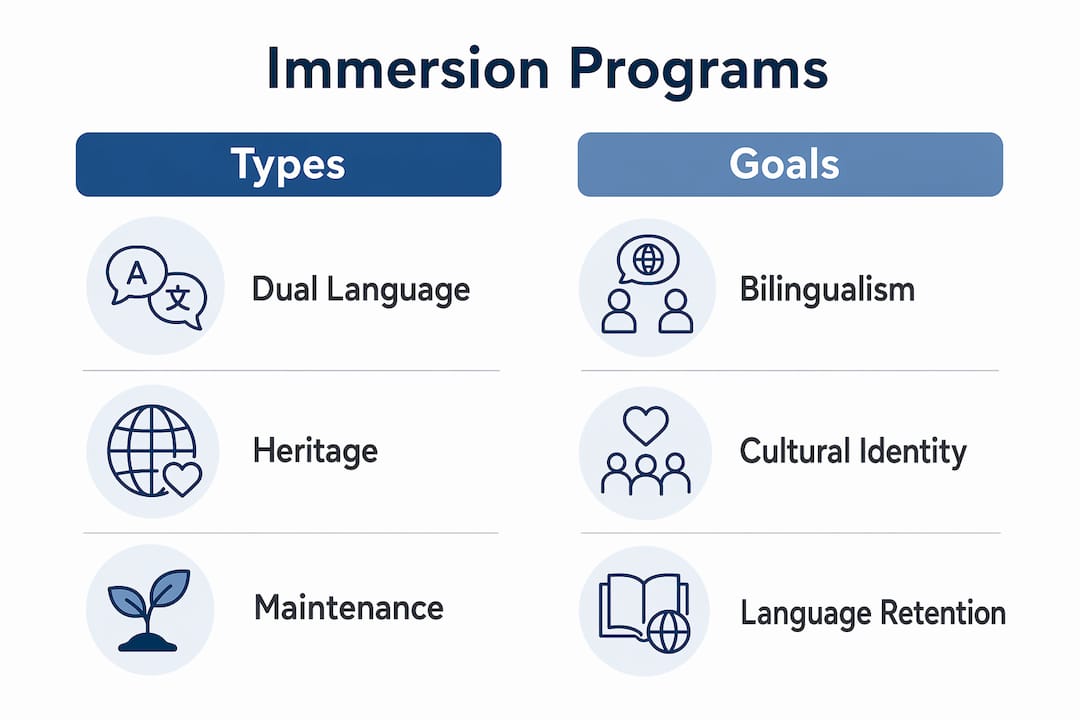
The most widely recognized model in the United States is dual language immersion (DLI). These programs teach academic content and language instruction in both English and a partner language, typically starting in kindergarten or first grade. They serve both native English speakers and English learners side by side, with the goal of full bilingualism and biliteracy.
Beyond DLI, there are five recognized program types in K-12 education:
| Program type | Primary goal | Who it serves |
|---|---|---|
| Dual language immersion | Bilingualism and biliteracy for all | Mixed groups: English learners and native speakers |
| Heritage language | Maintain or restore a home language | Students with family roots in the partner language |
| Maintenance bilingual | Sustain the home language while building English | English learners transitioning to mainstream classes |
| Enrichment bilingual | Add a second language as an academic asset | Predominantly English-speaking students |
| Transitional bilingual | Build enough of the home language to transition to English | Early-stage English learners |
Parents should carefully match their child’s home language background and learning goals to the appropriate model before enrolling. A native English speaker placed in a transitional bilingual program, for example, may find the structure is not designed with their needs in mind.
Pro Tip: Ask any prospective program to clarify the time split between languages, the model type, and whether teachers are trained to deliver academic content in the partner language. The label “immersion” alone tells you very little.
How language immersion works in practice
The most widely accepted explanation for why immersion produces results is Stephen Krashen’s Input Hypothesis. The theory holds that comprehensible input at level i+1 drives acquisition: learners absorb a new language most effectively when the material is understandable yet slightly beyond their current ability.
This means a well-designed immersion classroom is not about throwing learners into incomprehensible content and hoping fluency emerges. Teachers use deliberate scaffolding strategies to keep input understandable:
- Visual aids such as pictures, diagrams, and labeled objects
- Predictable daily routines that give learners contextual cues
- Repetition and rephrasing to reinforce new vocabulary
- Gestures and physical demonstration to clarify meaning
You can read more about the theory behind this in Teflinstitute’s overview of language acquisition insights for educators.
However, input alone is not sufficient. Research confirms that programs requiring active production generate fuller language competence than input-only environments. Learners need to speak, write, ask questions, and engage in real communicative tasks.
“Being surrounded by a language without interaction does not equal effective immersion. Consistent communication and participation matter more.” — The Linguist
This is the single most important distinction between effective and ineffective immersion. A student who sits quietly in a partner-language classroom without being required to produce output may absorb some vocabulary but will not develop functional fluency. Active, meaningful use of the language is what converts exposure into competence.
Benefits of language immersion
The benefits of immersion extend well beyond being able to hold a conversation in another language. Research consistently points to a range of academic, cognitive, and cultural advantages for learners who participate in quality programs.
- Improved fluency and pronunciation: Because learners hear and use the target language across real communicative contexts, their speaking patterns and intonation develop more naturally than in grammar-focused instruction.
- Long-term retention: Learners who acquire language through meaningful interaction retain it longer. The association with real experiences and academic content strengthens memory more than rote memorization of vocabulary lists.
- Cognitive benefits: Regularly managing two languages strengthens executive function, including attention control and problem-solving skills, benefits observed even in young children.
- Academic achievement: DLI participants frequently demonstrate strong academic performance across subjects, partly because learning content in two languages builds deeper conceptual understanding.
- Cultural competence: Immersion, particularly programs involving cultural engagement abroad, gives learners direct contact with communities that speak the language, building genuine cross-cultural understanding rather than textbook awareness.
Pro Tip: For adults considering immersion programs abroad, look for programs that include homestay options and structured cultural activities alongside formal classes. Small group sizes and real-world interaction outside the classroom significantly accelerate results.
Choosing or creating an immersion experience
Whether you are a parent evaluating school programs or an individual planning a language immersion experience, the quality of the structure around the immersion matters as much as the immersion itself.
For parents assessing school programs, ask the following:
- Are teachers fluent in the partner language, and are they trained to teach academic content through it?
- What percentage of the school day is delivered in the partner language?
- Does the program use deliberate scaffolding, or is instruction delivered without support for comprehension?
- Is there a clear progression in language complexity from grade to grade?
For adults building immersion experiences, the options range widely. Programs abroad now cater to diverse age groups, including those 50 and older, offering small classes, homestays, and structured cultural excursions designed to put language to immediate practical use.
At home, you can build partial immersion through consistent habits:
- Designate specific times or rooms where only the target language is spoken
- Use media in the target language, including podcasts, films, and books appropriate to the learner’s level
- Work with tutors or language exchange partners who commit to using only the target language in sessions
- Supplement with apps that require production, not just recognition
The key across all settings is to move from passive consumption to active use as quickly as possible. Understanding specific immersion teaching methods can also help parents identify whether a classroom is applying them correctly.
My perspective on what immersion actually requires
I’ve spent considerable time studying how immersion environments succeed and fail, and the pattern is consistent. The word “immersion” is applied broadly to situations that range from genuinely transformative to barely functional. What I’ve found is that the label is often more marketing than methodology.
In my view, the biggest pitfall is programs that use the partner language as a surface feature. A classroom where teachers switch to English whenever learners look confused is not an immersion classroom. It is a bilingual classroom with aspirations. The scaffolding requirement is not optional. Without it, learners either disengage or coast on their dominant language.
What I’ve seen work best is when cultural and linguistic engagement happen together. A student learning Spanish through math problems, music, and conversation with native-speaking peers develops something qualitatively different from one who memorizes conjugations. The cultural layer makes the language meaningful, and meaning is what drives retention.
For parents, my honest advice is this: visit the classroom before enrolling. Watch whether teachers use the partner language consistently, whether learners are required to respond in it, and whether there is visible scaffolding in the environment. Those three things predict outcomes better than any program brochure.
— Muller
Preparing to teach or support immersion programs
If this guide has clarified how immersion works, the next practical step is gaining the skills to support or deliver it effectively. Teflinstitute offers targeted courses for educators and parents who want to engage directly with language immersion contexts. The Teaching English to Young Learners course provides a focused 30-hour program designed for those working with children in immersion or ESL settings. For those interested in delivering academic subjects through English, the CLIL-focused TEFL course covers content and language integrated learning at Level 5. Both programs are available online, making them accessible to parents, aspiring teachers, and educators looking to build specific expertise in immersion-style instruction.
FAQ
What is language immersion in simple terms?
Language immersion is a learning approach where the target language is used as the main medium for communication and instruction, rather than being taught as a separate subject.
Is language immersion effective for children?
Yes. Research consistently shows that quality immersion programs improve fluency, pronunciation, long-term retention, and even academic performance across subjects when proper scaffolding is in place.
How does language immersion differ from traditional learning?
Traditional language learning treats the language itself as the subject of study. Immersion uses the language as the medium for learning other subjects, which produces more natural acquisition over time.
What are the main types of language immersion programs?
The five main types are dual language immersion, heritage language, maintenance bilingual, enrichment bilingual, and transitional bilingual. Each serves a different learner background and carries different goals.
Can adults benefit from language immersion programs?
Absolutely. Adults benefit from structured immersion programs abroad that combine formal instruction with homestays and cultural activities, with research showing real-world interaction accelerates fluency at any age.
Recommended
TEFL Institute guides

Taiwan
Buxibans, pay and visas
China
Z visa, pay and cities
Cambodia
Pay, requirements and visas
Portugal
Jobs, pay and visa routes
Dubai
Pay, requirements and visas