
 United Kingdom (UK)
 United States (US)
 Canada
 South Africa
 India
India Australia
 New Zealand
 China
China Russia
 Germany
 France
 Spain
Spain Netherlands
 Vietnam
 United Arab Emirates
 Italy
Italy Poland
 Thailand
 Türkiye








 Algeria


What Is Job Placement? A Guide for Job Seekers

TL;DR:
- Job placement services connect candidates with employers at no cost to the job seeker, with agencies acting as intermediaries. They access hidden job markets, provide expert guidance, and streamline the hiring process, but do not guarantee employment. Effective use requires active candidate participation, careful contract review, and understanding the distinctions between job placements and internship experiences.
Most people assume job placement services cost money. That assumption stops a lot of qualified candidates from using one of the most effective tools available to them. Understanding what is job placement, how it works, and what it actually costs can shift your entire approach to finding employment. This guide covers the full picture: clear definitions, process breakdowns, honest limitations, and practical steps to use these services effectively, whether you are a recent graduate, a career switcher, or someone re-entering the workforce.
Table of Contents
- Key takeaways
- What is job placement, and what types exist
- How job placement services work
- Benefits and limitations of job placement
- Job placement vs. work placements
- Tips for getting the most from placement services
- My perspective on how job placement really works
- TEFL careers and placement support from Teflinstitute
- FAQ
Key takeaways
| Point | Details |
|---|---|
| Job placement is free for candidates | Reputable agencies never charge job seekers; employers pay the placement fee. |
| Placement services access hidden roles | Agencies connect candidates to unadvertised openings not found on public job boards. |
| Candidate initiative drives results | Active participation in mock interviews and portfolio updates directly improves placement outcomes. |
| Placement is not a guarantee | Job placement services provide support and connections, not a guaranteed job offer. |
| Know the contract terms | Success-based or reverse recruiting programs carry specific conditions that require careful review before signing. |
What is job placement, and what types exist
Job placement is the process by which a service, agency, or program connects job seekers with employers looking to fill open roles. It is not the same as applying for a job on your own. A job placement service acts as an intermediary. The agency assesses your skills, matches your profile to employer requirements, and facilitates the hiring conversation between both sides.
What is employment placement, in practice? It covers a broad range of service types. Not all placement services work the same way, and understanding the differences helps you choose the right one.
- Temporary staffing agencies place candidates in short-term or contract roles. This suits people who want flexible work or need income while searching for a permanent position.
- Temp-to-perm agencies start candidates in a temporary role with the possibility of a full-time offer based on performance.
- Permanent placement firms focus exclusively on full-time hiring. They work with employers who need to fill long-term positions and are often industry-specific.
- Outplacement services are employer-funded programs offered to employees who have been laid off. These include resume writing, career coaching, and job search support.
- Reverse recruiting agencies take a more hands-on approach, where a dedicated recruiter actively applies and advocates on your behalf.
Job placement programs also exist within academic institutions. Universities and trade schools often run career services offices that connect graduating students with employers. These are distinct from private agencies but serve a similar matching function. Job placement for students through campus offices is frequently underused, which is a significant missed opportunity given the direct employer relationships those offices maintain.
Who uses job placement services? The range is wider than most expect. Recent graduates use them to break into industries without prior connections. Mid-career professionals use them when changing fields or after a layoff. Employers use them to reduce hiring time and access pre-screened talent. According to agency research, employers benefit from reduced time-to-hire and improved candidate quality when working through agencies.
How job placement services work
The process behind job placement services follows a fairly consistent structure, though the timeline and depth vary by agency type. Knowing what to expect at each stage helps you prepare and engage more productively.
- Initial consultation and screening. You meet with a recruiter or counselor who reviews your resume, work history, and career goals. This is also where skills assessments may occur, particularly for technical or specialized roles.
- Resume and profile optimization. Most agencies will suggest revisions to your resume and LinkedIn profile. Recruiters provide resume optimization and interview briefs, though they are not substitutes for candidates understanding their own market value.
- Candidate-employer matching. The agency compares your profile against current employer needs and open roles. This step is where access to unlisted positions becomes relevant. Many of the roles agencies fill are not posted publicly.
- Interview preparation. Good placement agencies conduct mock interviews, provide company-specific briefings, and coach you on negotiation. This is particularly valuable for candidates who have been out of the workforce for a period.
- Employer communication. The agency presents your profile to employers, manages scheduling, and often facilitates early-stage negotiations on salary range and role expectations.
- Offer and placement. When an employer extends an offer, the agency coordinates the final steps. The employer then pays the agency a commission or finder’s fee. Job placement services are free for job seekers in legitimate arrangements.
Some newer programs follow a reverse recruiting model. These charge a fee to the candidate, but only after a job offer is accepted. Some programs charge $5,000 to $7,500 post-placement with refund clauses under specific conditions. These are legitimate options, but the contract terms require close review before you commit.
Pro Tip: Ask any placement agency directly: “How do you get paid, and when?” A legitimate agency will answer clearly. If the answer is vague or involves upfront payment, that is a warning sign.

Benefits and limitations of job placement
Understanding both sides of this equation helps you use placement services strategically rather than expecting them to do everything for you.
Key benefits
- Access to hidden job markets. Agencies use extensive networks to find unlisted job openings. A meaningful share of positions are filled before they ever reach public job boards.
- Expert guidance. You receive professional input on your resume, interview performance, and how to position your skills for specific industries or roles.
- Reduced application effort. Instead of sending out dozens of applications manually, you work with someone who targets only relevant openings on your behalf.
- Faster hiring timelines. Employers using agencies are typically actively hiring, which compresses the time between first contact and offer.
Limitations to be aware of
Placement services do not guarantee employment. Placement assistance means support; a placement guarantee carries stringent conditions and is often misunderstood by candidates who expect it to function as a promise.
“Candidates who actively engage see better outcomes from placement services.” This finding reflects a core truth: the agency opens doors, but the candidate must walk through them.
Upfront fees are red flags for scams. If an agency asks for money before any placement occurs and before any offer is accepted, disengage immediately. Legitimate job placement agencies are compensated by employers, not candidates.
Job placement vs. work placements
These two terms are frequently confused, and the distinction matters for students in particular.
| Feature | Job placement services | Work placements (internships) |
|---|---|---|
| Primary purpose | Match candidates to paid employment | Provide work experience, often for academic credit |
| Who it serves | Job seekers of all backgrounds | Students, typically in final academic years |
| Duration | Varies: temporary to permanent | Fixed term, usually weeks to months |
| Compensation | Typically paid employment | May be unpaid or minimally compensated |
| Outcome | Job offer and employment contract | Practical experience, possible academic credit |
| Who initiates | Agency or candidate | Student and educational institution |
Work placements are academic-credit-bearing temporary arrangements completed during study. They are structured learning experiences, not job offers. Job placement services, by contrast, aim to produce actual employment. Confusing the two leads students to underutilize career services offices or to expect job placement agencies to provide the type of mentored, supervised experience that a work placement offers.
Every TEFL opening, salary and deadline that matters.
In your inbox every two weeks. Free, no spam, unsubscribe any time.
Teacher pay by country
New TEFL openings
Programme and visa dates
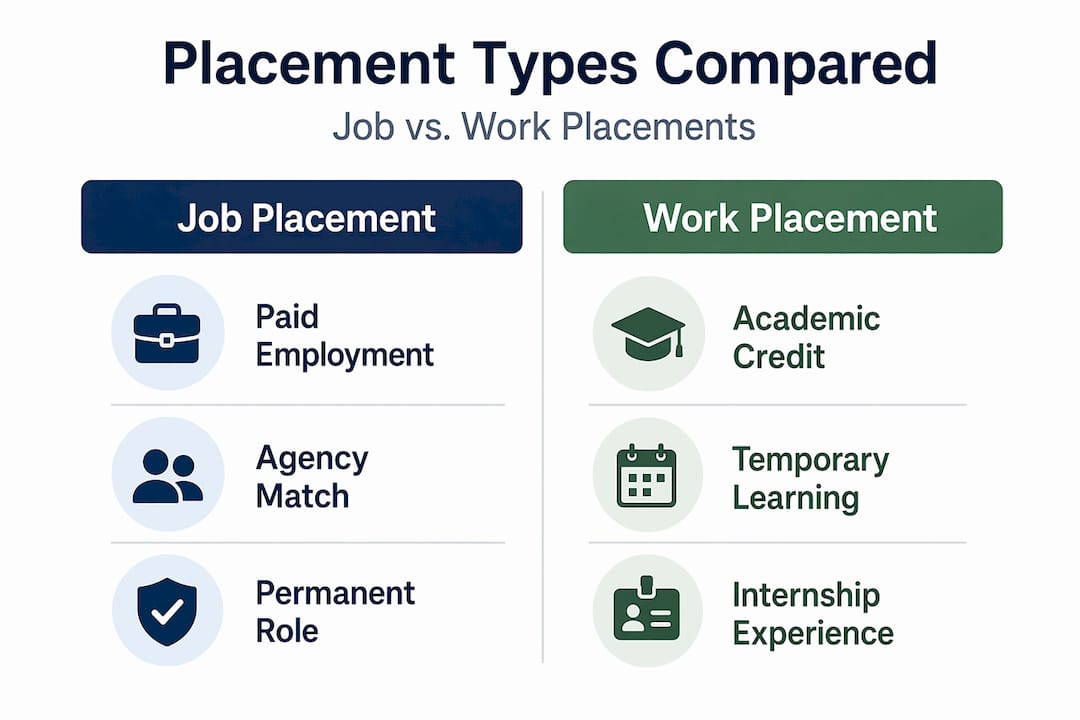
If you are a student nearing graduation, you likely have access to both. Using a work placement to gain industry experience while simultaneously registering with a job placement agency for your post-graduation job search is a practical and effective combination.
Tips for getting the most from placement services
Finding the right agency matters as much as using the process correctly. A specialized agency that focuses on your industry will have stronger employer relationships and more relevant openings than a generalist firm.
- Research agency specialization. A technology staffing firm has different networks than a healthcare placement agency. Match the agency to your field.
- Update your portfolio before outreach. Candidates who actively engage with mock interviews, hiring events, and updated materials see better results. Do this before your first meeting.
- Attend employer hiring events. Many placement agencies run or facilitate direct hiring drives. These are high-value touchpoints where employer decision-makers are present.
- Use AI tools to complement agency support. The future of job hunting involves strategic use of AI tools to sharpen your messaging and increase search efficiency. Agencies support your search, but AI-assisted targeting adds another layer. Resources like job search tips and career coaching guides can help you develop that independent capability.
- Read every contract carefully. Success-based fee contracts may include clauses about payment if you independently accept a job after the program ends. Know what you are agreeing to.
Pro Tip: Before registering with any agency, check their employer client list and ask for recent placement examples in your field. Agencies with verifiable placements in your sector are worth your time. Those that deflect or generalize are not.
The free resources from Teflinstitute, including the Job Hunter’s Pack and Recruit Me Kit, provide useful templates and tools for candidates preparing to engage with placement services.
My perspective on how job placement really works
I have observed a consistent pattern across hundreds of job seekers who use placement services: most of them expect too much from the agency and too little from themselves. The agency handles outreach, screens roles, and prepares you for interviews. What it cannot do is perform in that interview for you or make an employer choose you over another qualified candidate.
The other thing I have noticed is how few candidates ask the right questions before signing up. They focus on whether the service costs money rather than whether the agency has real relationships with employers in their sector. A well-connected niche agency will outperform a large generalist firm for most candidates. Smaller network, deeper access.
The rise of AI in job searching has also changed the dynamic. Candidates who use AI tools to sharpen their applications, research employers, and prepare for interviews arrive better equipped than those who rely entirely on the agency. The best outcomes I have seen come from candidates who treat the placement agency as one component of a broader, active job search strategy rather than a passive handoff.
Placement assistance and placement guarantees are not the same thing, and most people only discover this distinction after they have been waiting for results for weeks. Read the terms before you commit to any program.
— Muller
TEFL careers and placement support from Teflinstitute
If you are exploring teaching English abroad as a career path, job placement support is a real part of what Teflinstitute provides alongside its TEFL certifications. The 120-hour TEFL course and the 240-hour Master TEFL Course both include access to career resources and job placement tools designed to connect graduates with international teaching roles. Certified candidates gain access to the TEFL Institute Jobs Board and global employer networks, which function much like a specialized placement agency for English teaching positions. Explore how Teflinstitute finds TEFL jobs after certification to understand how placement support works in the context of ESL careers.
FAQ
What is job placement in simple terms?
Job placement is the process of matching a job seeker with a suitable employer, typically through an agency or program that handles screening, matching, and coordination. The goal is an actual employment offer, not just an introduction.
Do job placement agencies charge candidates?
Legitimate agencies never charge job seekers. Employers pay a commission or finder’s fee when a successful hire is made. Any agency requesting upfront payment from a candidate is a red flag.
How does job placement work for students?
Job placement for students typically involves a university career office or a specialized agency that connects graduating students with employers in their field. Students should register early and attend hiring events to maximize results.
What is the difference between job placement and a work placement?
Job placement services connect candidates to paid employment through an agency-employer matching process. Work placements are structured academic experiences, often unpaid, completed during study for academic credit rather than employment.
How long does job placement take?
Timelines vary by industry, role level, and candidate readiness. Temporary positions can be filled within days. Permanent placements through agencies typically take several weeks to a few months depending on the sector and employer hiring pace.
Recommended

Tara and Jess talk through different TEFL and EFL topics, from finding work abroad to life in the classroom.