

 United Kingdom (UK)
 United States (US)
 Canada
 South Africa
 India
India Australia
 New Zealand
 China
China Russia
 Germany
 France
 Spain
Spain Netherlands
 Vietnam
 United Arab Emirates
 Italy
Italy Poland
 Thailand
 Türkiye









 Algeria


What Is Teaching Practice? A TEFL Guide for Aspiring Teachers
What Is Teaching Practice? A TEFL Guide for Aspiring Teachers

TL;DR:
- Teaching practice transforms theoretical knowledge into practical classroom skills through supervised lessons, observation, and feedback. It significantly improves lesson planning, classroom management, and confidence, helping candidates secure employment and succeed in diverse teaching environments. Engaging in authentic, cyclical practice prepares teachers for real-world challenges, making it a crucial component of effective TEFL certification.
Knowing the theory of second language acquisition is valuable, but it does not automatically produce an effective classroom teacher. Many aspiring educators complete coursework covering grammar, phonology, and lesson planning only to find themselves underprepared when they stand in front of real students for the first time. Teaching practice, also called a practicum, addresses this gap directly by placing candidates in supervised classroom environments where they plan lessons, deliver instruction, and receive structured feedback. For anyone pursuing TEFL certification, understanding what teaching practice involves and why it matters is a foundational step in building a credible, lasting career.
Table of Contents
- Defining teaching practice: What it really means
- The core components of effective teaching practice
- Microteaching and innovative methods in teaching practice
- Debates and evolving best practices in teacher education
- How teaching practice shapes your TEFL career
- Why teaching practice often matters more than theory
- Take the next step: TEFL teaching practice with expert support
- Frequently asked questions
Key Takeaways
| Point | Details |
|---|---|
| Hands-on learning | Teaching practice gives you guided classroom experience essential for teacher development. |
| Feedback-driven growth | Regular mentor and peer observations help you improve lesson delivery techniques faster. |
| Career advantage | Employers value practicum experience, boosting readiness for international or online teaching jobs. |
| Varied practices matter | Combining microteaching and full lessons prepares you for different classroom challenges. |
Defining teaching practice: What it really means
Teaching practice is not simply an add-on to a TEFL course. It is a structured, supervised phase designed to convert theoretical knowledge into practical classroom skill. In teacher education, a practicum is a supervised phase where aspiring teachers plan and deliver real lessons and receive observation and feedback to bridge theory and classroom realities. That definition captures why this component occupies a central position in any well-designed certification program.
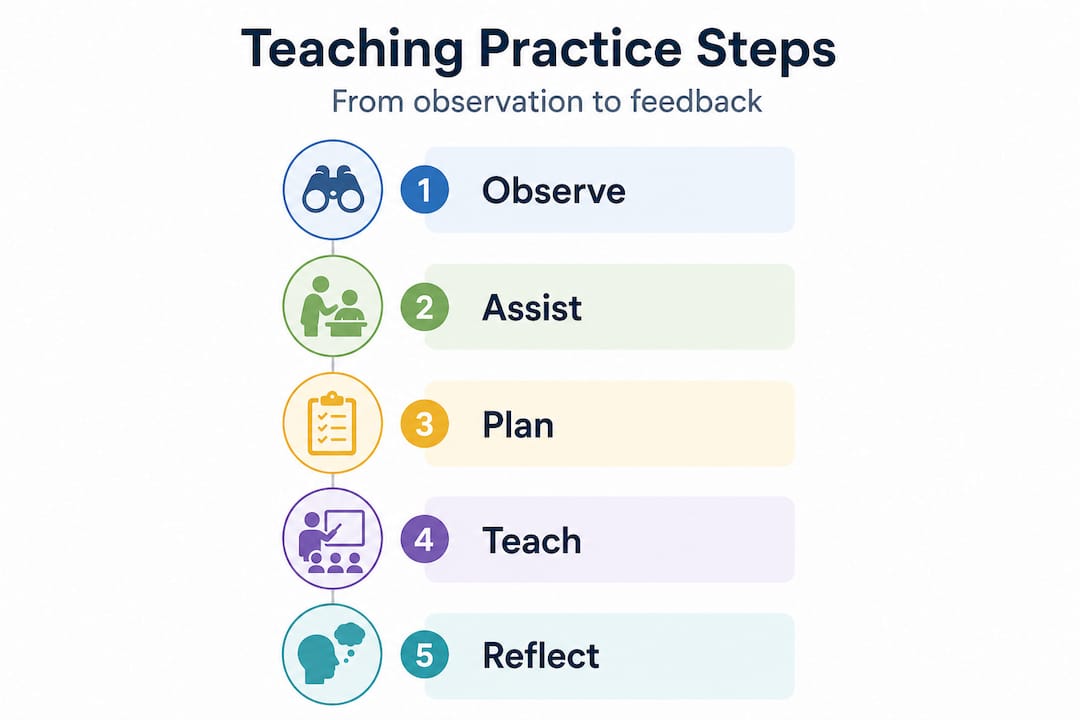
During a practicum, candidates engage in several distinct activities. First, they observe experienced teachers in action, noting how professionals manage transitions, handle unexpected questions, and adjust pacing in real time. Second, they design and deliver their own lessons under the supervision of a qualified mentor. Third, they receive detailed feedback, both written and verbal, on what worked and what requires adjustment. Reviewing this feedback and applying it to subsequent lessons is what transforms single observations into genuine professional development.
The following table summarizes key teaching practice activities and their primary purpose.
| Activity | Primary purpose |
|---|---|
| Observing mentor lessons | Build a reference model for effective teaching |
| Designing lesson plans | Apply theoretical knowledge to real learning objectives |
| Delivering supervised lessons | Develop timing, pacing, and classroom communication |
| Receiving structured feedback | Identify specific areas for improvement |
| Reflecting and revising | Consolidate learning and internalize adjustments |
For TEFL candidates specifically, a TEFL practicum guide outlines how these activities map onto the particular demands of teaching English to non-native speakers across different age groups and proficiency levels. The contexts vary widely, from young learners in Southeast Asia to adult professionals in Europe, and teaching practice prepares candidates to navigate that variation with confidence.
Key outcomes of a well-structured teaching practice phase include:
- Improved lesson sequencing based on real student responses rather than theoretical models
- Greater classroom management competence developed through direct experience
- A documented record of supervised hours that employers recognize as verifiable professional preparation
- Increased personal confidence when entering new teaching environments
The core components of effective teaching practice
With a definition in place, it helps to know what actually happens during teaching practice and why each piece is important. Required components typically include observing others’ teaching, delivering lessons under supervision, and using peer and mentor feedback to develop teaching based on that feedback. Each component serves a distinct developmental function, and omitting any one of them weakens the overall preparation.
Most TEFL programs structure teaching practice using a cyclical model that repeats across the duration of the practicum:
- Observe a lesson delivered by a qualified, experienced teacher
- Plan your own lesson informed by what you observed
- Deliver that lesson to real or practice students while a mentor observes
- Reflect through written self-assessment and discussion with your mentor
- Revise your approach for the next delivery cycle
This iterative structure is intentional. A single lesson delivery rarely produces dramatic change. Repeated cycles, each building on the last, create the kind of habit formation and adaptive thinking that defines effective teaching.
The table below compares program types based on how teaching practice is structured.
| Program type | Supervised hours | Feedback format | Ideal for |
|---|---|---|---|
| Online only (no practicum) | 0 | Self-directed | Theory knowledge only |
| Online with virtual practicum | 6 to 10 hours | Recorded review | Remote learners |
| Hybrid (blended) | 10 to 20 hours | Live mentor observation | Most candidates |
| In-person intensive | 15 to 20+ hours | Direct, real-time feedback | Maximum job readiness |
Pro Tip: Before enrolling in any TEFL program, confirm whether the practicum uses real students or peer simulation. Employers increasingly differentiate between the two, and programs that incorporate authentic student interaction carry more weight on a resume.
For candidates preparing their first practicum, practical TEFL practicum tips can help reduce anxiety and set clear performance expectations before the first observed lesson. Additionally, candidates who cannot access in-person placements can explore a virtual TEFL practicum as a credible and increasingly accepted alternative that preserves the supervised, feedback-driven structure of traditional teaching practice.
Microteaching and innovative methods in teaching practice
Beyond traditional practice, innovative methods like microteaching play a crucial role in modern teacher training. Microteaching is a common training method within teaching-practice programs that lets teachers refine specific techniques in a controlled setting using feedback. Rather than managing a full 45-minute lesson from start to finish, a microteaching session typically lasts 5 to 15 minutes and focuses on one discrete skill, such as giving instructions clearly, correcting errors sensitively, or introducing new vocabulary effectively.
The advantages of microteaching for TEFL candidates are significant:
- Targeted skill development allows candidates to isolate and improve specific weaknesses
- Lower stakes environment reduces the pressure associated with full-lesson observation
- Immediate feedback from peers or mentors is easier to absorb when the session is short
- Iterative repetition means candidates can reteach the same segment after feedback to measure improvement
- Flexible delivery makes microteaching suitable for both in-person and online formats
Beyond microteaching, modern TEFL teacher training programs are incorporating role-play scenarios, online classroom simulations, and peer-teaching exercises where candidates take turns being teacher and student. These methods serve a parallel function to literacy training approaches used in other educational fields, where structured, low-stakes practice environments accelerate skill acquisition before high-stakes deployment.
“The goal of microteaching is not to create a performance for evaluation, but to build a technical repertoire that functions reliably under the unpredictable conditions of a real classroom.”
TEFL candidates teaching young learners benefit particularly from microteaching because managing attention, motivation, and behavior in younger age groups requires specific, practiced techniques that cannot simply be read about and applied. Pairing microteaching with an understanding of proven ESL methodologies gives candidates both the theoretical framework and the hands-on competence to execute those methods reliably.
Pro Tip: Record your microteaching sessions when possible. Watching your own delivery back, even once, reveals habits of speech, body language, and classroom positioning that mentor feedback alone may not capture.

Debates and evolving best practices in teacher education
Alongside new techniques, there are open discussions and even disagreements on the best way to train great teachers. The field of teacher education is not static. Research continues to challenge assumptions about which instructional strategies produce the best learning outcomes, and TEFL is not exempt from this scrutiny.
One of the most actively debated areas concerns the effectiveness of specific instructional approaches. There is debate around one-size-fits-all instruction and which strategies actually improve learning. Some researchers argue that commonly used instructional practices lack sufficient evidence, while others stress that multiple approaches can yield benefits depending on what aspect of learning is being targeted.
For TEFL teachers, this debate has practical implications. A method that produces strong reading outcomes in one context may underperform in a conversation-focused class. A grammar-translation approach may serve adult learners preparing for academic exams but frustrate young learners seeking communicative fluency. The key insight from current research is that effective teaching practice should develop adaptive teachers, not just technically proficient ones.
Key considerations arising from current debates in teacher education include:
- No single instructional method has been shown to be universally superior across all learner types and contexts
- Reflective practice, the habit of evaluating and adjusting your own teaching, is one of the most consistently validated skills across research studies
- Evidence-based adaptation requires that teachers understand multiple methods well enough to select the right one for a specific learner group
- Feedback literacy, the ability to receive, interpret, and act on critical feedback, is increasingly recognized as a core professional competency
“The most effective teachers are not those who master one method perfectly, but those who can recognize when a method is not working and pivot without losing the room.”
Developing strong classroom management strategies is one area where the research consensus is relatively clear: proactive management reduces disruption more reliably than reactive discipline. Pairing this with thoughtful lesson planning for TEFL gives candidates both the structure and the flexibility their future classrooms will demand. Incorporating student engagement tactics from adjacent fields further strengthens a candidate’s toolkit for maintaining productive classroom environments.
How teaching practice shapes your TEFL career
Understanding the debates and options, the real question becomes: how does participating in teaching practice impact your future TEFL career? The answer is direct. Teaching practice offers supervised phase experience that helps bridge theory and classroom realities, which is essential for job readiness. This is not a theoretical benefit. It has observable consequences for how candidates perform in interviews, how quickly they integrate into new teaching environments, and how they are evaluated by hiring schools and language centers.
Here is a structured approach to maximizing the career impact of your teaching practice:
- Document every supervised session with dates, student levels, lesson objectives, and mentor names. This creates a verifiable professional record.
- Request written feedback from mentors after each observed lesson and file it as supporting evidence of your development.
- Track measurable improvement across your practicum by comparing early and late feedback reports. Employers respond well to candidates who can articulate their growth.
- Include practicum details on your resume with specific hours completed, student demographics, and lesson types delivered.
- Prepare to discuss your practicum experience in job interviews. Specific examples of challenges you encountered and how you addressed them demonstrate professional maturity.
Key career statistic: Candidates with verified practicum experience report substantially higher confidence ratings and faster initial employment compared to those completing theory-only programs. Schools hiring for international positions, particularly in Asia and the Middle East, frequently list practicum experience as a preferred or required qualification.
Exploring the TEFL practicum job benefits in detail can help candidates understand precisely how supervised teaching hours translate into competitive advantages in the global ESL job market. For employers, a verified practicum is evidence that a candidate has been observed, evaluated, and confirmed competent by a qualified assessor. That third-party validation carries weight that a grade on a theory exam simply cannot replicate.
Why teaching practice often matters more than theory
With a look at career impact, it is time to offer an honest, experience-driven take on the unique value of actual classroom teaching during a TEFL journey. The professional development that happens inside a practicum is qualitatively different from anything produced by reading, watching, or studying alone.
Theory prepares you to understand why a method should work. Teaching practice teaches you what to do when it does not. That distinction is not minor. In a real classroom, a lesson plan can unravel within the first five minutes. A mentor observing that moment, and helping a candidate recover, reset, and adapt, provides a learning experience that no textbook chapter can replicate.
The most persistent misconception in TEFL preparation is that a high theory score signals readiness to teach. Employers who have hired dozens of certified teachers know otherwise. They look for candidates who have been observed, who have received critical feedback, and who have demonstrated the capacity to adjust. These qualities are developed in practice, not in written assessments.
A lesson that does not go well is not a failure. It is data. Every awkward transition, every student who looks confused, every instruction that generates silence rather than action points toward a specific improvement. Candidates who receive honest, detailed feedback and insist on understanding why something did not work are the ones who develop quickly and stand out in competitive hiring processes. Review firsthand TEFL practicum advice to understand what experienced practitioners consider the most valuable aspects of the supervised teaching phase.
The instinct to be cautious with new teachers, to offer only positive feedback, ultimately does them a disservice. Candidates should seek mentors and programs that prioritize honest, specific, and actionable observation notes over general encouragement.
Take the next step: TEFL teaching practice with expert support
If you are ready to move beyond theory and strengthen your teaching career, here is how to get started with the right support. TEFL Institute offers a range of certification programs that integrate structured teaching practice components, giving candidates the supervised classroom hours that employers value and the expert mentor feedback that drives real professional development.

Whether you are based in the United States and exploring TEFL certification in Texas or looking to supplement an existing qualification through targeted TEFL course extensions, TEFL Institute provides flexible, accredited pathways designed around your schedule and career goals. Programs are structured to support both in-person and virtual practicum options, so candidates teaching internationally or online can access the same quality of supervised training regardless of location. The next step is not complicated: review the available programs, confirm the practicum structure included, and enroll with a provider that takes practical teaching preparation as seriously as you do.
Frequently asked questions
What is the main difference between teaching practice and theory courses?
Teaching practice involves supervised classroom experience where candidates deliver real lessons and receive structured feedback, while theory courses focus on educational concepts without direct student interaction.
Is microteaching required for all TEFL teaching practice?
Microteaching is common in many teaching-practice programs as a skill development tool, but specific requirements vary by certification provider and program format.
How long does teaching practice usually last in TEFL programs?
The duration typically ranges from 6 to 20 hours of supervised classroom time, with variation depending on the certification level and program provider.
Can teaching practice be completed online?
Yes, many accredited TEFL programs now offer virtual or blended practicum options that preserve the supervised, feedback-driven structure of traditional in-person teaching practice.
Does practicum experience improve TEFL job prospects?
Supervised teaching practice is highly valued by ESL employers worldwide because it provides verifiable evidence of classroom competence and professional readiness that theory-only certification cannot supply.
Recommended
TEFL Institute guides

Czech Republic
Pay, visas and cities
Cambodia
Pay, requirements and visas
Estonia
Jobs, pay and work routes
Spain
Jobs, pay and visa routes
Germany
Freelance work and pay