
 United Kingdom (UK)
 United States (US)
 Canada
 South Africa
 India
India Australia
 New Zealand
 China
China Russia
 Germany
 France
 Spain
Spain Netherlands
 Vietnam
 United Arab Emirates
 Italy
Italy Poland
 Thailand
 Türkiye









 Algeria


What Is Syllabus Design? A Guide for Educators
What Is Syllabus Design? A Guide for Educators

TL;DR:
- Syllabus design involves creating a learner-centered document that clearly communicates course objectives, assessments, and policies. It guides student engagement, promotes inclusivity, and bridges curriculum goals with course-level planning. Regular revision based on feedback enhances its effectiveness as a teaching tool.
Syllabus design is defined as the structured process of creating a learner-centered course document that outlines learning objectives, assessments, policies, and resources to guide student success. In language teaching, this process functions as both a policy document and a pedagogical tool, giving students a transparent roadmap from day one. The Harvard Derek Bok Center for Teaching and Learning describes syllabus design as a detailed process establishing course logistics, learning objectives, schedules, and student responsibilities. For TEFL educators and curriculum developers, understanding what syllabus design requires in practice is the foundation of effective course management.
What is syllabus design and why does it matter?
Syllabus design is the intentional process of constructing a document that communicates course expectations, aligns instructional goals with assessments, and reduces student uncertainty before the first lesson begins. It is not simply a list of topics or a course calendar. A well-designed syllabus functions as the first pedagogical intervention a student encounters, setting the tone for the entire learning experience.

The importance of syllabus design extends beyond administrative convenience. When students understand how weekly tasks connect to broader learning outcomes, they engage more purposefully with course material. Portland State University’s Office of Academic Innovation confirms that effective syllabi reflect alignment between learning objectives, instructional methods, and assessments. This alignment is what separates a functional syllabus from a generic course outline.
For language educators specifically, the syllabus communicates not just what will be taught, but how proficiency will be measured and what support is available. A TEFL course syllabus that maps speaking tasks to communicative competency goals, for example, gives learners a clear picture of how their practice connects to real-world language use. That clarity reduces anxiety and increases motivation, two factors that directly affect language acquisition outcomes.
What are the essential components of effective syllabus design?
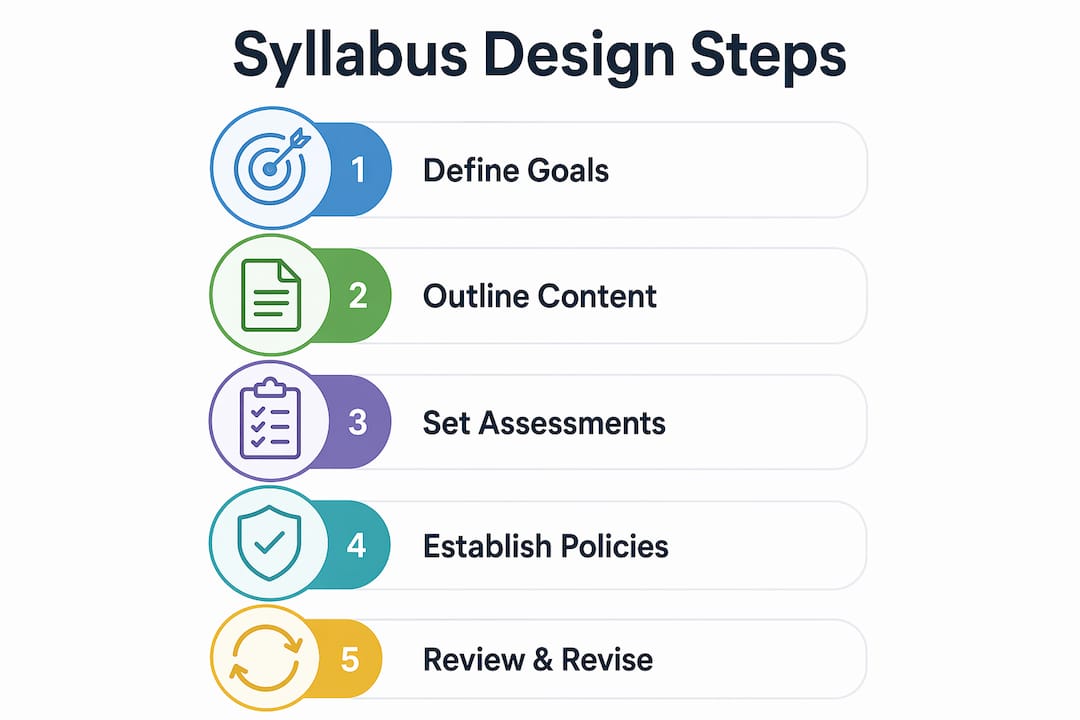
A well-structured syllabus contains several core components, each serving a distinct function in the learner-centered course experience. UMass Dartmouth’s instructional development resources identify the following as standard elements:
- Course basics: Title, instructor contact information, meeting times or platform details, and a brief course description that frames the subject matter.
- Learning objectives: Measurable, specific goals that describe what students will be able to do by the end of the course. In language teaching, these often reference proficiency frameworks such as the Common European Framework of Reference (CEFR).
- Course schedule: A week-by-week or unit-by-unit breakdown of topics, readings, and key deadlines that allows students to plan their workload.
- Assessment and grading criteria: A transparent explanation of how student performance is evaluated, including weighting for each task type.
- Student responsibilities and policies: Participation expectations, late work procedures, academic integrity standards, and any prerequisites for course activities.
- Course materials and technology: Required texts, digital platforms, and any tools students need to access or purchase before the course begins.
- Communication and support: Office hours, response time expectations, and links to institutional support services such as writing centers or tutoring programs.
Santa Clara University’s Center for Teaching Excellence notes that clear formatting and headings reduce cognitive load and improve student comprehension. This means the visual structure of a syllabus is as important as its content. Students skim documents before they read them, so front-loading critical information increases the likelihood that key expectations are actually absorbed.
Pro Tip: Place your most critical policies, such as grading breakdown and late work rules, within the first third of the syllabus document. Students who skim will still encounter the information that matters most.
How does syllabus design promote inclusivity and equitable learning?
Syllabi are not culturally neutral documents. The language, examples, and policies embedded in a course document reflect assumptions about who the “ideal student” is, and those assumptions can disadvantage learners from underrepresented backgrounds. The University of Colorado Boulder’s Center for Teaching and Learning confirms that inclusive syllabus design minimizes misunderstandings by writing for diverse learners rather than a single imagined audience.
Equity-minded syllabus design involves more than adding a diversity statement. The UC Davis Center for Educational Effectiveness identifies deep reflection and revision as necessary steps, requiring educators to examine whose norms inform their materials and assessments. Superficial additions do not address the underlying assumptions that can create barriers for students who are first-generation college attendees, non-native English speakers, or learners without consistent technology access.
Practical strategies for building equity into a syllabus include:
- Write participation policies that account for different communication styles, not just verbal classroom contributions.
- Specify technology requirements clearly and early, and identify institutional resources for students who lack access.
- Use plain, direct language in all policy sections to avoid penalizing students who are still developing academic literacy.
- Include an explicit accessibility statement and outline the process for requesting accommodations without stigma.
- Consider co-creating elements of the syllabus with students, a practice sometimes called the “liquid syllabus” approach, which increases student ownership of course expectations.
“Equity is more than diversity statements in syllabus design; it involves critically examining whose norms and language inform materials and assessments.” — UC Davis Center for Educational Effectiveness
Language educators working in TEFL contexts face a specific equity challenge: many students are learning in a second or additional language, which means policy language that is dense or idiomatic can itself become a comprehension barrier. Writing policies in plain, direct English is not just good practice. It is a form of respect for the learner’s position.
What processes and strategies optimize syllabus design for language teaching?
The syllabus design process for language educators requires deliberate alignment between what students are expected to learn, how they will practice it, and how their progress will be assessed. Santa Clara University’s guidance confirms that linking objectives to assessments in the syllabus helps students understand how specific tasks relate to skill development. For a TEFL course, this might mean explicitly connecting a weekly conversation task to the speaking descriptor in the course’s stated CEFR level.
Transparent assignment design is one of the most effective syllabus development strategies available. Northeastern University’s learning design resources show that transparent assignment descriptions that include purpose, task, and success criteria reduce ambiguity and increase student agency from the first week. Rather than writing “Essay 1: 500 words on a cultural topic,” a transparent description explains why the task exists, what the student must produce, and what distinguishes a strong response from a weak one.
The table below compares two common approaches to syllabus structure in language teaching contexts:
| Approach | Characteristics | Best suited for |
|---|---|---|
| Traditional syllabus | Topic-by-topic list, minimal rationale, policy-heavy | Short courses with experienced learners |
| Learner-centered syllabus | Objectives mapped to tasks, transparent criteria, equity-aware language | Diverse classrooms, TEFL, and online delivery |
Integrating the syllabus with a learning management system such as Canvas or Moodle improves usability without increasing document length. UMass Dartmouth recommends that syllabi complement LMS platforms by providing a course overview and major components, while the LMS holds detailed module-level information. This division keeps the syllabus scannable and reduces the need for constant revisions to the core document.
Revision is itself a critical part of the syllabus design process. Collecting student feedback at the midpoint of a course and adjusting policies or pacing for the following term treats the syllabus as a living document rather than a fixed contract. Educators who create effective TEFL curricula consistently report that iterative revision based on learner experience produces measurably better course outcomes over time.
Pro Tip: After each course, annotate your syllabus with notes on what worked and what confused students. These annotations become the foundation for a stronger document next term without requiring a full redesign.
How does syllabus design differ from curriculum design?
Syllabus design and curriculum design are related but operate at different levels of scope. Understanding the distinction helps educators make more deliberate choices about what belongs in each document.
- Curriculum design refers to the program-level framework that defines the overall goals, scope, sequence, and philosophy of an educational program. It answers the question: what should learners be able to do by the end of this program?
- Syllabus design is course-specific and operational. It translates curriculum goals into a concrete plan for a single course, specifying how those goals will be pursued within a defined timeframe.
- A curriculum document for a TEFL diploma program might specify that graduates demonstrate B2-level spoken fluency. The syllabus for an individual speaking course within that program then defines the specific tasks, assessments, and weekly activities that build toward that benchmark.
- Syllabi communicate curriculum goals to students in accessible language, making the connection between individual assignments and program-wide outcomes visible.
- In language teaching, this distinction matters because educators often inherit curriculum frameworks from institutions or accrediting bodies. Syllabus design is where individual educators exercise professional judgment about pacing, materials, and assessment methods within those constraints.
Portland State University’s course design resources reinforce that the syllabus functions as an on-ramp that communicates outcomes, assessments, and support derived from broader course design decisions. Educators who understand this relationship can design syllabi that are both institutionally aligned and genuinely responsive to their specific learners. For those exploring how TEFL specializations shape course-level decisions, the distinction between curriculum and syllabus becomes especially relevant when designing for niche contexts such as business English or exam preparation.
The syllabus as a first act of teaching
Every syllabus I have reviewed that confused students shared one characteristic: it was written for the institution, not the learner. Policies were dense, objectives were vague, and the document read more like a legal disclaimer than an invitation to learn. The educators who produced those syllabi were not careless. They were simply working from a template that prioritized compliance over communication.
What I have found consistently is that the most effective syllabi treat the document as the first act of teaching. The tone, the structure, and the level of transparency all signal to students what kind of learning environment they are entering. A syllabus that explains why an assignment exists, not just what it requires, tells students that their understanding matters. That signal is not trivial. It shapes how students approach the course from week one.
The equity dimension is where I see the most room for growth among experienced educators. Many instructors assume that clear policies are sufficient. They are not. Language that is technically clear can still carry assumptions about prior knowledge, communication norms, or technology access that disadvantage specific learners. Reviewing a syllabus through the lens of a first-generation student or a non-native English speaker reveals gaps that are invisible from the instructor’s perspective.
The syllabus is not finished when the course begins. It is a document that should evolve with each iteration of the course, informed by what students found confusing, what policies created unintended barriers, and what objectives needed sharper definition. Treating it as a living document is not a sign of inconsistency. It is a sign of professional commitment to continuous improvement.
— Muller
Advance your syllabus design skills with Teflinstitute
Teflinstitute offers structured TEFL courses designed for educators who want to move beyond basic course planning and develop genuine expertise in syllabus and curriculum design for language teaching.

The 120-hour Elective TEFL Course provides focused training in language teaching methodology, including how to align learning objectives with assessments and structure course documents for diverse learners. For educators seeking deeper preparation, the 240-hour Master TEFL Course covers curriculum development, lesson planning, and advanced instructional design within an externally accredited framework. Both programs are delivered online and structured to fit around existing teaching commitments, making professional development accessible without requiring a career pause.
FAQ
What is syllabus design in simple terms?
Syllabus design is the process of creating a structured course document that outlines learning objectives, assessments, policies, and resources. It functions as both a course roadmap and a communication tool between instructor and student.
What are the main components of syllabus design?
The core components include course basics, measurable learning objectives, a course schedule, assessment and grading criteria, student responsibility policies, required materials, and communication expectations. Each component serves a distinct function in reducing student uncertainty.
How does syllabus design differ from lesson planning?
Syllabus design operates at the course level, defining overall goals and structure across an entire term. Lesson planning operates at the session level, detailing specific activities and content for individual class meetings within that broader framework.
Why is inclusive syllabus design important in language teaching?
Inclusive design ensures that course policies and language do not create unintended barriers for diverse learners, including non-native English speakers and students with varying technology access. The UC Davis Center for Educational Effectiveness identifies equity-minded revision as a core principle of effective syllabus development.
How often should a syllabus be revised?
A syllabus should be reviewed and updated after each course iteration, incorporating student feedback and adjustments to pacing, policies, or assessment criteria. Treating the syllabus as a living document produces stronger course outcomes over successive terms.
Key takeaways
Effective syllabus design requires alignment between learning objectives, assessments, and course structure, combined with equity-aware language and transparent policies that serve all learners.
| Point | Details |
|---|---|
| Definition of syllabus design | It is the structured process of creating a learner-centered course document that aligns objectives, assessments, and policies. |
| Core components | Every syllabus needs learning objectives, a course schedule, grading criteria, student policies, and support resources. |
| Equity and inclusivity | Effective syllabi examine language and assumptions to remove barriers for diverse and non-native English-speaking learners. |
| Syllabus vs. curriculum | Curriculum design sets program-level goals; syllabus design translates those goals into a course-specific operational plan. |
| Revision as practice | Updating the syllabus after each course term, based on student feedback, produces measurably better outcomes over time. |
Recommended
TEFL Institute guides

Estonia
Jobs, pay and work routes
China
Z visa, pay and cities
Spain
Jobs, pay and visa routes
Germany
Freelance work and pay
Portugal
Jobs, pay and visa routes