

 United Kingdom (UK)
 United States (US)
 Canada
 South Africa
 India
India Australia
 New Zealand
 China
China Russia
 Germany
 France
 Spain
Spain Netherlands
 Vietnam
 United Arab Emirates
 Italy
Italy Poland
 Thailand
 Türkiye









 Algeria


What Is Language Proficiency? A Clear Definition
What Is Language Proficiency? A Clear Definition

TL;DR:
- Language proficiency involves the ability to communicate effectively in real-world contexts across listening, speaking, reading, and writing skills. It is assessed using frameworks like ACTFL and CEFR that focus on spontaneous, authentic language use rather than rote memorization. Evaluating proficiency across multiple dimensions and skills ensures accurate learner profiles and informed instructional decisions.
Language proficiency is defined as the ability to use a language spontaneously and effectively to accomplish real-world communication objectives across four skill domains: listening, speaking, reading, and writing. This definition, formalized by the American Council on the Teaching of Foreign Languages (ACTFL), separates proficiency from rote memorization or rehearsed performance. Two major frameworks, ACTFL and the Common European Framework of Reference for Languages (CEFR), provide the measurement standards used by educators, institutions, and employers worldwide. Understanding how proficiency is defined, measured, and developed is foundational for anyone involved in language learning or teaching.
What is language proficiency, and how is it defined?
Language proficiency refers to functional communicative competence, not grammatical perfection. The ACTFL Proficiency Guidelines define it as the capacity to use language in unrehearsed, authentic situations to meet a communication goal. This means a learner who can negotiate a hotel room, read a news article, or follow a lecture in a second language demonstrates proficiency, even if their grammar contains errors.

The four skill domains that define proficiency are listening, speaking, reading, and writing. Each domain is assessed independently because learners develop these skills at different rates. A student may read academic texts at an advanced level while speaking only at an intermediate level. This skill-specific nature of proficiency is one of the most frequently misunderstood aspects of language development.
ACTFL’s guidelines apply a four-part evaluation framework known as FACT: Functions/tasks, Accuracy, Context/content, and Text type. These four criteria determine what a learner can do in a language, not just what they know about it. The CEFR operates on a parallel principle, using “can-do” statements to describe learner abilities from A1 (beginner) through C2 (mastery). Both frameworks treat proficiency as a spectrum of communicative ability rather than a binary pass or fail.
How is language proficiency measured across different frameworks?
The two dominant measurement systems are ACTFL and CEFR, and both take a performance-based approach to assessment.
ACTFL proficiency levels and the FACT criteria
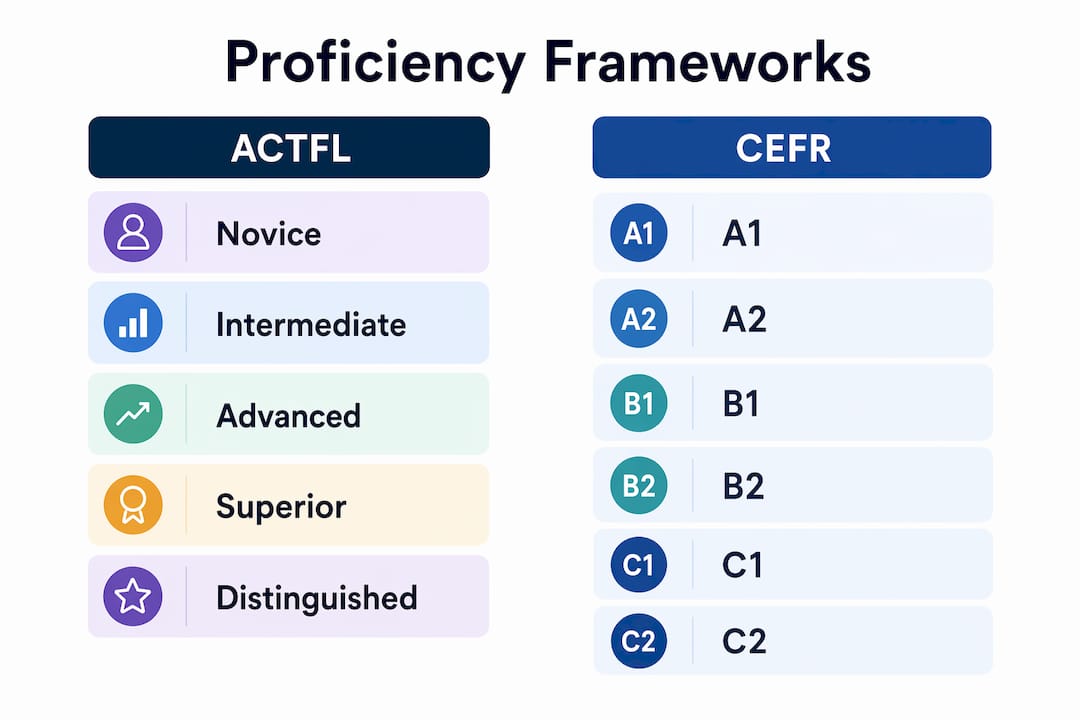
ACTFL organizes proficiency into five major levels: Novice, Intermediate, Advanced, Superior, and Distinguished. Within each level, sub-levels (Low, Mid, High) provide finer distinctions. The FACT framework evaluates each level across four dimensions: what communicative functions the learner can perform, how accurately they use the language, what contexts and content they can handle, and what types of text they can produce or comprehend. A Novice-High speaker, for example, can handle simple, predictable exchanges using memorized phrases, while an Advanced-Mid speaker can narrate and describe in paragraph-length discourse across a range of familiar topics.
CEFR levels and can-do statements
The CEFR provides six reference levels organized into three broad bands: Basic User (A1, A2), Independent User (B1, B2), and Proficient User (C1, C2). Each level is described through can-do statements that specify what a learner can understand and produce in communicative contexts. The CEFR’s learner-focused design makes it widely applicable across languages and educational systems. It is the standard used by most European universities, international employers, and language certification bodies such as Cambridge Assessment English and the Goethe-Institut.
Comparing ACTFL and CEFR
| Feature | ACTFL | CEFR |
|---|---|---|
| Number of levels | 5 main levels with sub-levels | 6 levels (A1 to C2) |
| Assessment criteria | FACT (Functions, Accuracy, Context, Text type) | Can-do descriptors |
| Primary use | North American education and government | European and international contexts |
| Skill reporting | Separate scores per domain | Separate scores per domain |
| Focus | Spontaneous, unrehearsed communication | Communicative competence in context |
Proficiency reporting by skill is a shared feature of both frameworks. This approach produces more accurate learner profiles than a single overall score, and it gives teachers specific information about where instruction should focus.
Pro Tip: When reviewing a learner’s proficiency report, look at each skill domain separately. A single composite score can mask significant gaps between, for example, reading ability and oral production.
Why is language proficiency important for learners and educators?
Language proficiency directly determines whether a person can function effectively in academic, professional, and social contexts in a second language. The importance of proficiency extends beyond the classroom into every setting where communication across languages is required.
For learners, proficiency defines what they can realistically accomplish in a language at any given point. A B2-level English speaker can participate in most professional meetings and understand complex written texts, while an A2 speaker cannot. This distinction shapes decisions about study abroad eligibility, job applications, and graduate school admissions. University proficiency exams, such as those administered by UFU in Brazil, test comprehension and interpretation of academic texts to certify readiness for graduate study. These exams demonstrate that proficiency has direct institutional consequences, not just pedagogical ones.
For educators, proficiency levels serve as the foundation for curriculum design and assessment. Key applications include:
- Placing students in appropriate courses based on assessed skill levels rather than years of study
- Writing learning objectives that specify the proficiency level learners should reach by the end of a course
- Designing tasks that require spontaneous language use rather than rehearsed recitation
- Selecting materials whose complexity matches the target proficiency level
- Evaluating whether instruction is producing measurable gains across all four skill domains
Understanding ESL proficiency levels also helps teachers communicate progress to learners and parents in concrete, meaningful terms. A statement like “your student is now at B1 in reading” carries more information than a percentage grade.
Pro Tip: Align every lesson objective with a specific ACTFL or CEFR descriptor. This practice keeps instruction focused on communicative outcomes rather than isolated grammar points.
Common misconceptions about language proficiency and assessment
Several persistent misunderstandings complicate how proficiency is taught and measured. Addressing them directly improves both assessment quality and instructional design.
- Proficiency equals grammatical accuracy. Grammatical accuracy is one criterion within the FACT framework, not the whole of proficiency. A learner who produces error-free sentences but cannot sustain a conversation on an unfamiliar topic has not demonstrated proficiency at a high level.
- Performance equals proficiency. Performance and proficiency are distinct. Performance describes what a learner can do in practiced, familiar contexts. Proficiency describes what they can do in unrehearsed, authentic situations. A student who memorizes a presentation in Spanish performs well but may not be proficient.
- A single score captures the full picture. Because learners develop skills unevenly, a single composite score obscures important differences. A learner may score at B2 in reading and A2 in speaking. Treating these as equivalent misrepresents the learner’s actual communicative capacity.
- High comprehensibility means high proficiency. Jen Carson, writing for Language Testing International, highlights that relying on comprehensibility alone can produce false positives in proficiency ratings. A response that is easy to understand but off-topic or contextually inappropriate does not demonstrate the required proficiency level.
“Writing and speaking rubrics must ensure responses address the communicative objective to avoid false positives where linguistic skill is high but task relevance is low.” — Language Testing International
● THE HIRE WIREHiring windows close while you scroll.
Deadlines, salaries and visa notes for teaching jobs worldwide, checked against official sources and sent free every two weeks.
Get on the Wire
Valid proficiency assessment requires tasks that are spontaneous, contextually appropriate, and evaluated against multiple criteria simultaneously. A single feature, whether fluency, accuracy, or vocabulary range, cannot substitute for a multi-criteria evaluation.
How to assess and improve language proficiency effectively
Effective proficiency assessment and development follow from the same principle: focus on what learners can do in real-world communication, not on isolated language features.
Assessment best practices
Sound assessment of language proficiency levels applies the FACT criteria across all four skill domains. Practical steps include:
- Using open-ended speaking and writing tasks that require learners to produce language without a script
- Selecting reading and listening texts that reflect authentic contexts, such as news articles, lectures, or workplace communications
- Scoring responses against rubrics that address all four FACT dimensions, not just accuracy
- Administering standardized tests aligned with ACTFL or CEFR, such as the ACTFL Oral Proficiency Interview (OPI), the IELTS, or the DELF/DALF for French
- Reporting results by skill domain to give learners and teachers a clear, multidimensional learner profile
Methods for improving proficiency
Proficiency grows through consistent exposure to and use of the language in authentic contexts. The following approaches are grounded in communicative language teaching principles:
- Engage with native-speaker content regularly. Podcasts, films, news broadcasts, and social media in the target language build listening and reading proficiency faster than textbook exercises alone.
- Practice speaking in unrehearsed situations. Language exchange platforms, tutoring services, and conversation groups provide the spontaneous interaction that proficiency requires.
- Write for real audiences. Blogging, correspondence, or participation in online communities in the target language develops writing proficiency more effectively than isolated composition exercises.
- Use spaced repetition tools such as Anki or Quizlet to build vocabulary, but treat vocabulary acquisition as a support for communication, not a substitute for it.
- Seek feedback aligned with proficiency criteria. A tutor or teacher who evaluates responses against ACTFL or CEFR descriptors provides more useful feedback than one who focuses only on grammar corrections.
Pro Tip: Improving language proficiency requires moving beyond comfort. Regularly attempt tasks slightly above your current level, such as reading texts rated one CEFR level higher than your current score. This targeted challenge accelerates growth more reliably than repeating familiar material.
Technology also supports proficiency development. Platforms like Duolingo provide structured practice, while tools like iTalki connect learners with native-speaker tutors for authentic conversation. For those preparing for standardized tests, resources aligned with language acquisition principles help learners understand how proficiency develops over time.
Key takeaways
Language proficiency is a multidimensional, skill-specific ability measured by frameworks like ACTFL and CEFR, and it requires assessment across spontaneous, real-world communication tasks rather than rehearsed performance.
| Point | Details |
|---|---|
| Proficiency is skill-specific | Assess listening, speaking, reading, and writing separately for an accurate learner profile. |
| FACT criteria define levels | ACTFL evaluates Functions, Accuracy, Context, and Text type across all four domains. |
| CEFR uses can-do statements | Six levels from A1 to C2 describe communicative ability in practical, observable terms. |
| Performance is not proficiency | Rehearsed tasks measure performance; only spontaneous tasks reveal true proficiency. |
| Multi-criteria assessment is required | Relying on a single feature like accuracy or comprehensibility produces misleading results. |
Why the field is still getting proficiency assessment wrong
The frameworks exist. The research is clear. Yet a large share of language classrooms still measure proficiency through grammar tests and memorized recitations. I have reviewed curricula where every assessment task was scripted, every rubric weighted accuracy above all else, and every learner received a single composite score. These practices do not measure proficiency. They measure preparation.
The ACTFL shift toward functional communicative competence is not new, yet it remains underimplemented in many programs. Part of the problem is institutional inertia. Grammar-based tests are easier to design, easier to score, and easier to defend to administrators who associate rigor with error correction. But a learner who produces flawless sentences about topics they have rehearsed for weeks has not demonstrated the ability to communicate in an unfamiliar situation.
The other problem is that multidimensional assessment takes more time and training. Scoring an oral proficiency interview against FACT criteria requires calibrated raters and clear rubrics. Many programs lack both. The result is that proficiency, as defined by ACTFL and CEFR, is frequently described in syllabi but rarely assessed in practice.
For teachers, the practical implication is straightforward. Build at least one spontaneous, unrehearsed task into every major assessment. Evaluate it against all four FACT dimensions. Report results by skill. This does not require a complete curriculum overhaul. It requires a deliberate shift in what you treat as evidence of learning. The Spanish proficiency framework applied through CEFR offers a useful model for how this can work across different languages and learner populations.
— Muller
Deepen your proficiency knowledge with Teflinstitute
Understanding language proficiency frameworks is foundational for effective TEFL teaching. Teflinstitute offers advanced certification courses designed to build exactly this expertise.

The 120 Hour Elective TEFL Course covers language teaching methodologies aligned with ACTFL and CEFR standards, giving teachers the tools to design proficiency-based lessons and assessments. For a more thorough qualification, the 240 Hour Master TEFL Course provides externally accredited training across the full range of language teaching competencies, including proficiency assessment, curriculum design, and learner evaluation. Both courses are delivered online and structured for working professionals. Visit Teflinstitute to review course details and enrollment options.
FAQ
What is the definition of language proficiency?
Language proficiency is the ability to use a language spontaneously and effectively in real-world situations across four domains: listening, speaking, reading, and writing. It is measured by frameworks such as ACTFL and CEFR using functional, communicative criteria rather than grammatical accuracy alone.
What are the main language proficiency levels?
ACTFL defines five main levels: Novice, Intermediate, Advanced, Superior, and Distinguished, each with sub-levels. CEFR uses six levels from A1 to C2, grouped into Basic, Independent, and Proficient User bands.
How is language proficiency assessed?
Proficiency is assessed through tasks that require spontaneous, unrehearsed language use, evaluated against multiple criteria including communicative function, accuracy, context, and text type. Standardized tools include the ACTFL Oral Proficiency Interview, IELTS, and DELF/DALF.
What is the difference between language proficiency and language performance?
Performance describes what a learner can do in practiced, familiar contexts. Proficiency describes what they can do in unrehearsed, authentic situations. Only spontaneous tasks provide valid evidence of true proficiency.
Why does language proficiency matter in education?
Proficiency levels inform course placement, curriculum design, and assessment in language education. Institutions such as universities use proficiency exams to certify readiness for academic study, making proficiency a direct determinant of academic and professional opportunity.
Recommended
TEFL Institute guides

Taiwan
Buxibans, pay and visas
Germany
Freelance work and pay
Japan
JET, ALT and eikaiwa pay
Estonia
Jobs, pay and work routes
Vietnam
Work permits and requirements