United Kingdom (UK)
 United States (US)
 Canada
 South Africa
 India
 Australia
 New Zealand
 China
 Russia
 Germany
 France
 Spain
 Netherlands
 Vietnam
 United Arab Emirates
 Italy
 Poland
 Thailand
 Türkiye






 Algeria


Most English teachers in Poland spend roughly 4,000 to 5,500 zloty a month, about 930 to 1,280 euro, with a one bedroom flat outside central Warsaw. A flatshare brings that down to around 3,300 to 4,200 zloty. Warsaw is the most expensive city, mainly because of rent.
Cost of Living in Poland for English Teachers: A Full Budget Breakdown
The cost of living in Poland for an English teacher is roughly 4,000 to 5,500 zloty a month (about 930 to 1,280 euro) outside central Warsaw, rent included. Typical language school pay of 4,000 to 6,500 zloty gross covers that, but rent decides everything, and private lessons are what turn breaking even into saving.
Key takeaways
- A one bedroom flat typically costs 2,300 to 3,500 zloty a month in Krakow, Wroclaw or Gdansk, and 2,800 to 4,500 zloty in Warsaw, before the building admin fee
- A room in a shared flat, commonly 1,300 to 2,000 zloty, is the single biggest saving available to a new teacher
- Food, public transport and eating out are well below UK, Irish and US prices, with a 30 day Warsaw city pass costing around 110 zloty
- Poland’s national minimum wage is 4,806 zloty gross a month in 2026, which gives you a useful floor for judging any job offer
- Private lessons at 80 to 150 zloty an hour are the difference between a comfortable month and a tight one
- All figures are approximate typical ranges, converted at roughly 4.3 zloty to the euro, not quotes
What does a month in Poland cost an English teacher?
A single teacher living modestly in a big Polish city will usually spend 1,500 to 2,200 zloty a month on everything except housing. Rent then sits on top, and it is the number that swings your budget by a thousand zloty or more depending on the city and whether you share.
The pattern is similar to much of Central Europe. The things you buy every day, a tram ride, a coffee, a bag of groceries, a lunch at a milk bar, are clearly cheaper than in London, Dublin or Boston. The things you pay once a month, rent and the winter heating bill, feel much closer to Western prices than most guides admit, particularly in Warsaw.
| Category | Typical monthly cost (PLN) | Approx. EUR | Notes |
|---|---|---|---|
| Utilities and admin fee | 400 to 800 | 95 to 185 | Heating is often billed through the building fee |
| Groceries | 900 to 1,300 | 210 to 300 | Discount supermarkets keep this low |
| Public transport | 80 to 110 | 20 to 25 | Monthly city pass |
| Mobile and internet | 80 to 130 | 20 to 30 | Home broadband plus a SIM only plan |
| Eating out and social | 400 to 800 | 95 to 185 | Entirely within your control |
| Health and incidentals | 100 to 250 | 25 to 60 | Pharmacy, toiletries, the odd private appointment |
Add rent and you have your number. For most teachers in Krakow, Wroclaw, Gdansk or Poznan, total monthly outgoings land between 4,000 and 5,500 zloty with a one bedroom flat, or closer to 3,300 to 4,200 zloty in a flatshare. In Warsaw, assume 5,000 to 6,500 zloty for your own place.
How much is rent in Warsaw, Krakow and the other big cities?
Rent is the line that decides whether a Polish teaching salary feels generous or tight, and the gap between Warsaw and everywhere else is wide enough to change the whole experience of the job.
| City | Central one bedroom (PLN) | Outside centre (PLN) | Room in a flatshare (PLN) |
|---|---|---|---|
| Warsaw | 3,500 to 4,500 | 2,800 to 3,500 | 1,600 to 2,200 |
| Krakow | 2,800 to 3,600 | 2,300 to 2,900 | 1,400 to 1,900 |
| Wroclaw | 2,600 to 3,300 | 2,200 to 2,700 | 1,300 to 1,800 |
| Gdansk | 2,700 to 3,400 | 2,200 to 2,800 | 1,300 to 1,800 |
| Poznan and Lodz | 2,300 to 2,900 | 1,900 to 2,400 | 1,100 to 1,600 |
Warsaw pays a little more, but not enough to cancel out its rents, which is why many teachers who could work there choose Krakow, Wroclaw or Poznan instead. The smaller university cities such as Lublin, Torun or Rzeszow are cheaper again, and competition for teaching posts there is thinner.
Most flats in Poland are let furnished, which saves a new arrival a great deal of money. Landlords usually ask for a deposit of one to two months’ rent plus the first month in advance, so arrive with at least 6,000 to 8,000 zloty in reserve if you plan to take a flat on your own.
What is the czynsz, and what other housing costs catch teachers out?
The czynsz administracyjny is a monthly building fee paid on top of rent, and it is the cost new arrivals most often forget.
Listings are frequently advertised as a headline rent “plus czynsz plus media”, meaning plus the admin fee plus utilities. The admin fee covers building maintenance, water, rubbish collection and often the communal heating, and for a one bedroom flat it commonly runs 400 to 800 zloty a month. Ask for the total monthly figure, all in, before you view anything, because two flats with the same headline rent can differ by several hundred zloty once the czynsz is added.
It is also worth asking whether the landlord offers an umowa najmu okazjonalnego, the occasional lease used by many private landlords. It is perfectly normal, but it involves a notarised declaration and sometimes a named address you could move to if evicted, so ask your employer or a colleague to walk you through it before you sign.
What do utilities, internet and phone cost in Poland?
Budget 400 to 800 zloty a month for the admin fee and utilities combined in a one bedroom flat, with electricity and gas billed separately in some buildings.
Winter is the season that matters. Polish winters are properly cold, and in older buildings on district heating the cost is folded into the czynsz and spread across the year, which is kind to your cash flow. In flats with their own gas boiler or electric heating, a January bill can be two or three times an October one. Ask what the heating system is and, if you can, what last winter’s bills came to.
Connectivity is cheap and good. Fibre broadband is widely available in the cities for around 50 to 80 zloty a month, and a SIM only mobile plan with generous data commonly costs 30 to 50 zloty. Prepaid SIMs are easy to buy on arrival, though Polish law requires them to be registered with your passport.
How much should you budget for food?

Less than at home, and noticeably less if you shop the way Polish households do.
A single teacher cooking most meals will typically spend 900 to 1,300 zloty a month on groceries. The discount chains, Biedronka and Lidl above all, set the price level, and the covered markets and street stalls are where seasonal fruit, vegetables, bread and dairy are cheapest and best. Imported goods, branded cereals and anything that smells of a British or American supermarket aisle are where prices stop being a bargain.
Eating out is the pleasure in the budget. A bar mleczny, the old style milk bar, serves soup, pierogi and a main course for around 20 to 35 zloty. A sit down meal in a neighbourhood restaurant commonly lands between 50 and 80 zloty a head, and a coffee costs 12 to 18 zloty. That is why teachers on modest salaries describe a social life they could not afford on the same money in London or Dublin, and why the eating out line quietly doubles if you stop watching it.
What does getting around cost?
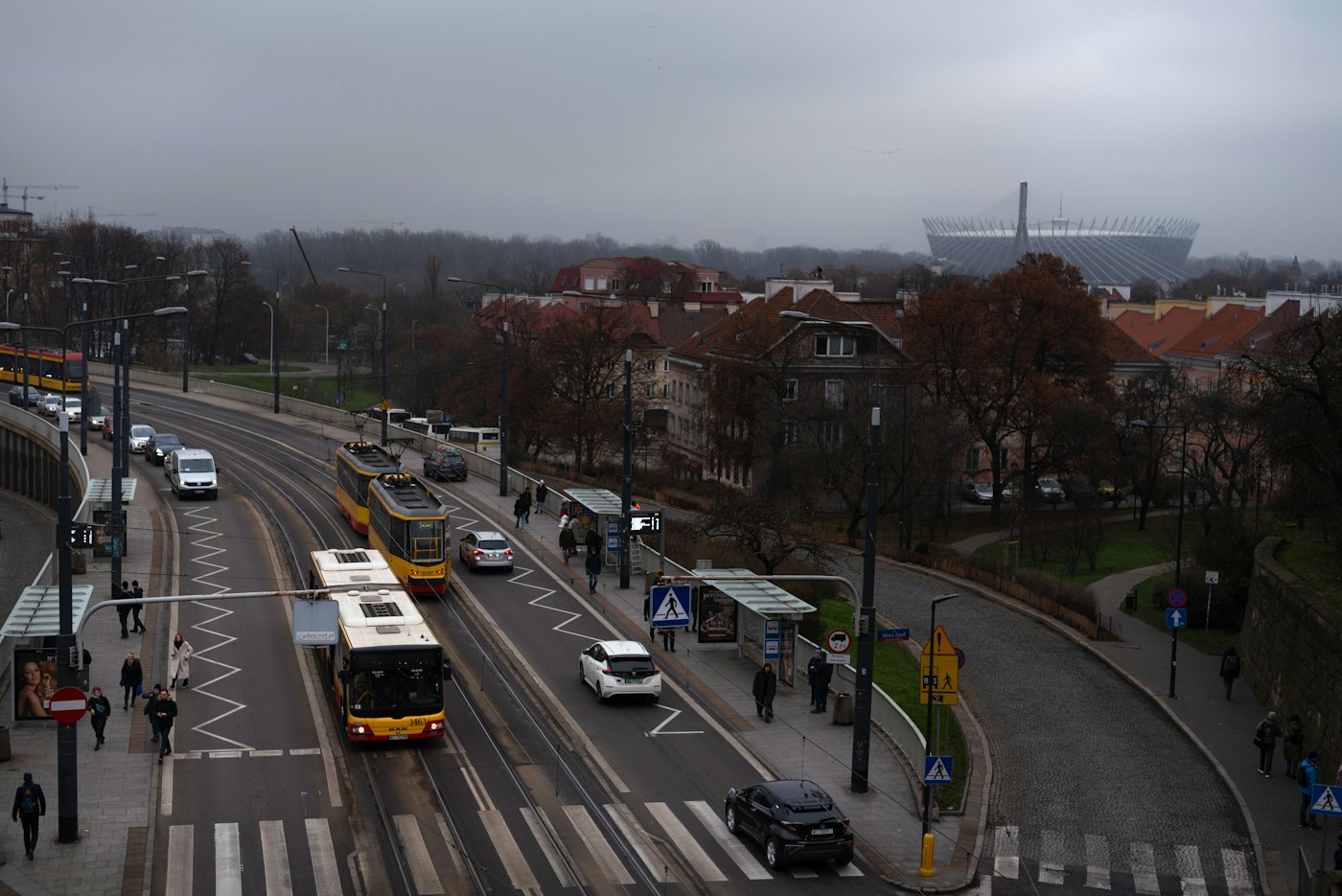
Very little. Every large Polish city has a cheap, reliable network of trams and buses, and Warsaw adds two metro lines, so almost no teacher needs a car.
A 30 day city pass in Warsaw costs around 110 zloty for the central zone, and passes in Krakow, Wroclaw, Gdansk and Poznan are in a similar range or cheaper. Many language school teachers travel between several sites or to company offices for business English classes, so a monthly pass pays for itself quickly. City bikes and e-scooters fill the gaps in summer.
Intercity travel is where costs appear, though they stay reasonable. Advance tickets on the national rail network are good value, and budget coach operators link the big cities. Weekend trips to Prague, Berlin or Vienna are easy by train or bus, which is one of the quiet pleasures of teaching in Poland.
What do English teachers in Poland earn?
Most full time language school teachers earn roughly 4,000 to 6,500 zloty gross a month, about 930 to 1,510 euro, with experienced teachers, business English specialists and exam teachers at the top of that range.
Hourly rates at private language schools commonly run 50 to 90 zloty, and a full timetable is often 20 to 25 teaching hours a week, much of it in the late afternoon and evening when children finish school and adults finish work. Private lessons pay better, typically 80 to 150 zloty an hour, and international schools and universities pay more again but usually want a teaching licence, a master’s degree or both.
A useful benchmark is the national minimum wage, which the Polish Ministry of Family, Labour and Social Policy sets at 4,806 zloty gross a month from 1 January 2026, with a minimum of 31.40 zloty an hour on civil law contracts. An offer that does not comfortably clear that floor for full time hours is not a good offer. For how the job market works in practice, see our guide to English teaching jobs in Poland.
Academic
The TEFL Institute Group
Cost of Living in Poland for English Teachers
teflinstitute.comWatch on YouTube · The TEFL Institute Group
A worked monthly budget for a teacher in Krakow
The figures below assume a single teacher on a full time language school contract in Krakow, renting a one bedroom flat outside the old town, and taking home the middle of the typical pay range.
| Line | Own flat | Flatshare |
|---|---|---|
| Net monthly pay, school contract | 4,300 (1,000) | 4,300 (1,000) |
| Rent | 2,500 (580) | 1,600 (370) |
| Admin fee and utilities | 550 (130) | 250 (60) |
| Groceries | 1,000 (230) | 1,000 (230) |
| Transport, phone and internet | 180 (40) | 150 (35) |
| Social and incidentals | 600 (140) | 600 (140) |
| Left at month end | Approximately minus 530 (minus 120) | Approximately plus 700 (plus 160) |
That is the honest arithmetic. On a school contract alone, a teacher with their own flat in Krakow is close to breaking even and can slip into the red, while the same teacher in a flatshare saves a little every month. Nothing in either column is extravagant. It simply shows why most teachers either share for their first year or add private students, and usually both.
How does your contract type change your take-home pay?
Quite a lot, because Poland uses several kinds of working arrangement, and they are taxed and insured differently.
An umowa o pracę is a standard employment contract, with paid holiday, sick pay and full social insurance through ZUS. An umowa zlecenie is a civil law contract, very common in language schools, which is more flexible and often pays a higher gross hourly rate, but with fewer employment protections and different contribution rules. Experienced teachers sometimes invoice schools as a registered sole trader on a B2B basis, which can raise take-home pay but brings its own accounting and insurance obligations.
The same gross figure can therefore produce quite different net pay, so always ask an employer for the net monthly amount, the contract type and whether paid holiday is included. Tax rules also differ for residents and non residents, so take local advice once you know which contract you will be on.
Google reviews
What our graduates say about the support after the certificate
 ★★★★★
“…On top of that, you get free access to job opportunities, webinars with graduates, and great support and guidance along the way. All in all ,you’re not just getting a certificate — you’re getting a real pathway into teaching and into the international job market.…”
Veronika Veronica · August 2026 · Google review
Rated 4.9 out of 5 from 1,876 Google reviews
What happens to your budget in July and August?
Many language school contracts run from September or October to June, so the summer months can be thin or unpaid unless your contract says otherwise.
This is the detail most cost of living guides leave out, because they quietly assume twelve months of income against twelve months of costs. Your rent does not pause in July. Ask at interview whether pay is spread across twelve months or stops when the teaching year ends. If it stops, there are three standard answers: summer camp work, which often includes accommodation and meals; keeping a few private or online students through the holidays; or setting aside 300 to 500 zloty a month from October onwards. Teachers who plan for the summer in September enjoy it. Teachers who discover it in June do not.
So is a Polish teaching salary enough to live on?
Yes, comfortably, provided you choose your city and your housing sensibly and treat private lessons as part of the job.
A teacher who shares a flat in Krakow, Wroclaw, Gdansk or Poznan, keeps six to eight private hours a week at around 100 zloty, and plans for the summer will live well, travel around Central Europe and put money aside. A teacher who takes a central Warsaw flat on a starting salary with no extra work will find the numbers tight by February. Compared with Western Europe, Poland pays less but costs a great deal less too, and the net position outside Warsaw is often better than in Spain or Italy. Our breakdowns of the cost of living in Spain for English teachers and the cost of living in Greece for English teachers make useful comparisons, and you can compare pay across markets on the TEFL Salary Index.
For official comparative price levels rather than typical ranges, Eurostat publishes price level indices across EU countries, which is the fairest way to sense check any figure you read on a blog, including this one.
Ready to teach English in Poland?
Every budget above starts with a job, and the job starts with a qualification a Polish school can check. Our Ofqual-regulated Level 5 TEFL course sits on the UK regulated qualifications framework and can be verified on the Ofqual register, while our 120 Hour Advanced TEFL Course meets the standard requirement most language schools ask for. If you hold a UK or US passport, read teaching English in Poland without an EU passport before you budget for anything. For cities, courses and the wider picture, start with our guide to teaching English in Poland and our look at the best cities to teach English in Poland.
Cost of living series: Spain · France · Germany · Greece · Morocco · Mexico · Colombia

Olivia Klimczyk
Marketing Executive at The TEFL Institute Group and the creative heart of our social media. A marketing graduate, Olivia keeps students up to date through newsletters, blogs and reels.
Reviewed 30 September 2026. Costs and pay are approximate typical ranges gathered from teacher reports, listings and market observation, not quoted prices, and vary by city, season and landlord. Euro figures use a rate of about 4.3 zloty to the euro. The minimum wage figure is from the Polish Ministry of Family, Labour and Social Policy.
We love taking your call.

TEFL Institute guides
Plan for 2027
Vietnam
Work permits and requirements
Read the guide
Plan for 2027
South Korea
EPIK, hagwons and pay
Read the guide
Plan for 2027
Germany
Freelance work and pay
Read the guide
Plan for 2027
Czech Republic
Pay, visas and cities
Read the guide
Plan for 2027
Italy
Jobs, pay and visa routes
Read the guide
A one bedroom flat typically costs 2,300 to 3,500 zloty a month in Krakow, Wroclaw or Gdansk and 2,800 to 4,500 zloty in Warsaw. A room in a shared flat usually costs 1,300 to 2,000 zloty. Most flats are let furnished, with a monthly building admin fee on top.
Yes, if you choose your city and housing sensibly. Language school teachers typically earn 4,000 to 6,500 zloty gross a month. Sharing a flat and adding a few private lessons at 80 to 150 zloty an hour lets most teachers live comfortably and save a little each month.
The czynsz administracyjny is a monthly building fee paid on top of rent. It usually covers maintenance, water, rubbish collection and often communal heating, and commonly runs 400 to 800 zloty for a one bedroom flat. Always ask for the full monthly total before viewing a property.
Krakow is generally cheaper, mainly because rent is lower. A one bedroom flat outside the centre typically costs around 2,300 to 2,900 zloty in Krakow compared with 2,800 to 3,500 zloty in Warsaw. Warsaw pays slightly more, but usually not enough to cover the difference.
Plan on arriving with at least 6,000 to 8,000 zloty, about 1,400 to 1,900 euro, if you want your own flat. That covers a deposit of one to two months’ rent, the first month in advance and living costs until your first salary arrives, which is often at the end of your first month.